Gastric sleeve and gastric balloon treatment change the stomach in different ways. Sleeve gastrectomy is an operation that removes part of the stomach. An intragastric balloon is a temporary device placed in the stomach, with a defined removal or passage plan depending on the device. They differ in durability, risks, eligibility, recovery, and continuing care.
Neither should be selected from a price list alone. The useful comparison is whether a treatment fits your health, previous procedures, goals, and ability to follow the care plan. This guide explains the distinctions without treating results from unlike studies as a head-to-head trial.
What each treatment changes
During sleeve gastrectomy, the surgeon removes a large part of the stomach and leaves a narrower stomach. The removed tissue is not restored by simply taking out a device. The NIDDK overview describes sleeve alongside other established weight-loss operations and explains their different anatomy.
A balloon occupies space inside the stomach temporarily. Many devices are placed and removed endoscopically, while other designs have different placement and removal instructions. You need the exact device name and its country-specific instructions, rather than a general promise that every balloon works in the same way.
An endoscopically placed balloon avoids abdominal incisions, but it is still a medical intervention. Calling it non-invasive can obscure sedation, endoscopy, device-related symptoms, and possible complications. The balloon guide covers placement, planned removal, and the longer-term weight-management plan.
| Question | Gastric sleeve | Gastric balloon |
|---|---|---|
| What changes? | An operation removes stomach tissue. | A temporary device occupies space in the stomach. |
| Does treatment have a planned removal? | No routine device-removal stage. | Duration and removal or passage depend on the device. |
| What continuing care matters? | Nutrition, symptoms, health conditions, and long-term follow-up. | Tolerance, device follow-up, removal planning, and treatment after the device is gone. |
| Can prior surgery matter? | Yes; previous anatomy affects assessment. | Yes; a balloon should not be assumed suitable after prior stomach surgery. |
Eligibility requires more than a BMI number
A simple rule such as sleeve above one BMI and balloon below it does not capture the assessment. Health conditions, previous treatment, eating and digestive symptoms, medications, nutritional status, and procedure-specific restrictions can all matter. Device labeling and local clinical policies also need to be considered.
The 2022 ASMBS/IFSO indications guideline updated recommendations for metabolic and bariatric surgery. Those recommendations do not mean that every patient within a BMI range should receive the same operation, or that a person outside a program’s criteria can be approved online.
Being unsuitable for one procedure does not automatically make the other appropriate. For example, a condition that affects anesthesia, nutrition, or safe follow-up may remain relevant even if the proposed treatment uses an endoscope. Ask the clinician to explain the reason for the recommendation and what information could change it.
Tell the team if you have had a sleeve, bypass, band, other stomach surgery, or a previous balloon. A comparison intended for first-time treatment may not apply to altered anatomy. The revision library is the better starting point when an earlier procedure is part of the picture.
Compare weight outcomes with the correct denominator
A percentage is incomplete unless it identifies what was measured. Total weight loss divides the weight lost by weight immediately before the treatment being studied. Excess weight loss uses a different denominator. These measures cannot be exchanged or compared as though they mean the same thing.
For arithmetic illustration only, losing 20 pounds from a starting weight of 250 pounds is 8% total weight loss. That calculation is not a prediction for sleeve or balloon treatment. If a page gives a large percentage without identifying its denominator, ask for the original study before using it in a decision.
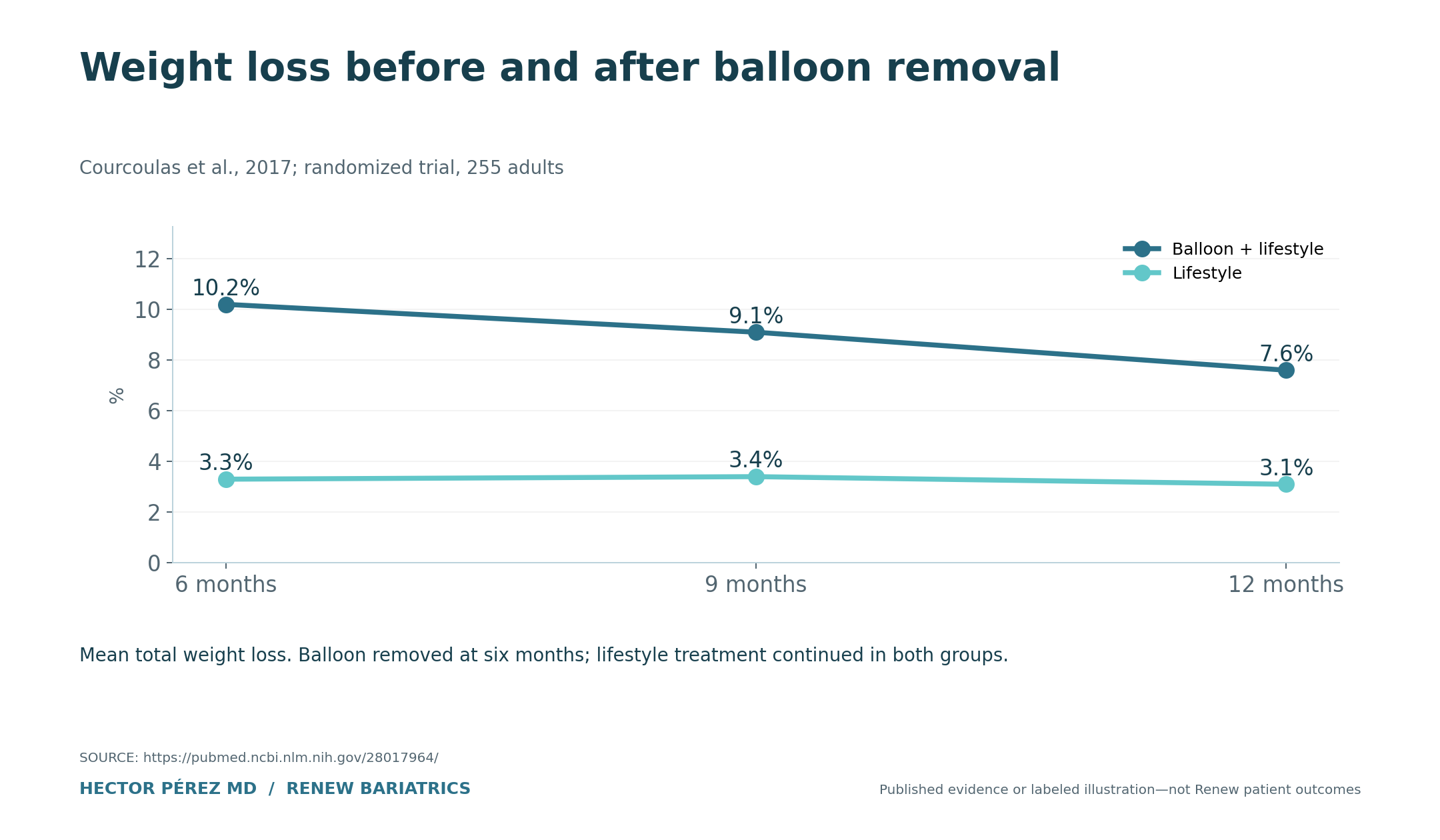
The custom research graphic accompanying this article reports balloon-trial findings from the cited study. It should be read with the device-removal timing and the continuing lifestyle treatment attached. It does not provide a direct comparison with a sleeve trial conducted in different patients or over a different follow-up period.
For sleeve evidence, see the gastric sleeve guide, which includes separate long-term research. Compare the patients studied, time since treatment, additional care, and number completing follow-up before drawing a conclusion from two averages. Ask how well either study resembles your circumstances.
Risks are different, not absent
Sleeve is abdominal surgery and has operative and longer-term risks. The discussion should include the team’s approach to complications, digestive symptoms, reflux, and nutritional follow-up. A shorter incision or shorter admission does not eliminate those questions.
Balloon treatment has its own risks and tolerance issues. A patient may need assessment for persistent symptoms, and a device may require earlier removal. Ask how urgent problems are managed, who can perform removal, and what the financial arrangements would be if the planned course changes.
The FDA’s weight-loss-device information is useful for understanding that devices have specific indications and safety considerations. Regulatory status is specific to a device and jurisdiction; a general statement about balloons should not be interpreted as approval of a particular device in Mexico.
Before consenting, ask for the exact warning signs and contact instructions that apply to your treatment. This article is not a substitute for those instructions. If an acute problem occurs, obtain appropriate medical assessment rather than relying on a comparison article or another patient’s experience.
Recovery and follow-up are part of the treatment
Ask about the expected stay, food-texture progression, hydration plan, medication instructions, and return to activities. These should come from the treating team. A procedure marketed as easier does not remove the need to arrange help at home or to respond promptly when recovery differs from the plan.
For balloon treatment, establish the removal plan before placement: when it is due, where it will happen, who will perform it, and what happens if travel or symptoms change the schedule. Ask whether the removal charge is included in the original quote. A temporary device should not create an uncertain endpoint.
For sleeve, discuss long-term monitoring and who will review symptoms and laboratory results after you return home. Nutrition care is not limited to the first weeks. The plan should remain usable when daily life becomes busy or when health conditions and medications change.
For either option, decide how progress will be reviewed and what the next step would be if the response is less than expected. A follow-up plan can include reassessment of nutrition, other obesity treatment, or a different clinical question. It should not depend entirely on reaching a particular scale number.
Look beyond the initial price
A balloon’s lower advertised starting price, where offered, is not the same as a complete cost comparison. Include placement, removal, monitoring, possible additional care, travel, and the plan after removal. For sleeve, include the surgical package and the continuing costs of follow-up and nutritional care.
Ask Renew for a current quote and confirmation of which treatments are available through the proposed surgeon and location. An educational page does not promise that every option can be booked with Dr. Pérez. Our pricing guide explains how to compare inclusions and exclusions.
Questions to take to the clinical team
Start with your goal: improving a particular health condition, changing weight, addressing symptoms, or improving daily function. Ask which treatment best addresses that goal in your circumstances and what it would not resolve. The answer should connect the recommendation with your history.
Ask why the other option was not preferred, whether medication or another approach remains reasonable, and what evidence supports the proposed plan. A clear explanation of alternatives is more informative than a statement that one treatment is universally best.
If you are considering travel, add practical questions about the length of stay, local follow-up, and access to device removal or urgent evaluation at home. The best theoretical option may require arrangements that are not yet in place. Discuss those barriers before committing.
Begin with an individual assessment
You can contact Renew’s coordinators to discuss the process or submit your health history for review. Include prior procedures, relevant symptoms, and the treatments you want to compare. The next step is a clinically grounded recommendation, not a choice based only on cost or a testimonial.
Clarify what happens when the first plan changes
Before selecting a treatment, ask what would happen if you cannot tolerate the recovery plan, if a test changes the recommendation, or if the proposed device is not suitable. Knowing the alternatives in advance helps you assess a complete course of care rather than only the first appointment.
For a balloon, ask how an early removal decision would be made and what treatment would follow. For sleeve, ask how persistent symptoms or an inadequate response would be evaluated. Neither discussion should begin with an assumption that a second procedure is inevitable or automatically appropriate.
Keep your personal goals in the conversation. The outcome you want may include relief of a health burden, better function, or less difficulty maintaining a treatment plan. Ask the clinician which of those goals the proposed option can reasonably address and which may need separate care. That is more useful than choosing solely from a headline percentage.