A gastric balloon is a temporary device placed inside the stomach to support weight loss alongside nutrition and behavioral care. For endoscopically placed balloons, the procedure is performed through the mouth and does not remove stomach tissue or reroute the intestine. It still involves a medical procedure, possible sedation or anesthesia, and risks that require follow-up.
The most important planning question is not simply how the balloon is inserted. It is how treatment will work from assessment through removal and afterward. Device type, permitted duration, removal arrangements and the long-term obesity-care plan should all be clear before placement.
What happens during assessment?
The team reviews weight history, medical conditions, medications and prior stomach or intestinal procedures. Do not assume that a balloon is suitable after a sleeve or bypass because it does not require abdominal incisions. Previous surgery can affect device suitability and must be disclosed.
Ask which specific balloon is proposed and which instructions apply to that model in the country where it will be used. Product names, duration limits and regulatory status should be verified individually. A description of one balloon cannot be safely applied to all balloons.
Placement and the early adjustment period
With an endoscopic balloon, the clinician examines the stomach and places the device through the mouth. Fluid-filled models are then filled according to their instructions. The team provides an intake and medication plan and explains how early symptoms will be managed.
Nausea, vomiting, cramping or reflux can occur during treatment, and some people need early removal because they cannot tolerate the device. Ask how to contact a clinician if symptoms are not controlled and what qualifies as a reason for urgent reassessment. A promise of “non-invasive weight loss” understates the actual treatment burden.
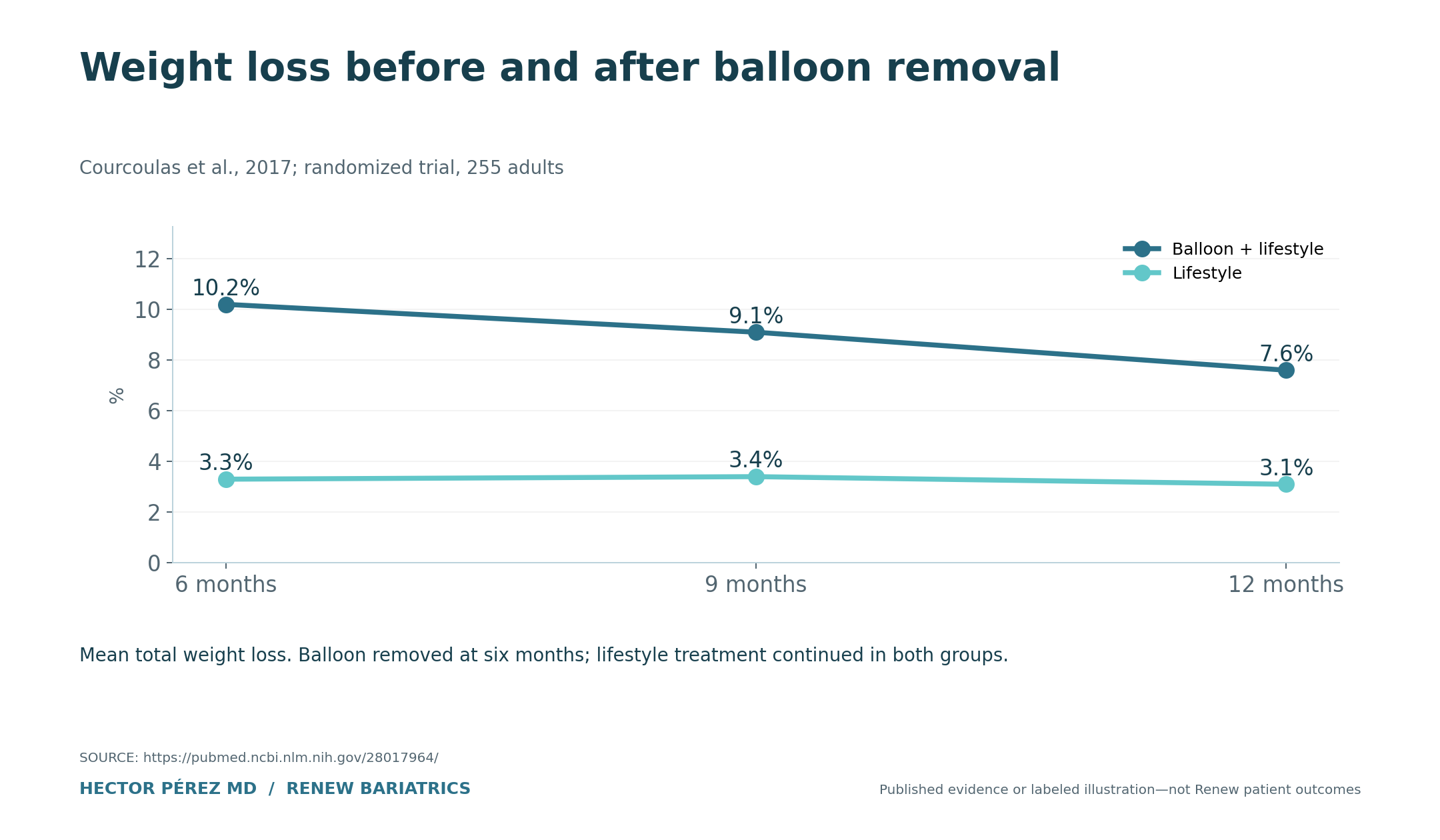
Figure data and interpretation
| Measure or group | Reported value or context |
|---|---|
| Balloon + lifestyle — 6 months | 10.2% |
| Balloon + lifestyle — 9 months | 9.1% |
| Balloon + lifestyle — 12 months | 7.6% |
| Lifestyle — 6 months | 3.3% |
| Lifestyle — 9 months | 3.4% |
| Lifestyle — 12 months | 3.1% |
Mean total weight loss. Balloon removed at six months; lifestyle treatment continued in both groups.
What does a randomized trial show?
In a randomized open-label trial of 255 adults with BMI 30–40, ORBERA plus lifestyle support produced average total body-weight loss of 10.2% at six months, compared with 3.3% with lifestyle support alone. The balloon was removed at six months. At twelve months, average losses were 7.6% and 3.1%, respectively. This is evidence for that device and treatment program, not a promise for every balloon or patient. Read the trial abstract.
The change between six and twelve months is a reason to plan maintenance before removal. It does not mean every patient follows the same trajectory. Ask which continuing treatments are available and how the team will respond if hunger or weight begins to rise again.
Removal is part of the treatment, not an optional extra
Endoscopically placed balloons generally require a separate removal procedure. The deadline depends on the specific device and applicable labeling. Do not extend treatment on your own because you are still losing weight or cannot easily arrange another trip.
Before placement, confirm where removal will happen, who will perform it, what it costs and who handles urgent removal if necessary. If you live in another country, identify a practical backup pathway. The complete cost comparison should include placement, removal, follow-up and possible unplanned care rather than only the initial price.
Risks that patients should understand
The FDA’s patient safety information describes serious reported problems with liquid-filled balloons, including acute pancreatitis, spontaneous overinflation and deaths. Persistent abdominal or back pain, repeated vomiting, a swollen abdomen, chest pain or breathing difficulty needs prompt assessment. Severe symptoms should be evaluated locally without waiting for an online reply.
Device instructions also describe risks such as deflation with migration or obstruction, injury to the digestive tract and perforation. ORBERA/BIB instructions illustrate why the exact device’s safety information matters. Ask your clinician to explain the material risks for the model proposed for you.
How a balloon compares with ESG or surgery
| Treatment | Defining feature | Question to ask |
|---|---|---|
| Gastric balloon | A temporary device remains in the stomach | What happens at removal and afterward? |
| ESG | Endoscopic sutures reshape the stomach | How do its benefits, limitations and follow-up fit my goals? |
| Sleeve gastrectomy | Part of the stomach is permanently removed | Is a surgical approach appropriate for my health and treatment needs? |
The table explains differences in treatment, not a recommended order. Suitability depends on the clinical assessment. Avoid comparing an early balloon result with a five-year surgery result as if they measured the same outcome.
Frequently asked questions
Is a balloon permanent?
No. Treatment duration and removal requirements depend on the device. Obtain the specific deadline in writing before placement.
Can it replace long-term obesity care?
A temporary device does not answer the ongoing question of weight maintenance. The plan should include what support or treatment continues once the balloon is gone.
Does Renew currently list balloon treatment?
Yes. See Renew’s gastric balloon page, then ask a coordinator to confirm the current device, treating clinician, location and removal arrangements as part of clinical review. Published program availability does not establish that a particular balloon is right for you.
The removal plan is part of the treatment from day one
A gastric balloon is temporary. Before placement, confirm the specific device, intended duration, removal arrangements, and what happens if early removal becomes necessary. The treatment is incomplete if the initial quote and itinerary leave those questions unanswered.
Ask who performs removal, where it takes place, and which costs are included. If you are traveling for treatment, clarify whether a return trip is expected and how a changed removal date would be handled. A plan should remain workable if symptoms or another clinical issue changes the original schedule.
Do not assume that a device can remain indefinitely because weight loss is continuing or because travel is inconvenient. Follow the device-specific and clinician-issued plan. If you cannot attend the planned removal, contact the treating team promptly rather than simply postponing it yourself.
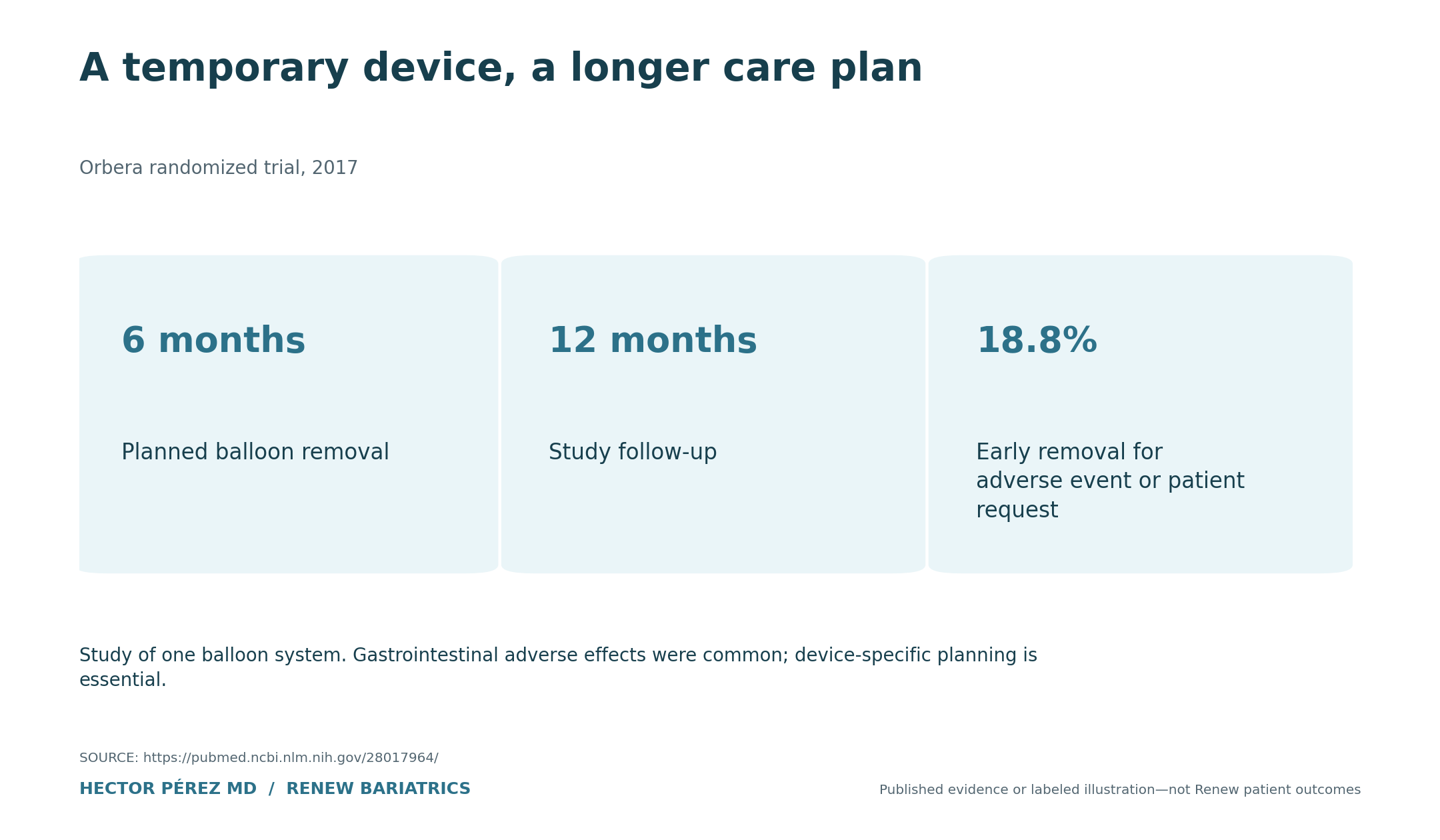
Figure data and interpretation
| Measure or group | Reported value or context |
|---|---|
| 6 months | Planned balloon removal |
| 12 months | Study follow-up |
| 18.8% | Early removal for adverse event or patient request |
Study of one balloon system. Gastrointestinal adverse effects were common; device-specific planning is essential.
What the randomized balloon study actually tested
The trial illustrated here evaluated a particular balloon system as an addition to lifestyle treatment. Both groups continued lifestyle care, and the balloon was removed at six months. The later measurements therefore describe follow-up after removal within that continuing program.
This is useful evidence for the studied device and population, but it should not be generalized to every balloon design or every patient. Ask which device is proposed and whether the quoted evidence concerns that system. Device duration, placement, and removal requirements can differ.
The study was also not a comparison with sleeve, bypass, ESG, or a modern medication regimen. Its result should not be used to declare the balloon superior to alternatives that were not tested in the trial.
The curve after removal is a planning question
The plotted group average changed after removal. That does not predict the exact path of one patient, but it makes the maintenance discussion necessary before placement. Ask what care will continue when the device is no longer present.
A temporary intervention can still be useful when it fits a clear clinical goal and a longer plan. It becomes misleading when advertised as if the device permanently changes anatomy or eliminates the need for ongoing obesity treatment.
Define what happens at the end of the device period: review of weight and health outcomes, nutrition care, medication discussion when appropriate, and reassessment of future options. A removal appointment should not automatically be the last planned contact.
Common symptoms and serious concerns need separate instructions
Nausea, vomiting, and abdominal discomfort were common in the trial, and some devices were removed early because of adverse events or patient request. The figure makes early removal visible alongside weight results. Tolerability is part of the treatment outcome, not an irrelevant detail.
Ask what symptoms are expected, which require contact, and which require urgent assessment. The team should explain how persistent vomiting, inability to drink, severe pain, or other concerning changes are evaluated. Do not assume that every symptom is normal simply because discomfort can occur after placement.
If you need care away from the original facility, tell the clinicians that a balloon is present and provide device and placement information. Keep the relevant documents accessible throughout the treatment period.
Previous bariatric surgery changes the suitability question
If you have had a sleeve, bypass, band, or another stomach operation, disclose it before discussing balloon placement. An unoperated stomach and altered bariatric anatomy are not interchangeable settings. A general balloon BMI range does not establish suitability after previous surgery.
Ask the clinical team whether the specific device is appropriate for your anatomy and whether the evidence being quoted includes people with that history. Do not infer approval from an online calculator or a patient story involving a different operation.
If the main concern is a complication after earlier surgery, the priority may be investigation of that problem rather than a temporary weight-loss device. The revision evaluation guide provides a more appropriate starting framework for that situation.
Compare the balloon with other nonsurgical and procedural options
A balloon occupies space temporarily; ESG uses endoscopic suturing; surgical sleeve removes tissue; medications act through different mechanisms. Their evidence, expected effects, burdens, and follow-up differ. The appropriate comparison begins with your health objective.
Ask why the balloon is preferred for that objective and what alternatives remain reasonable. If the goal is a temporary phase of care before another treatment, ask how success will be assessed and what would change the next step. The proposed sequence should be explicit.
Do not choose only by the starting price or the word nonsurgical. Endoscopic placement and removal still involve clinical procedures and associated risks. A useful recommendation explains both the benefit being sought and the care required to pursue it.
Preparation includes anesthesia and medication review
Provide all medicines, injections, supplements, nicotine products, and cannabis use. Ask which clinician will issue instructions before placement and before removal. The medication plan may need to be reviewed again when the second procedure approaches.
For GLP-1 medicines, report the dose, timing, recent changes, and digestive symptoms. Do not apply a generic stopping interval without agreement from the treating teams. The GLP-1 article explains the reason for individualized planning.
Clarify the prescribed intake and final fasting instructions. If you accidentally deviate or develop symptoms, report the details. Do not try to compensate by extending fasting or changing other medicines on your own.
Organize the first recovery period
Ask about transport, adult supervision requirements, permitted intake, symptom treatment, and the clinical contact route. If nausea or discomfort makes it difficult to follow the plan, the team should provide a response pathway rather than leave you to manage alone.
Keep work and travel arrangements flexible enough for the expected recovery and possible reassessment. A short procedure does not guarantee immediate readiness for a full workday or a long journey. Confirm the timing for the actual treatment and your response.
If a companion is helping, review the instructions together with your permission. Their role can include practical support and communication, while the clinical team remains responsible for medical advice. The companion guide helps organize those tasks.
Track more than the scale while the balloon is present
Record symptoms, ability to maintain intake, and the goals agreed with the clinical team. If weight changes but tolerability is poor, that deserves review. The success of a temporary device should include whether the treatment remains workable and safe for the patient.
Ask how often progress will be assessed and what information to provide. A scheduled review can identify the need for a change before a problem becomes more difficult. Contact the team sooner when symptoms meet the instructions for earlier assessment.
Do not compare your weekly pattern with a study average measured months later. Use the evidence to understand possibilities and limitations, then let the clinical plan guide interpretation of your own course.
Prepare for removal before the final week
Confirm the appointment, instructions, transport, and any required testing with enough time to resolve problems. Update the medication list and health history since placement. A new medicine or symptom may be relevant to anesthesia and removal planning.
Ask what to expect immediately afterward and how the ongoing care plan begins. The absence of the balloon does not answer every question about weight maintenance, nutrition, or future treatment. Those decisions should already be part of the program discussion.
If early removal is recommended, request the clinical reason and the next care plan. It should not be framed solely as a failed weight-loss attempt. Tolerability and health take priority over completing an originally planned duration.
Compare the full treatment cost
Request a written estimate covering placement, device, removal, follow-up, and the handling of early removal or unexpected care. Include travel and accommodation for each required visit. A placement-only figure is not equivalent to a complete treatment quote.
Confirm current program information with Renew Bariatrics and ask the clinical team to determine suitability. The published studies describe their own patients and devices; they are not a guarantee of an individual result or proof that a balloon is appropriate for every person seeking a less invasive option. ## Additional questions about a temporary device
Is early removal always a treatment failure?
No. It may be recommended because of tolerability or another clinical concern. Ask why removal is appropriate and what care should follow. Completing an originally planned duration should not take priority over health. The research reports early removal because it is part of the real treatment experience, and it should remain visible when benefits are discussed.
Can I arrange removal with a different clinician?
Discuss this before placement if it may be necessary. The receiving clinician needs to know the device and relevant history and must confirm that they can provide appropriate care. Do not assume that any endoscopy appointment includes balloon removal. A coordinated plan is particularly important when placement occurs abroad and you expect to spend most of the treatment period near home.
What should I compare between two balloon offers?
Confirm the device, intended duration, placement and removal services, clinical follow-up, early-removal arrangements, and treatment of unexpected problems. Include the travel needed for both ends of the treatment. A lower placement price may exclude services included elsewhere. Clinical suitability and device-specific evidence should be assessed before deciding which written plan represents better value.
How do I judge whether the treatment met its goal?
Use the outcomes agreed with the clinical team, including weight response, tolerability, health changes, and the transition to continuing care. A temporary device should be considered within that longer plan. The final weight on removal day is informative, but it does not by itself describe maintenance or determine the next appropriate treatment.