Comparing bariatric surgery across countries requires comparing specific clinicians, facilities, procedures, and care arrangements. Country-level price ranges or a destination’s popularity cannot establish the quality of an individual treatment plan. A useful comparison includes both the operation and the care available before and after it.
If you are considering Mexico alongside treatment closer to home, organize the decision around the questions below. The aim is to compare like with like: the same proposed procedure, a defined clinical assessment, an itemized quote, and a realistic plan for follow-up. This article does not rank countries or promise a particular result.
The same procedure name can conceal important differences
Start with the exact operation or endoscopic treatment. Gastric sleeve, Roux-en-Y bypass, one-anastomosis bypass, ESG, and TORe are not interchangeable. Even within a broad category, the anatomical plan and reason for treatment need to be explained.
The NIDDK procedure overview describes important differences among established operations. Our procedure library separates first operations, revisional surgery, and endoscopic approaches so you can begin with the relevant clinical question.
If one clinic recommends a sleeve and another recommends bypass, comparing their package prices alone will not resolve the disagreement. Ask each clinician why that operation fits your history, which alternatives were considered, and what findings could change the recommendation. Use the same health information for both assessments.
Distinguish eligibility rules from clinical suitability
Health systems, insurers, individual programs, and professional guidelines may use different criteria for different purposes. A rule determining insurance coverage is not necessarily the same as a clinician’s recommendation. A program’s willingness to accept an application is not proof that treatment is suitable.
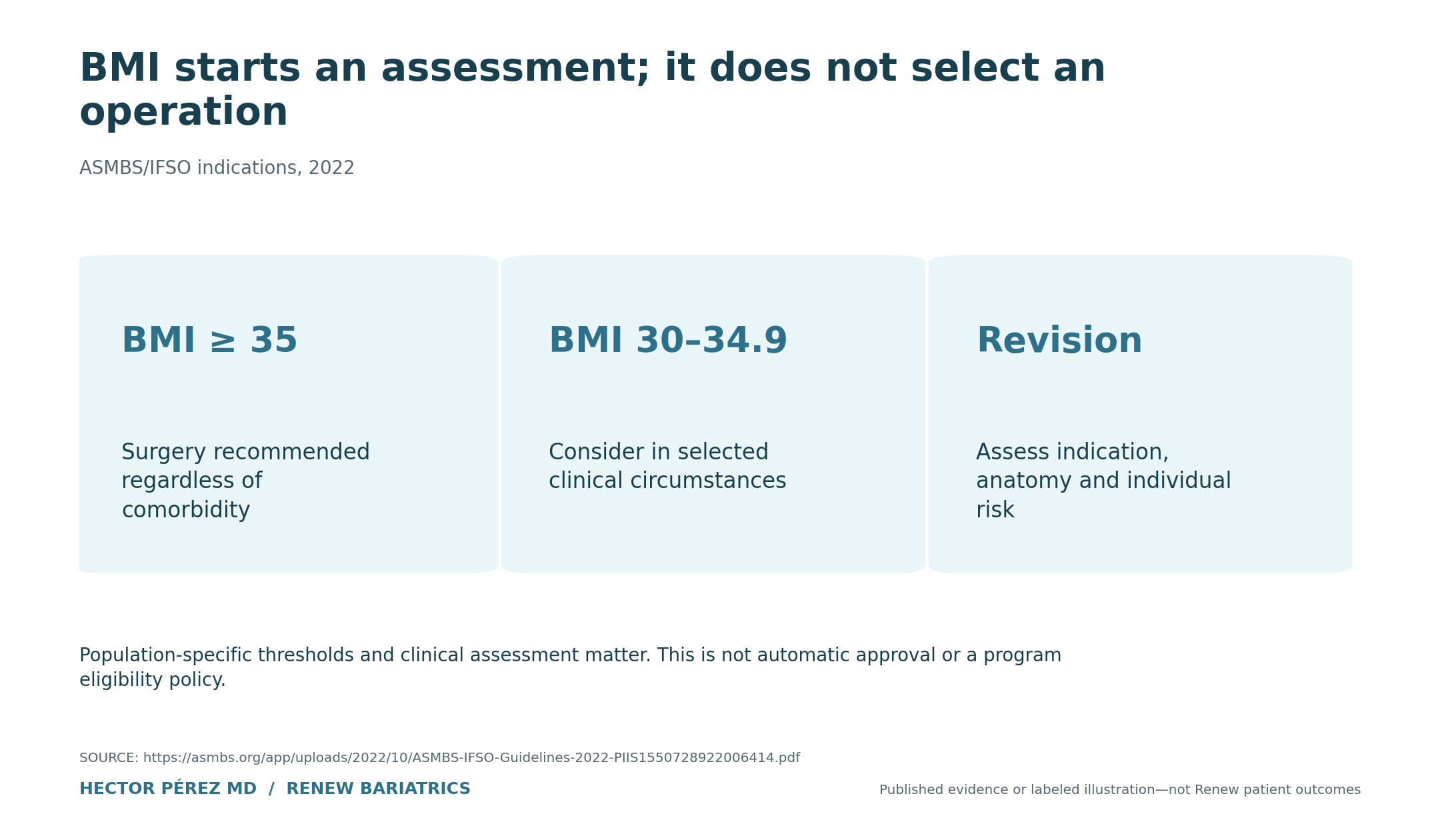
The 2022 ASMBS/IFSO guideline provides an international professional framework for metabolic and bariatric surgery. The research graphic accompanying this article highlights that BMI can begin an assessment without selecting an operation or guaranteeing approval.
Ask why you do or do not meet a program’s criteria. Is the concern a medical condition, current nutritional status, previous anatomy, a required test, follow-up access, or an administrative rule? The explanation should be specific enough to identify a reasonable next step.
Be particularly careful when seeking another opinion after being declined. Provide the same records and explain the earlier concern rather than leaving it out. A different recommendation is useful only when the new clinician has considered the relevant facts.
Compare facilities and professional records directly
The CDC’s medical-tourism guidance recommends investigating the clinicians and facilities involved. It also explains why travelers should consider continuity of care and possible complications before going abroad. These questions apply to the specific provider, not just the destination.
Request the physician’s full name and a way to verify the professional qualifications relevant to the proposed treatment. Ask which hospital will be used, what services are available there, and how the team arranges further care if the plan changes. Promotional photographs do not answer those questions.
Distinguish offices, hospitals, hotels, and recovery accommodation. Each has a different role. A package may include several locations, but the itinerary should state where clinical assessment, surgery, immediate recovery, and later accommodation occur.
For Dr. Pérez, the biography, documented professional work, and care-locations information are starting points. Confirm the proposed surgeon and facility for your own treatment rather than assuming every service listed on an educational site is available in every location.
Build a complete cost comparison
International cost comparisons are often misleading because they combine different procedures, hospitals, dates, currencies, and package inclusions. A historical average is not a quote. Ask each program for current written details and compare the same categories.
| Cost category | Questions to compare |
|---|---|
| Assessment and procedure | Which tests, professional fees, anesthesia, and hospital services are included? |
| Travel | Who pays for flights, ground transport, flexible tickets, and a companion? |
| Accommodation | How many nights are included, where, and at what cost if the stay is extended? |
| Continuing care | Which appointments, laboratory tests, prescriptions, and nutritional products are separate? |
| Unexpected events | What happens financially if surgery is postponed, additional treatment is needed, or you require care after returning home? |
Also account for time away from work, childcare, and the practical cost of attending follow-up. A lower starting price may still be affordable and appropriate, but it should be evaluated with those expenses visible. A higher price is not, by itself, evidence of a better clinical outcome.
Ask how currency conversion, payment deadlines, financing charges, and cancellation terms apply to your booking. These are separate from the clinical recommendation. Read the applicable terms rather than relying on another patient’s description of an earlier package.
Do not compare outcomes without their context
A claim about expected weight loss should identify the procedure, measurement, follow-up period, and population. Total weight loss and excess weight loss use different denominators. Results after a first operation do not automatically predict outcomes after revision.
A center that reports its own outcomes should explain who was included, how many patients had follow-up, and how complications or additional procedures were counted. A selected photograph or a collection of favorable reviews cannot provide that denominator.
Published research can help, but international differences in study populations and care programs still matter. Our guides link to the underlying evidence and identify when a graphic describes research from another center. Those study findings are not presented as Renew’s own outcomes.
For an individual decision, ask which result matters most: weight change, improvement in a health condition, relief of a symptom, function, or quality of life. If reflux is your central concern after sleeve, a general weight-loss percentage leaves an important part of the question unanswered.
Make follow-up possible in both locations
Before traveling, identify which care can be provided remotely and which requires a local examination or test. Ask your home clinician what support is available and how records should be transferred. Do not wait until a problem develops to discover that responsibilities are unclear.
The discharge information should identify the actual procedure, medications, dietary instructions, follow-up arrangements, and contact route for new concerns. Ask for records in a form your local clinician can use. Keep copies accessible when traveling rather than relying solely on a message thread.
Clarify who reviews results after you return home. Having blood drawn locally does not by itself establish that someone has interpreted the findings. The plan should name the responsible clinician and explain how recommendations reach you and any other care team involved.
For a temporary device, discuss removal or passage requirements before treatment. For an operation, discuss longer-term monitoring and the circumstances that require reassessment. A convenient trip is only one part of a treatment that may affect care for years.
Include travel-related uncertainty
Flight changes, delays, mobility needs, and recovery that takes longer than expected can affect the itinerary. The CDC notes that recent surgery and travel require attention to risks such as blood clots. Ask the treating team for individualized travel instructions.
Avoid scheduling a return flight so rigidly that it becomes difficult to follow clinical advice. Confirm the process and likely expenses if you need to stay longer. A companion should also understand the possibility of changes and the support they are expected to provide.
Language access matters during consent and discharge as well as during booking. Ask how detailed clinical information will be explained and how you can get clarification. A translated brochure is useful, but it does not replace a conversation you understand.
A practical way to compare two proposals
Prepare one document with your previous operations, current conditions, medications, weight history, symptoms, and main goals. Share the same information with each team. Record what is confirmed, what is provisional, and which assessments remain outstanding.
Then compare the recommendations in three columns: clinical reasoning, practical care arrangements, and total cost. If one proposal is vague in a category, ask for the missing detail. An attractive package should not make an unresolved clinical issue disappear from the comparison.
Finally, consider whether you can realistically carry out the follow-up plan. If work, transport, finances, or local access create a barrier, say so during assessment. The answer may involve additional preparation, a different treatment, or a different setting.
Discuss care through Renew Bariatrics
Renew coordinates inquiries for care in Mexico. Use the Contact page to ask about the process or See If I Qualify to submit your health history. Request Dr. Pérez if you would like him considered, and ask the team to confirm the proposed surgeon, hospital, quote, and follow-up arrangements for your individual plan.
Make communication part of the comparison
Ask each program how clinical questions move from the coordinator to the medical team. A helpful administrative conversation can clarify logistics, but a treatment recommendation needs appropriate clinical involvement. Know which questions remain unanswered and who is responsible for answering them.
Confirm how the team will contact you and how you should report changes before travel. Include your time zone and a reliable number. If you need interpretation, accessible written information, or help understanding a document, discuss that before the consent process.
After the consultation, summarize the proposal in your own words: the treatment, its purpose, the remaining assessment, and the follow-up plan. Ask the team to correct any misunderstanding. Comparing two clear proposals is easier than comparing promotional pages, and it reduces the chance that an important assumption remains unspoken until you arrive.