Endoscopic sleeve gastroplasty, or ESG, uses sutures placed through an endoscope to reshape the stomach from inside. It does not remove stomach tissue or reroute the intestine. The word “sleeve” describes the resulting shape; it does not make ESG the same procedure as surgical sleeve gastrectomy.
This page discusses primary ESG in people whose stomach has not already been changed by bariatric surgery. If you have a prior sleeve or gastric bypass, start with the revision surgery guide. Evidence from a first-time ESG procedure should not be used to predict results after a different operation.
How ESG works and who may be considered
How does ESG work?
The endoscope and suturing equipment enter through the mouth. Sutures bring parts of the stomach together without an abdominal incision. Mayo Clinic’s procedure overview describes the approach and the use of general anesthesia.
The effect involves more than simply counting stomach volume. A small mechanistic study nested within the MERIT trial found slower gastric emptying after ESG. That helps explain why the procedure can change eating capacity and fullness, but it cannot predict exactly how an individual will experience hunger.
Who might consider ESG?
The 2024 ASGE–ESGE guideline suggests primary endoscopic bariatric therapy with lifestyle treatment for adults with BMI at least 30, or BMI 27–29.9 with an obesity-related condition. This is a broad clinical framework, not an automatic eligibility rule or a statement of device authorization in every country.
A personal assessment should address your medical history, previous weight treatments, symptoms, anatomy, medications, and ability to participate in follow-up. Ask how the clinician weighs these factors together. A person can meet a BMI threshold and still need a different treatment or additional assessment.
Describe what you want treatment to change in daily life: a specific health problem, mobility, appetite management, or a weight trajectory. Then ask what evidence supports ESG for that objective. A clear goal makes it easier to judge whether the proposed intervention and its aftercare match your needs.
Preserving the stomach does not make selection automatic
ESG reshapes the stomach with endoscopic sutures without removing tissue. That feature may be important to a patient considering options, but it does not establish suitability by itself. The team still needs to assess health goals, existing symptoms, prior procedures, medication history, and the care needed afterward.
Tell the clinician why you prefer an endoscopic approach. It may be concern about surgery, recovery time, permanent tissue removal, or another issue. Discussing the reason helps the clinician explain which concerns ESG addresses and which remain relevant despite the different technique.
Do not assume that preserving tissue guarantees easy reversal or an uncomplicated later operation. Ask what is known about future treatment options and what would require another assessment. A procedure decision should include the uncertainty around later choices rather than promise that every option remains simple.
What clinical research shows
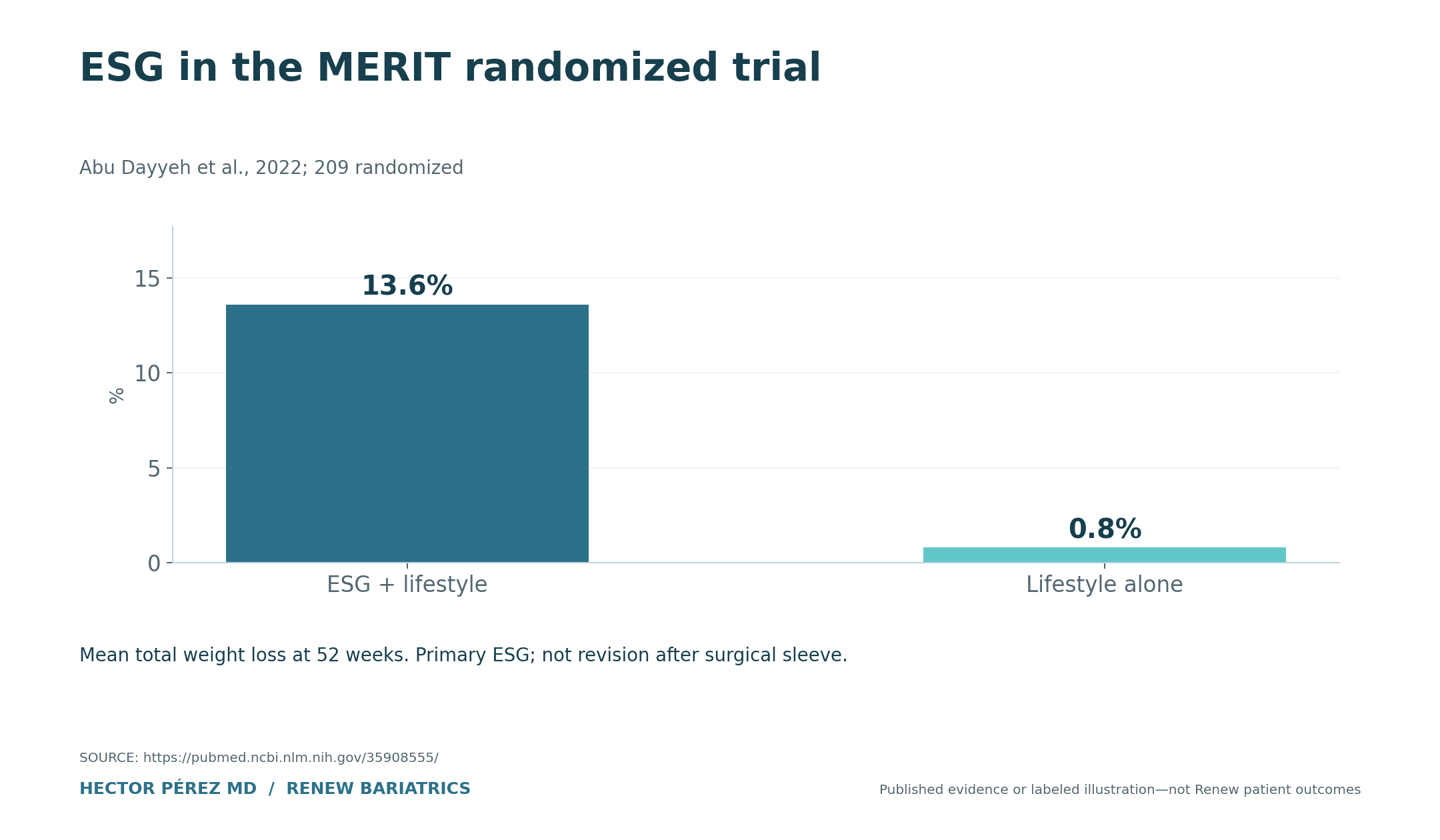
Figure data and interpretation
| Measure or group | Reported value or context |
|---|---|
| ESG + lifestyle | 13.6% |
| Lifestyle alone | 0.8% |
Mean total weight loss at 52 weeks. Primary ESG; not revision after surgical sleeve.
What does the best-known randomized trial show?
In MERIT, 209 adults with class I or II obesity were randomized to ESG with lifestyle treatment or lifestyle treatment alone. Average total weight loss at 52 weeks was 13.6% versus 0.8%. The trial supports ESG’s benefit in that setting; it did not compare ESG directly with surgical sleeve or current anti-obesity medications.
Mean weight loss describes a group. It is not a minimum, guarantee, or clinic-specific success rate. Ask whether any outcome quoted during your review refers to total weight loss, excess weight loss, or another measurement, and when it was measured. See how to interpret weight-loss results.
Read the MERIT outcome with the treatment setting attached
MERIT compared ESG plus lifestyle treatment with lifestyle treatment alone. The weight-loss difference supports the value of adding ESG in the studied population. It does not directly compare ESG with surgical sleeve, bypass, or a current medication regimen.
The distinction between total and excess weight loss also matters. The two measures use different denominators, so the larger-looking percentage is not necessarily a larger change in body weight. The chart uses total weight loss and states the follow-up time to keep the comparison clear.
Ask how closely the trial population resembles your circumstances. Primary ESG evidence should not be applied directly to a stomach that has already undergone surgical sleeve or another bariatric operation. If you have previous surgery, the exact anatomy and proposed revision need separate consideration.
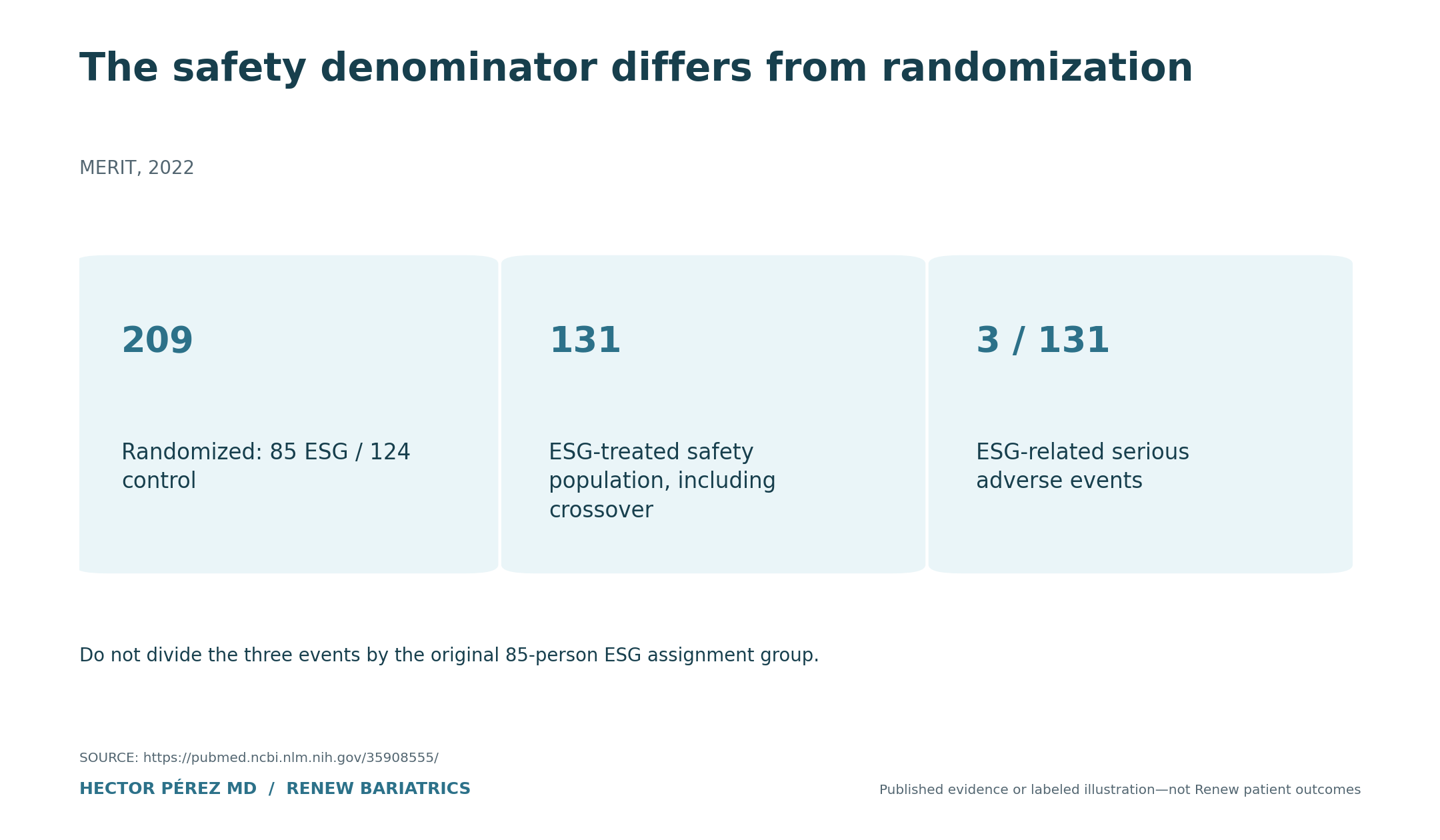
Figure data and interpretation
| Measure or group | Reported value or context |
|---|---|
| 209 | Randomized: 85 ESG / 124 control |
| 131 | ESG-treated safety population, including crossover |
| 3 / 131 | ESG-related serious adverse events |
Do not divide the three events by the original 85-person ESG assignment group.
Understand the serious-adverse-event denominator
The MERIT report included an ESG-treated safety population of 131 people, including patients treated after crossover. Three ESG-related serious adverse events were reported in that population. It would be incorrect to divide those events only by the original 85-person ESG assignment group.
This example illustrates why safety percentages need methods as well as numbers. Ask who was included, how events were defined, and how long patients were observed. A trial’s serious-event category also does not describe every symptom or inconvenience during recovery.
For an individual decision, discuss the complications relevant to the proposed procedure and the plan for recognizing and treating them. A low event frequency is not a substitute for knowing where to obtain assessment if a concerning symptom develops.
What do we know about longer-term results?
A prospective single-center study reported average total weight loss of 15.9% at five years among the available long-term follow-up group. Only 68 of the original 216 participants had reached that time point, and 82% of those eligible had follow-up. These are encouraging observations with a smaller long-term denominator.
For your own planning, ask what happens after the initial recovery period. How often will progress be reviewed? Who will assess an inadequate response? Are additional treatments considered, and who would prescribe or coordinate them? These practical questions matter even when early weight loss is satisfactory.
Long-term evidence is useful without being a guarantee
Longer observational follow-up can show what happened in a program over several years. Its interpretation depends on how many patients were eligible, how many provided data, and what additional care they received. It cannot promise that every person will maintain the same response.
Ask whether a program’s outcome report includes all treated patients or only those who completed follow-up. If medication or another intervention was added, that should be disclosed. These details help distinguish the effect of one procedure from the results of continuing obesity care.
If your initial response is incomplete, ask how the team would reassess it. The answer may involve nutrition, medication, anatomy, or another clinical issue. A plan for reassessment is more useful than a claim that one treatment permanently resolves every future weight concern.
ESG compared with surgical sleeve
How is ESG different from gastric sleeve surgery?
| Question | ESG | Surgical sleeve |
|---|---|---|
| What changes the stomach? | Internal suturing reshapes it. | An operation removes part of it. |
| Are these identical treatments? | No; ESG has a separate evidence base. | No; surgical outcomes cannot be substituted for ESG outcomes. |
| What should the discussion cover? | Expected benefit, symptoms, anesthesia, endoscopic risks, and ongoing support. | Expected benefit, surgical risks, symptoms, and ongoing support. |
Read ESG versus gastric sleeve surgery for comparative studies. Choose neither procedure solely because a headline calls it “safer” or “stronger.” Ask how the comparison changes when your own history is considered.
Compare ESG with surgery using the outcomes that matter to you
Surgical sleeve removes part of the stomach, whereas ESG uses endoscopic suturing. These are different interventions with different evidence. The ESG-versus-sleeve comparison explains why a choice should include expected benefit, reflux, recovery, and long-term care rather than only the presence or absence of incisions.
Describe the health outcome you want to improve. If a larger weight response is needed to meet a clinical objective, ask how that affects the recommendation. If recovery demands or a medical condition are central concerns, ask how those change the balance.
A good comparison may lead to a third option or further evaluation. You do not need to choose between two procedures simply because they were the first ones you researched. The recommendation should follow your assessment.
Risks, recovery and continuing care
What are the risks and recovery requirements?
ESG is not risk-free. In MERIT, three of 131 participants treated with ESG, including crossover participants, had an ESG-related serious adverse event. This is a study-specific estimate, not Dr. Perez’s complication rate. A consent discussion should explain possible complications and the response plan in language you understand.
Mayo Clinic describes short-term pain or nausea, preparation instructions, and a staged diet after ESG. Screening also considers problems such as significant hiatal hernia or conditions associated with gastrointestinal bleeding. Your team should determine which findings matter in your case.
Request written instructions for medicines, eating and drinking before the procedure, the recovery diet, activity, and follow-up. Avoid adapting another patient’s medication schedule. Tell the team about every prescription, over-the-counter medicine, and supplement so the relevant clinicians can coordinate instructions.
If you are traveling, ask how long to remain nearby, whether you need a companion, and where an urgent assessment would take place. Confirm who is responsible for care after you return home. A recovery plan should include a contact method that works outside routine office hours and directions for situations that cannot wait.
Existing reflux and digestive symptoms need their own explanation
Tell the team about regurgitation, burning, swallowing difficulty, vomiting, and previous endoscopy. A study reporting less new reflux after one procedure does not establish that it will treat every patient’s existing reflux. Prevention of a new problem and treatment of an established one are different questions.
Ask what the evaluation has shown and whether another investigation could change the recommendation. If a symptom remains unexplained, it should not be ignored because you are also seeking weight treatment. The main clinical problem may need attention before an elective procedure.
Keep the actual test reports and pathology results when available. A summary such as “my stomach was normal” may not contain the information the treating clinician needs to assess the proposed intervention.
Medication planning should begin early
Provide all prescriptions, injections, supplements, and nonprescription products. Include the dose and timing of GLP-1 medicines and any recent changes or symptoms. Ask the prescribing clinician and anesthesia team to coordinate the final instructions.
Do not use an old handout or another patient’s stopping schedule as your plan. Current guidance can depend on treatment phase, digestive symptoms, and other factors. The GLP-1 preparation article explains the questions to resolve without providing an individual medication order.
Ask how treatment will be managed after the procedure as intake changes. If access or cost may interrupt a medication, discuss that in advance. The follow-up plan should reflect the treatment you can realistically obtain.
Make the recovery instructions usable
Obtain the prescribed food progression, symptom guidance, medicines, activity restrictions, and follow-up appointments in writing. Ask what to do if nausea, pain, or difficulty maintaining intake prevents you from following the plan. Persistent or concerning symptoms require clinical assessment rather than an improvised diet adjustment.
Describe your work, commute, caregiving responsibilities, and available help. A shorter expected recovery does not automatically mean immediate readiness for driving, lifting, or a long journey. Confirm the relevant milestones with the treating team.
If you travel for treatment, ask about local observation, the return itinerary, and the route to care after you get home. Package duration and medical clearance to travel should be discussed separately. Keep flexibility for a slower recovery or a changed clinical recommendation.
Ongoing care is part of the intervention
Ask who will review weight response, symptoms, nutrition, and any needed laboratory results. Identify the local clinician who can examine you when remote communication is insufficient. A scheduled follow-up plan is more concrete than a general promise of continuing support.
Define the baseline and outcome measures used to judge progress. Include health goals beyond weight when relevant. If the initial plan needs adjustment, the team should explain the next assessment and the options available.
The research on this page describes published study populations. It does not report Dr. Perez’s own ESG results. Patient reviews and photographs should be used only with their verified procedure and context, while the clinical decision rests on your assessment and the evidence relevant to it. ## Additional questions about the ESG decision
Questions about ESG
Is ESG temporary or easily reversible?
Do not choose ESG on a promise of simple reversal. It is intended as an ongoing anatomical treatment. If you are concerned about future procedures, ask how the treating clinician would evaluate them; “no stomach removed” does not establish that every later intervention is straightforward.
Can I have ESG after a gastric sleeve?
That is a different clinical question involving revisional endoscopic sleeve treatment. It has less extensive evidence, and availability must be confirmed separately.
Can I compare ESG results with medication advertisements?
Not simply by comparing percentages from unrelated studies. Check starting BMI, follow-up time, supporting care, and the number of people who remained in the analysis. Our medication and revision discussion guide offers questions to take to a clinician.
Does a randomized trial mean ESG is the best choice for me?
No. It establishes evidence for the comparison and population studied. Your decision also depends on existing symptoms, health goals, prior procedures, alternatives, and continuing care. Ask the clinician to explain where your situation resembles the trial and where it differs. A citation is useful when it supports that reasoning rather than replacing it.
Can I use a primary ESG result to estimate a revision outcome?
Not directly. A surgically altered sleeve is a different anatomical setting from an unoperated stomach. Research on revisional ESG should be identified separately, including its smaller samples and follow-up limitations. Ask for the exact procedure proposed and the evidence relevant to that procedure before comparing outcome percentages.
What should happen if I lose less than the study average?
The team should review the response in context, including symptoms, nutrition, medication, and the original treatment goals. An average is not a minimum standard every patient must meet. Ask in advance when reassessment will occur and which options may be considered if the result is incomplete. That continuing plan is more useful than treating the initial procedure as the only available decision.
How do I distinguish a research graphic from clinic results?
Check the named study, population, follow-up, and source. The graphics on this page explicitly describe published external research. They do not represent Dr. Perez’s patient series. A separate practice report would need its own methods, patient counts, follow-up completeness, and adverse-event definitions before it could support clinic-specific claims.
Explore whether ESG fits your goals
Read the ESG research review, then visit Renew Bariatrics’ ESG information. A coordinator review can organize your history and identify the next steps for a medical assessment.
Selected sources
- ASGE–ESGE guideline on primary endoscopic bariatric and metabolic therapies for adults with obesity (2024).
- Endoscopic sleeve gastroplasty for treatment of class 1 and 2 obesity (MERIT): a prospective, multicentre, randomised trial (2022).
- Five-Year Outcomes of Endoscopic Sleeve Gastroplasty for the Treatment of Obesity (2021).
- The Effect of Endoscopic Sleeve Gastroplasty on Gastric Emptying, Motility, and Hormones: A Comparative Prospective Study (2023).
- Endoscopic sleeve gastroplasty (2026).