Gastric sleeve revision means treating a problem after a previous sleeve gastrectomy. The treatment may change the existing sleeve, convert it to another operation, or use medication or an endoscopic approach. The appropriate choice depends on what needs to improve: weight, reflux, swallowing, metabolic health, or several problems together.
Dr. Hector Perez’s practice includes complex revisional bariatric surgery. This guide explains the decisions that matter before requesting an evaluation. A procedure name alone cannot establish whether a revision is appropriate for you.
What is the best revision after a gastric sleeve?
There is no single best operation for every sleeve patient. An operation chosen mainly to treat severe reflux may differ from one selected for substantial weight recurrence without reflux. The 2026 ASMBS statement supports choosing among medical, endoscopic, and surgical options through individualized multidisciplinary assessment. It also highlights inconsistent outcome reporting and loss to follow-up in the research.
Start by defining the problem in everyday terms. “I regained weight” and “I cannot sleep because fluid comes into my mouth” require different investigations. If both are present, the plan needs to address both rather than selecting an operation solely from a weight-loss comparison.
How the main options differ
| Option | What changes | What needs particular attention |
|---|---|---|
| Sleeve to Roux-en-Y gastric bypass | A small stomach pouch connects to a rearranged small intestine. | Reflux findings, intestinal complications, ulcers, and long-term nutrition. |
| Sleeve to SADI-S | The sleeve remains part of the food route; a duodenal connection bypasses a substantial intestinal segment. | Weight and metabolic goals, reflux, protein intake, supplements, and laboratory follow-up. |
| Re-sleeve gastrectomy | Additional stomach tissue is removed in selected anatomy. | Whether dilation is relevant, staple-line risks, and existing reflux. |
| Medical obesity treatment | No surgical reconstruction; treatment addresses ongoing obesity biology and health needs. | Eligibility, tolerance, cost, follow-up, and a sustainable treatment plan. |
| Endoscopic sleeve revision | Selected patients may undergo internal suturing without additional stomach removal. | Anatomical suitability, durability, and the exact procedure being offered. |
TORe is a different endoscopic procedure directed at the outlet of a previous gastric bypass. A patient with an unconverted sleeve does not have that bypass outlet. Primary ESG, endoscopic revision of a sleeve, and TORe should therefore never be used interchangeably in a treatment plan. Read the endoscopic weight-loss overview for those distinctions.
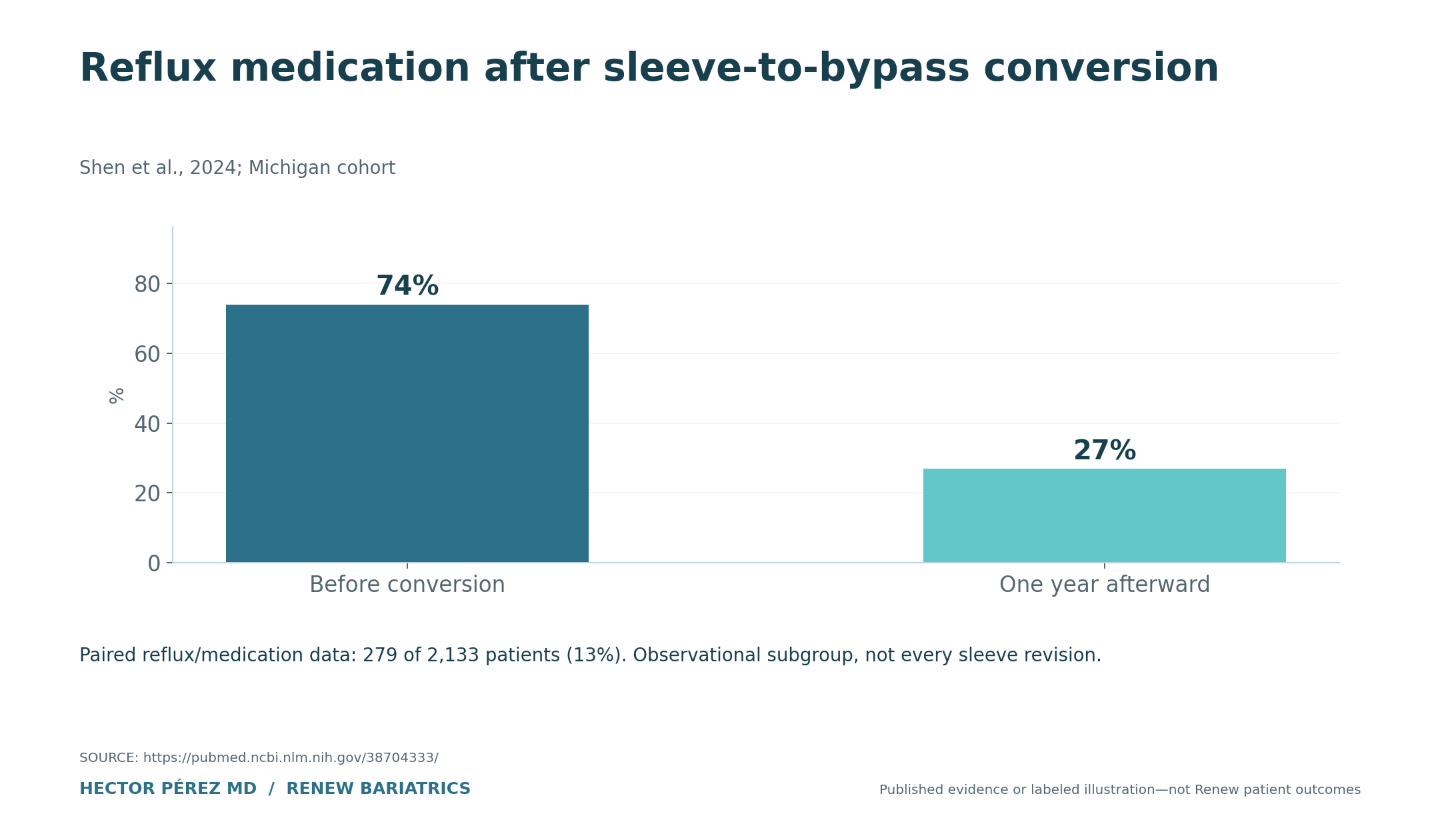
Figure data and interpretation
| Measure or group | Reported value or context |
|---|---|
| Before conversion | 74% |
| One year afterward | 27% |
Paired reflux/medication data: 279 of 2,133 patients (13%). Observational subgroup, not every sleeve revision.
Separate weight recurrence from a mechanical problem
A change in weight does not prove that your sleeve has stretched. Conversely, difficulty eating does not prove that the sleeve is working well. Vomiting, food sticking, regurgitation, or an inability to tolerate normal textures may require investigation for an anatomical or functional problem.
A useful review brings together your original operation report, subsequent procedures, weight history, symptoms, current medicines, and nutrition results. Endoscopy or imaging may be appropriate depending on the question. A test should have a purpose: identifying inflammation, showing the route food takes, or investigating a suspected narrowing, for example.
If weight is the main concern, document the pre-sleeve weight, lowest sustained weight, current weight, and approximate dates. Add whether diabetes, sleep apnea, mobility limitations, or other health problems have returned. Those details help distinguish a disappointing number on the scale from a broader change in health.
When reflux changes the decision
Reflux can be a major reason to reconsider sleeve anatomy. The SAGES guideline addresses this decision, with important limitations in the evidence. A guideline should inform a discussion rather than replace an individual assessment.
Keep a short symptom record: daytime burning, nighttime regurgitation, swallowing difficulty, coughing associated with meals, and response to prescribed treatment. Bring any previous endoscopy and biopsy reports. See reflux after sleeve for the diagnostic questions that determine whether conversion is a reasonable next step.
What research can and cannot tell you
A 2023 registry analysis compared 7,388 sleeve conversions performed for weight recurrence or inadequate weight loss. Its follow-up was 30 days. That makes it useful for early safety questions, but it cannot establish which operation produces the best five-year weight, nutrition, or quality-of-life result.
When someone quotes a success rate, ask what success meant. A reduction in reflux medication is different from complete absence of reflux. Percentage total weight loss is different from percentage excess weight loss. A result measured from the original sleeve weight is different from additional loss after the revision. Your consultation should make the baseline and time point explicit.
Preparation includes the years after surgery
A revision plan should name who will monitor nutrition and manage problems after you return home. Ask how your original supplement routine would change and how laboratory results will reach the clinical team. The OMA nutrition statement emphasizes monitoring matched to the operation rather than a single supplement plan for all bariatric patients.
Also discuss your ability to attend follow-up, obtain prescribed supplements, manage food transitions, and access urgent assessment locally. These practical details belong in the decision before travel is arranged. The operation and the continuing care plan should be evaluated together.
Questions to bring to your review
- Which problem is this revision intended to treat first?
- What in my tests supports that choice?
- What reasonable nonsurgical or alternative surgical options apply?
- What would a useful result look like at one year and later?
- What additional risks come from my previous operation or current health?
- Who will manage nutrition, persistent symptoms, and unexpected problems after discharge?
Severe or increasing abdominal or chest pain, vomiting blood, black stools, or inability to keep fluids down needs urgent local medical evaluation. An online revision request is not the right route for an acute problem.
Request a records-based assessment
Renew Bariatrics currently lists several gastric sleeve revision options, including sleeve-to-SADI-S with Dr. Perez. Contact a Renew coordinator to ask which records are needed for clinical review and which location and procedure can be considered. A coordinator can organize the next step; procedure suitability requires clinical assessment.
A revision choice should follow the main problem
Patients may use the phrase sleeve revision to describe very different goals. One wants relief from reflux, another wants help with weight recurrence, and another cannot maintain adequate intake. Those are not interchangeable indications. Ask the clinician to identify the problem that should take priority.
When several concerns overlap, discuss whether one treatment can address them together or whether a sequence of care is needed. A procedure that offers additional weight loss may not be the best response to poor nutrition or unexplained swallowing difficulty. The mechanism needs to fit the goal.
Write your main concern in ordinary language before the review. This helps keep the discussion focused when anatomy, research, and logistics become detailed. The purpose is to improve a clinical problem, not simply to obtain another operation.
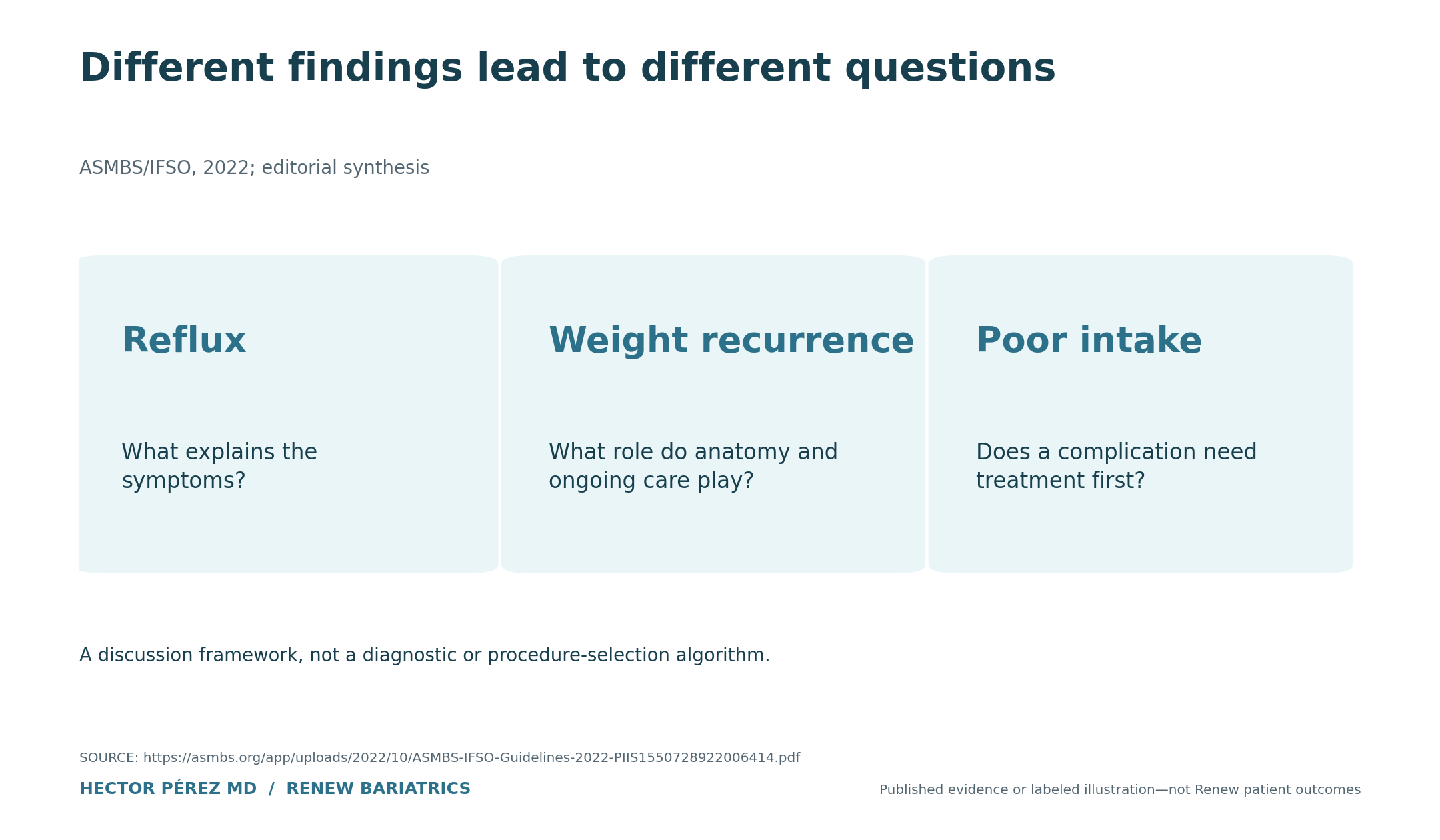
Figure data and interpretation
| Measure or group | Reported value or context |
|---|---|
| Reflux | What explains the symptoms? |
| Weight recurrence | What role do anatomy and ongoing care play? |
| Poor intake | Does a complication need treatment first? |
A discussion framework, not a diagnostic or procedure-selection algorithm.
Start with the sleeve that actually exists
The original operative report and later procedures can clarify what anatomy remains. Endoscopy or imaging may add information when clinically indicated. A remembered description such as a small sleeve does not replace those records.
Ask what an anatomical finding means in your case. Dilation, narrowing, twisting, or another reported feature should be interpreted by the clinician alongside symptoms and history. A single image does not automatically select the operation.
If you have had prior repairs, a leak, stents, or another revision, include the sequence. The current decision may be more complex than a straightforward first conversion. Missing records should be identified rather than replaced with assumptions.
Reflux and weight response need separate outcome measures
If reflux is the main indication, ask how benefit will be assessed: symptoms, medication needs, endoscopic findings, or another measure. Additional weight loss may occur, but it should not be the only definition of success for a symptom-focused operation.
If weight recurrence is the main issue, ask how reflux affects the choice of intervention. A capacity-focused procedure should not be assumed to treat existing reflux merely because it might affect weight. The clinical recommendation should explain both concerns.
The conversion illustration shows medication use in a subgroup with paired data, not guaranteed relief for every patient. Its denominator is part of the result. Ask how the evidence applies to your findings and what follow-up would remain necessary.
Sleeve-to-bypass and sleeve-to-SADI-S change different things
Conversion to Roux-en-Y bypass and conversion to SADI-S create different intestinal arrangements. They should not be compared only as options producing more or less weight loss. Reflux, absorption, nutrition, medical conditions, and continuing care all belong in the decision.
Ask why one is recommended for your anatomy and goals. If a weight-loss estimate comes from primary SADI-S, it should not be presented as additional loss after a previous sleeve. The starting population and baseline matter.
The dedicated bypass conversion and SADI-S conversion pages explain these distinctions. Use them to prepare questions, then obtain a recommendation based on the actual evaluation.
Re-sleeve and endoscopic revision are also distinct
Re-sleeve involves further surgical removal of stomach tissue. Endoscopic sleeve revision uses suturing in selected existing sleeves. Neither is TORe, which targets a bypass outlet that an unconverted sleeve does not have.
Published case series may use carefully selected patients and different follow-up methods. A favorable average should not be extended to everyone who feels able to eat more than during the first postoperative months. Ask what selection findings were required and whether your history resembles that population.
Confirm current program availability before making travel plans. Educational coverage of an option is not a promise that it can be booked through Renew or that Dr. Perez has recommended it for you.
Medication remains part of the treatment discussion
A previous sleeve does not eliminate the possible role of obesity medication. Describe prior prescriptions, response, side effects, and why treatment stopped. Access problems should be distinguished from inadequate benefit.
If medication and a procedure are both proposed, ask what each contributes and how progress will be reviewed. A combined approach should have a clear rationale rather than an assumption that adding treatments necessarily improves every outcome.
Before anesthesia, the medication plan needs coordination with the prescriber and procedure team. The GLP-1 preparation guide explains why a generic stopping rule is not enough for an individual patient.
Nutrition can change the timing of revision
Bring current intake, supplements, laboratory results, and any history of deficiency treatment. Poor intake or persistent vomiting may require assessment before another weight-focused intervention. Body size does not establish adequate nutrition.
Ask which findings need correction, who will manage treatment, and when readiness will be reassessed. If the recommendation is to delay, the purpose and next step should be clear. Do not try to meet a perceived eligibility requirement through an extreme unsupervised diet.
The long-term plan should be feasible near home, especially if intestinal absorption will change. Identify the clinician, laboratory access, and means of obtaining supplements or treatment before choosing the procedure.
Compare early risk without borrowing a first-operation guarantee
Revision can differ from primary surgery in complexity and patient characteristics. A first-time sleeve or bypass complication rate should not be used as if it precisely describes a conversion. Ask for evidence relevant to the actual intervention and indication.
Clarify the outcome definition and period. Serious events within 30 days do not capture every later nutritional issue, symptom, or additional operation. Consent should address both early and continuing concerns.
Ask how complications would be recognized and treated, including after returning home. A clear response plan matters alongside the estimated frequency. It should distinguish emergency assessment from routine remote follow-up.
Prepare for a recommendation that may change after testing
An initial review may identify a plausible option while leaving important questions unanswered. Ask which findings could change the recommendation and whether further testing must occur before travel. A conditional plan should be labeled as conditional.
If a different procedure is recommended later, request the reason and updated information about risks, recovery, nutrition, and cost. Do not treat the alternative as a simple substitution because both are called revision.
Keep the recommendation and supporting reports together. They are useful if you seek another opinion and help future clinicians understand how the final decision was reached.
Make recovery planning specific to your life
Describe work duties, lifting, commuting, caregiving, and available help. Ask when each activity can resume and how the plan will be reviewed. The recovery from your original sleeve is background information, not a guarantee for the next procedure.
Discuss travel readiness separately from the package itinerary. Include the entire journey and the possibility of a longer local stay. The travel guide explains the clinical questions to resolve before booking.
Arrange local aftercare and transfer of the new operative report. The final anatomy, not just the name revision, should be available to clinicians who manage nutrition, medicines, or later symptoms.
Define the next step before leaving the review
A useful assessment ends with a specific action: obtain a report, investigate a symptom, treat a deficiency, begin medical care, consider a procedure, or seek referral. Ask who is responsible and how the result will be communicated.
If revision is not recommended, clarify whether the issue is temporary, procedure-specific, or related to the setting. Your concerns should still lead to a care plan. The not-a-candidate guide can help frame that discussion.
For a review with Renew, provide the original sleeve history and the problem you most want to address through the application. Clinical suitability comes before a finalized procedure and travel schedule. ## Additional questions about selecting a sleeve revision
Can one test tell me which revision to choose?
Usually the decision requires several kinds of information rather than one isolated result. Ask how the test finding fits your symptoms, operation history, nutrition, and goals. A report can clarify anatomy without establishing the complete risk-benefit balance. The clinician should explain the connection between the finding and the proposed treatment.
Does the most powerful weight-loss operation give the best outcome?
Not necessarily. Greater effects on absorption can bring greater nutritional demands, and an operation selected for weight may not address reflux or another symptom. The best fit depends on the problem being treated and the care you can sustain. Ask what the recommended procedure improves, what it leaves unresolved, and what new responsibilities it creates.
Should I wait until all the weight has returned?
You can seek assessment when the trend or its health consequences concern you. A review does not commit you to surgery. It can identify medical treatment, nutrition support, further investigation, or an appropriate procedural discussion. A fixed amount of regain is not a substitute for evaluating the individual situation.
How should I prepare for a second opinion?
Provide the same records, symptoms, treatment history, and goals used in the first review. Include the recommendation and its stated reasoning. Ask the second clinician to address the unresolved question rather than only whether they can perform a preferred procedure. This makes differing opinions easier to compare meaningfully.
Sources and further reading
- ASMBS statement on treatment options for non-response and weight recurrence after metabolic and bariatric surgery (2026).
- Revisional Procedures after Sleeve Gastrectomy for Weight Recurrence or Inadequate Weight Loss: An Analysis of the MBSAQIP Database (2023).
- SAGES guidelines for the management of comorbidities relevant to metabolic and bariatric surgery (2024).
- Bariatric nutrition and evaluation of the metabolic surgical patient: Update to the 2022 OMA clinical practice statement (2024).
Care, in patients’ words
Patient experiences relevant to this guide
David H.
Sleeve-to-bypass revision
Describes bypass revision after problems with an earlier sleeve.
Selected patient accounts published by Renew Bariatrics. Procedures are labeled for each account; individual experiences and results vary.