Sleeve-to-SADI-S conversion adds an intestinal bypass to a previous sleeve gastrectomy. It may be considered when further weight or metabolic treatment is needed after sleeve surgery. It is a substantial anatomical change with ongoing nutritional responsibilities, and it is not automatically the right revision when reflux is the main concern.
Renew Bariatrics currently lists sleeve-to-SADI-S with Dr. Hector Perez in Tijuana and Cancún. Location, current availability and suitability require confirmation through the coordinator and clinical review. A listed service does not mean every previous sleeve can be converted safely or appropriately.
What does SADI-S mean?
SADI-S stands for single-anastomosis duodeno-ileal bypass with sleeve gastrectomy. The existing sleeve remains in the food pathway. The duodenum, the first part of the small intestine, is divided beyond the pylorus, and connected to a later portion of small intestine. The pylorus is the muscular outlet of the stomach.
This route changes where food meets digestive secretions and how much intestine is available for their combined passage. The ASMBS patient overview explains the procedure and highlights reduced nutrient absorption, possible reflux, and looser or more frequent stools among its tradeoffs.
SADI-S, duodenal switch and SASI are different operations
| Name | Key distinction | Question to clarify |
|---|---|---|
| SADI-S | A single duodenum-to-ileum connection follows the sleeve and preserved pylorus. | What intestinal route and monitoring plan are proposed? |
| Conventional biliopancreatic diversion with duodenal switch | Uses a different intestinal reconstruction with two intestinal connections. | Are quoted results actually for this operation rather than SADI-S? |
| SASI | Single-anastomosis sleeve ileal bypass connects the stomach to the ileum and preserves another food route. | Does the consent name SASI or SADI-S? They are not interchangeable. |
| Roux-en-Y gastric bypass | Uses a small stomach pouch and a different intestinal arrangement. | How do reflux, weight and nutrition considerations affect the comparison? |
These differences matter when comparing outcomes, supplement instructions or prices. The original SASI cohort’s methods describe its stomach-to-ileum connection. “One connection” does not identify a single operation. Ask for the full procedure name in your written plan and make sure any study being discussed describes the same reconstruction.
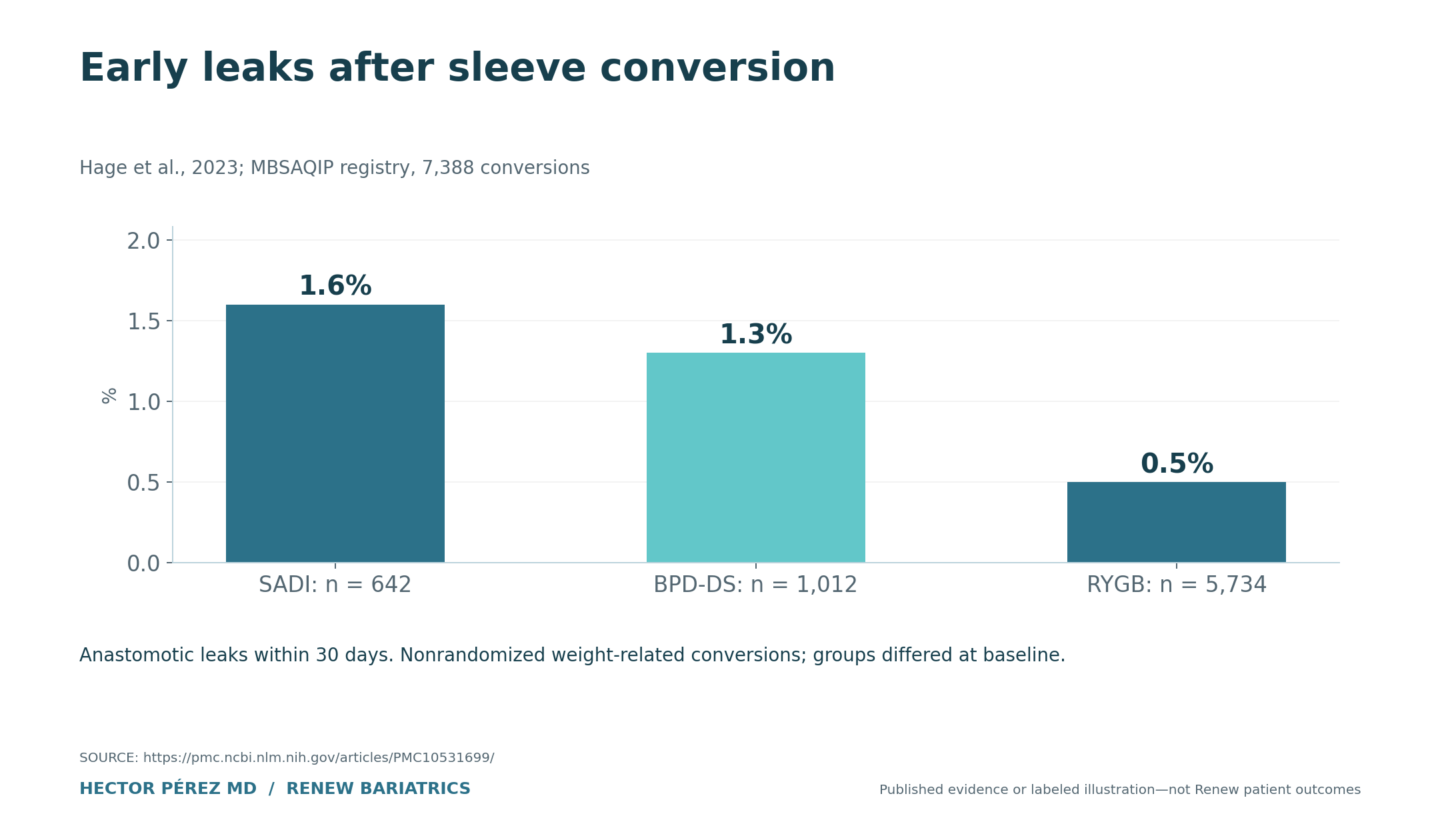
Figure data and interpretation
| Measure or group | Reported value or context |
|---|---|
| SADI: n = 642 | 1.6% |
| BPD-DS: n = 1,012 | 1.3% |
| RYGB: n = 5,734 | 0.5% |
Anastomotic leaks within 30 days. Nonrandomized weight-related conversions; groups differed at baseline.
Who might be considered after sleeve?
An evaluation may consider SADI-S when further treatment of obesity is warranted and the expected benefit fits the person’s health and ability to maintain follow-up. Current weight alone is not the whole decision. Relevant information includes the original sleeve response, later recurrence, metabolic disease, reflux symptoms, eating tolerance, previous complications and nutritional status.
Bring your actual weight timeline rather than an estimate of how much the first operation “worked.” Include medication treatment before and after the sleeve. The team should also consider whether another approach could address the main concern with a different balance of risks.
If significant reflux is present, investigate it before treating SADI-S as the default. Because this revision retains sleeve anatomy, it should not be presented as equivalent to Roux-en-Y conversion for reflux. The right question is whether the proposed operation addresses your documented problem.
What does comparative research show?
A 2021 Dutch cohort compared 63 SADI-S conversions with 78 bypass conversions. Observed additional weight loss favored SADI-S through four years. However, treatment was not randomized, the groups differed in indications, and only nine SADI-S patients contributed at the five-year point. That makes a headline claiming a dependable five-year superiority too strong.
A separate 2023 MBSAQIP analysis studied sleeve conversions for weight-related indications. Thirty-day leak rates were 1.6% for SADI, 1.3% for conventional duodenal switch and 0.5% for RYGB. Overall serious complications and mortality did not differ significantly between groups. This was an observational registry with only short-term follow-up; it cannot settle long-term nutritional safety or the best operation for an individual.
Read those findings together: a procedure can offer meaningful weight treatment while requiring careful safety and nutrition planning. Neither study reports Dr. Perez’s personal outcomes. Neither permits a guarantee of a specific number of pounds lost.
Why nutrition planning starts before the operation
Discuss your current dietary intake, laboratory findings, supplement use and any previous deficiencies. If you already have difficulty tolerating food or maintaining nutrition, those facts are central to the decision. The team needs a realistic plan for the additional demands after conversion.
The OMA nutrition statement gives procedure-specific attention to SADI-S and duodenal switch, including fat-soluble vitamins. Your personal plan should specify protein intake, supplementation, the laboratory schedule and who acts on abnormal results. Generic instructions from another bariatric procedure may not fit your anatomy.
Ask practical questions as well: Can you obtain the recommended products where you live? What is their ongoing cost? Will a local clinician order and interpret the necessary tests? Who coordinates treatment if results are abnormal? A plan that works during a surgical trip must also work after you return home.
What problems should be discussed?
Consent should address operative complications such as bleeding, leakage, infection and clots, alongside later issues such as altered bowel habits, reflux, inadequate nutrition and further intervention. Ask how the team evaluates persistent diarrhea, unintended excessive weight loss, poor food tolerance or nutritional deficiencies rather than accepting these as unavoidable tradeoffs.
More frequent bowel movements may affect work, travel and everyday comfort even when they do not require hospital care. Quality of life belongs alongside weight in the discussion. Describe your work schedule, access to bathrooms and any existing gastrointestinal symptoms during the review.
Questions that make the consultation more useful
- Why would SADI-S fit my current anatomy and goals?
- What findings would favor another option?
- How does my reflux history affect the recommendation?
- What results are available for comparable revision patients, with what follow-up?
- What are the nutrition and follow-up obligations beyond the first year?
- Who will manage complications or deficiencies after I return home?
Review the complete sleeve revision comparison, then contact a Renew coordinator through the revision information page to arrange records for clinical review. Choosing SADI-S requires a clinical decision about anatomy, expected benefit and continuing care.
Define the additional treatment goal from the current baseline
After sleeve, the relevant starting point for a conversion study is often the weight immediately before conversion. That differs from the weight before the original sleeve. Ask which baseline is being used when a clinician discusses expected additional loss.
Do not add a primary-operation percentage to a conversion percentage without checking the denominators. The weight-loss measurement guide explains why the arithmetic can otherwise be misleading. Actual weights and dates make the comparison easier to verify.
Also define the health outcome behind the additional weight goal. Diabetes management, mobility, or another concern may be part of the reason for treatment. The recommendation should explain how the proposed anatomy is expected to help and what uncertainty remains.
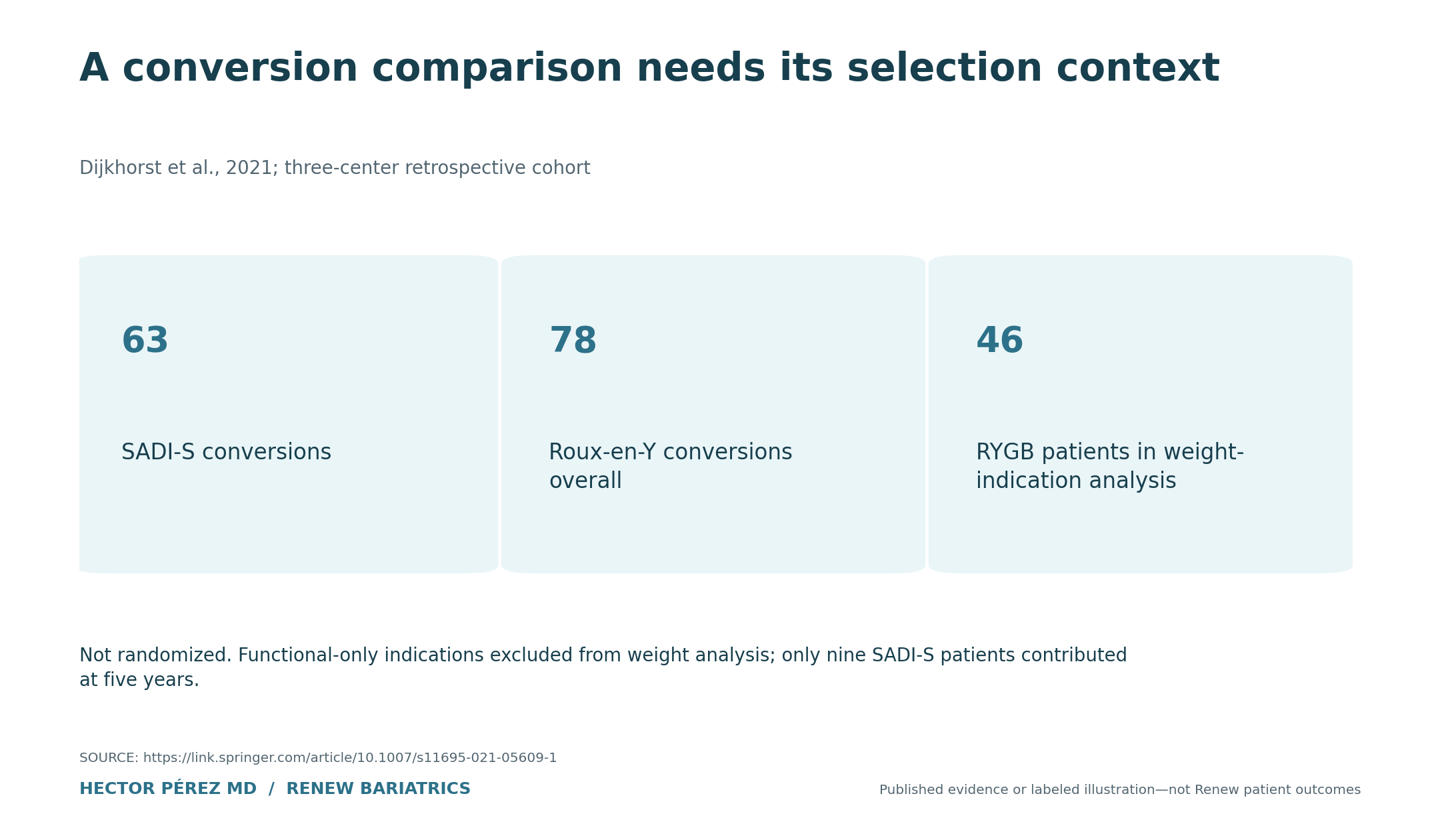
Figure data and interpretation
| Measure or group | Reported value or context |
|---|---|
| 63 | SADI-S conversions |
| 78 | Roux-en-Y conversions overall |
| 46 | RYGB patients in weight-indication analysis |
Not randomized. Functional-only indications excluded from weight analysis; only nine SADI-S patients contributed at five years.
The comparative cohort has important selection limits
Patients were not randomly assigned to SADI-S or Roux-en-Y conversion in the Dutch study. Different indications can influence both which procedure is selected and what outcomes are likely. A group treated mainly for weight response may not be directly comparable with a group containing more reflux-focused conversions.
The small number of SADI-S patients contributing at five years also limits a strong long-term superiority claim. A later time point can look authoritative while representing only a few observations. Ask how many patients actually support the number being quoted.
Use the study to discuss a possible tradeoff, not to declare a universal winner. The clinical question is which procedure fits your symptoms, anatomy, nutritional condition, and continuing care resources.
Short-term registry safety does not settle long-term nutrition
The registry comparison reports events within 30 days. It can inform discussion of early surgical outcomes but cannot establish the complete nutritional course years later. A finding of no statistically significant difference in one category does not prove identical safety in every respect.
Ask which complications are most relevant to the proposed conversion and how the team responds to them. Then ask separately about later nutritional issues, bowel symptoms, and possible further intervention. These questions address different parts of the care pathway.
A consent discussion should avoid combining the best weight figure from one cohort with the lowest risk figure from another as though they came from a single comparable population. Each result needs its own methods and limitations.
Primary SADI-S evidence provides context, not a conversion forecast
The primary SADI-S cohort discussed elsewhere on this site involved patients receiving the combined operation in one stage. Its long-term total weight-loss percentage does not represent additional loss after an earlier sleeve. That distinction should remain explicit whenever the study is cited.
It can still inform questions about the long-term commitment associated with SADI-S anatomy, including nutritional complications and follow-up. Background evidence is useful when its role is stated honestly. It becomes misleading when transferred directly into a personal prediction for a different operation history.
Ask the team to identify the most relevant conversion evidence and explain where clinical judgment must bridge gaps. A transparent discussion of uncertainty is more helpful than a precise number that does not fit your situation.
Reflux can change the preferred direction of revision
Because the sleeve remains part of the food pathway, SADI-S should not be assumed to provide the same reflux-related effect as Roux-en-Y conversion. Describe symptoms, prior testing, and response to treatment before deciding that additional weight loss is the only selection issue.
Ask whether reflux needs further investigation and how the findings influence the choice. If the main problem is regurgitation or esophageal disease, the clinician should explain why the proposed procedure addresses that concern.
Do not minimize reflux because you prefer the weight-loss profile of another operation. An informed decision considers the whole clinical problem, including the possibility that different goals favor different treatments.
Assess whether nutritional follow-up is realistically available
List the local clinicians, laboratories, supplements, and treatments you can access. Ask who will order tests, interpret results, and respond to abnormalities. A recommendation for lifelong monitoring should be translated into a practical care arrangement.
Bring any history of deficiencies or difficulty tolerating supplements. Include cost and supply barriers. The team needs to know whether the proposed plan can be maintained after the initial recovery period, not only during the surgical trip.
If a nutritional problem is identified before conversion, ask what must improve and how it will be reassessed. A high body weight does not establish adequate protein or micronutrient status. Preparation may need to address a deficiency before any further anatomy change.
Bowel changes deserve a quality-of-life discussion
Ask how the proposed operation may affect bowel frequency, consistency, urgency, and the ability to manage daily activities. Describe existing gastrointestinal symptoms and practical constraints such as limited bathroom access at work or lengthy commuting.
The discussion should distinguish expected changes from symptoms that require assessment. Persistent diarrhea, poor intake, or unintended excessive weight loss should not be accepted without review simply because absorption has changed. Ask whom to contact and where evaluation would occur.
These outcomes matter even when they are not counted as a major complication in a study. A treatment can achieve a weight goal while creating burdens that need management. Quality of life belongs in the decision from the beginning.
Medicines and preparation require a coordinated plan
Provide the full medication list and make sure the prescribing clinicians know about the proposed operation and diet changes. Diabetes treatment, blood thinners, and other medicines may require individualized instructions. Do not apply an old plan from the original sleeve without review.
For GLP-1 medicines, report the dose, last administration, recent escalation, and digestive symptoms. The preparation article explains the questions to resolve with the anesthesia and prescribing teams.
Clarify the preparation diet separately from final fasting instructions. If intake is difficult or the procedure date changes, ask for revised guidance rather than extending a restrictive plan on your own.
Plan recovery with flexibility for a complex history
Describe work, lifting, caregiving, mobility, and support at home. Ask for activity restrictions and the criteria for progressing. Your recovery from the first sleeve does not guarantee the same course after an intestinal conversion.
Confirm the local stay and medical timing of return travel. A package itinerary should not substitute for clinical clearance. The flying guide outlines the questions and public-health guidance to discuss before booking.
Arrange local aftercare and transfer of the operative report. The final anatomical details are important for future nutritional assessment and symptom evaluation. Remote communication can support that handoff without replacing all local services.
Ask what happens if the original plan is not suitable
Further evaluation may favor another approach, optimization first, or referral. Ask which findings could change the recommendation and how that affects scheduling and cost. A preliminary discussion should not be mistaken for a final decision to operate.
If you seek another opinion, provide the same records and treatment goals so the recommendations can be compared meaningfully. Ask each clinician to explain the evidence, tradeoffs, and continuing care rather than simply whether the procedure can be performed.
For a review through Renew, submit the original sleeve history, current symptoms, weight timeline, and available nutrition results. The decision should connect the expected benefit with your anatomy and ability to sustain the follow-up required after conversion. ## Additional questions about SADI-S conversion
Does keeping the sleeve mean the nutritional plan stays the same?
No. The intestinal change can alter the requirements for supplementation and monitoring. Ask which parts of the old sleeve plan continue and which change. Bring existing results and product labels so the new instructions address your actual starting point. The final regimen should come from the clinical team rather than a generic comparison online.
Can a normal early blood test rule out future deficiencies?
No. It describes the measured results at that time. Continuing monitoring remains important because intake, absorption, supplements, and health can change. Ask when reassessment is due and who will act on abnormal findings. The process should include treatment and follow-up of the response, not simply ordering another panel.
Why do studies with the same procedure name report different outcomes?
Selection, limb configuration, baseline weight, follow-up time, additional treatment, and missing data can differ. Check those details before comparing percentages. A higher average from another center does not automatically establish a better technique or a more appropriate choice for your situation.
What would make another option preferable?
Ask the clinician to identify the findings that would shift the recommendation, including reflux, nutritional concerns, anatomy, or the feasibility of follow-up. Understanding those conditions helps you assess the reasoning and prepare for a changed plan after testing. The objective is a treatment suited to the whole clinical picture, not a commitment to one name before the evaluation is complete.
Sources and further reading
- Single Anastomosis Duodeno-Ileal Bypass with Sleeve Gastrectomy.
- Single Anastomosis Duodenoileal Bypass or Roux-en-Y Gastric Bypass After Failed Sleeve Gastrectomy: Medium-Term Outcomes (2021).
- Revisional Procedures after Sleeve Gastrectomy for Weight Recurrence or Inadequate Weight Loss: An Analysis of the MBSAQIP Database (2023).
- Bariatric nutrition and evaluation of the metabolic surgical patient: Update to the 2022 OMA clinical practice statement (2024).
- Efficacy of single anastomosis sleeve ileal (SASI) bypass for type-2 diabetic morbid obese patients (2016).