Transoral outlet reduction, usually called TORe, is an endoscopic procedure for selected patients with weight recurrence after Roux-en-Y gastric bypass. It reduces an enlarged gastrojejunal outlet—the connection between the stomach pouch and small intestine. The original bypass remains in place. TORe does not reverse bypass or create a new gastric sleeve.
For someone who initially did well after bypass and is now considering another treatment, the first question is whether the outlet is contributing to the problem. Weight alone cannot answer that. A review should connect your symptoms, weight history, nutrition, medications, and anatomy with a clear treatment objective.
How TORe works
What does TORe actually change?
An endoscope passes through the mouth to reach the pouch and its outlet. Endoscopic treatment reduces the outlet opening, commonly with suturing; the exact method varies. Johns Hopkins explains the anatomy and approach. This description is general procedure education, not a description of a technique selected for an individual patient.
The distinction matters when reading the word “revision.” A gastric bypass revision can refer to several different procedures. Ask for the exact name, the part of the anatomy being treated, and what will remain unchanged. TORe addresses an outlet; it does not address every possible reason for symptoms or weight recurrence after bypass.
The outlet is one part of a larger clinical picture
The gastrojejunal outlet is the connection between the bypass pouch and the intestine. Its size can be relevant to the passage of food and the experience of fullness, but weight recurrence is not an outlet measurement. A useful evaluation connects the endoscopic finding with the history rather than assuming that every person who regains weight has the same anatomical problem.
Ask how the outlet was assessed and whether other findings matter. An endoscopy may identify a concern that needs attention before a weight-focused intervention. If you have pain, vomiting, trouble swallowing, or bleeding, those symptoms should be evaluated in their own right rather than attributed automatically to weight recurrence.
The original operative report remains useful even when the bypass was performed many years ago. It can clarify the type of bypass and any later changes. If you have had another revision, provide that report too. TORe is not a generic procedure for every operation that a patient remembers as a bypass.
Who needs an evaluation?
What makes an evaluation useful?
Bring a short timeline: date of bypass, weight before it, lowest postoperative weight, current weight, and when the trend changed. Include prior revisions and any recent endoscopy results. Document symptoms in your own words rather than trying to diagnose a stretched pouch from the amount you can eat.
| Information to discuss | Question it helps answer |
|---|---|
| Original operative report and revision history | What anatomy is actually present? |
| Endoscopy findings, when available | Is an enlarged outlet documented, and are other findings relevant? |
| Weight trajectory and treatment history | What response would make another treatment worthwhile? |
| Current medications and supplements | Who will coordinate medication decisions and ongoing bypass nutrition care? |
| Reflux, vomiting, pain, swallowing problems, or meal-related symptoms | Does symptom evaluation need to take priority over a weight-focused procedure? |
| Local follow-up arrangements | Who can assess you after you return home? |
These are preparation questions, not a self-screening tool. Some records can be reviewed remotely, while further examination or testing may be needed. Our revision evaluation guide explains how to organize the discussion.
Define a useful outcome before the procedure
The lowest weight reached after your original bypass may be emotionally important, but returning to it cannot be promised. Ask what improvement would be meaningful now: a change in weight trajectory, better management of an associated condition, or another agreed goal. The plan should distinguish a realistic treatment objective from an advertised ideal.
Record the baseline that will be used to measure response. A percentage calculated from the weight before TORe is different from a percentage calculated from the weight before your original bypass. Keeping the actual weights and dates avoids confusion when several treatments have occurred over time.
Agree on when the first meaningful reassessment will occur and which outcomes will be reviewed. If additional treatment is needed, that should be discussed as part of ongoing obesity care rather than framed as proof of personal failure.
What research shows about weight loss
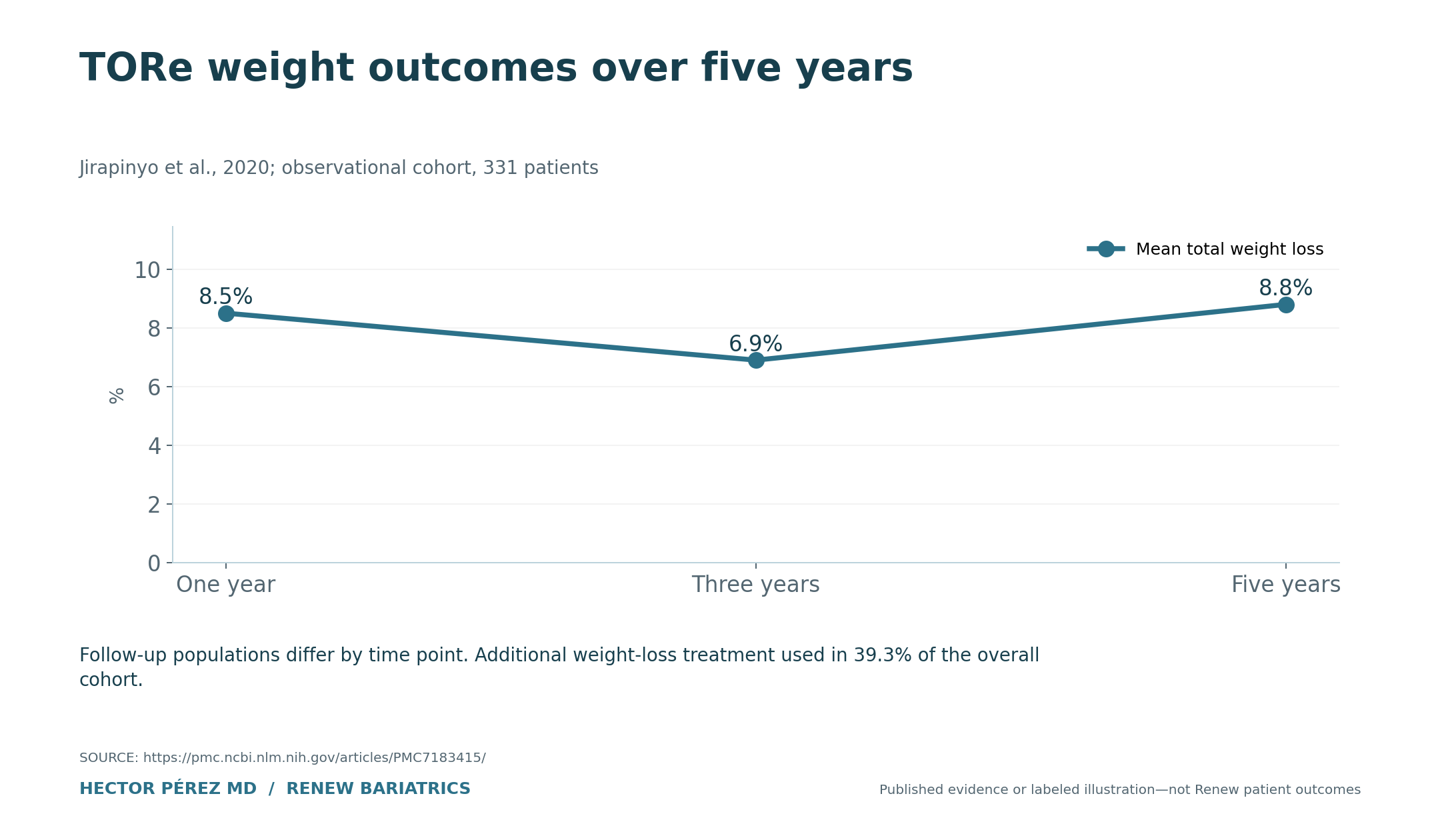
Figure data and interpretation
| Measure or group | Reported value or context |
|---|---|
| Mean total weight loss — One year | 8.5% |
| Mean total weight loss — Three years | 6.9% |
| Mean total weight loss — Five years | 8.8% |
Follow-up populations differ by time point. Additional weight-loss treatment used in 39.3% of the overall cohort.
How much weight loss does TORe produce?
A 2025 professional-society evidence review reported pooled total weight loss of 8.9% at 12 months. That is a research average across selected studies, not a forecast for every patient. Technique, baseline anatomy, additional treatment, and follow-up differ across programs.
Total weight loss uses the weight immediately before the treatment being studied. For illustration, an 8% change from 250 pounds is 20 pounds. This arithmetic example is not a predicted result. It also should not be confused with “excess weight loss,” which uses a different denominator.
Longer-term outcomes require context. In a five-year cohort, average total weight loss was 8.8% at five years, and 39.3% of the overall cohort received additional weight-loss treatment. The finding supports discussing sustained care; it does not isolate the effect of TORe alone. Read the TORe research review for study design and follow-up details.
What the short-term and long-term evidence answer
A pooled estimate at 12 months describes results across the studies included in that review. It can summarize the literature, but the underlying techniques, patient selection, and care programs may differ. A long-term cohort answers another question: what happened over time in a particular program.
The five-year figure on this page should therefore be read with its follow-up diagram. Of 331 patients in the original cohort, 123 had reached eligibility for five-year follow-up and 102 had data. It is inaccurate to describe all 331 as five-year observations, and it is also inaccurate to label everyone not yet eligible as lost to follow-up.
Additional weight-loss treatment was used in the cohort. That means the later outcome reflects a course of care in which TORe could be combined with other interventions. The finding is useful for discussing durability and continuing treatment, but it does not isolate a permanent effect from one procedure alone.
Why averages differ between TORe programs
A program’s reported outcome can be influenced by who it treats, how the procedure is performed, the starting weight, accompanying nutrition or medication care, and which patients return for measurement. A higher published average does not automatically prove that one technique or clinician is superior.
Before comparing two numbers, write down the weight-loss metric, baseline, follow-up time, and number assessed. Check whether patients receiving further treatment remain in the analysis. If one report includes only selected completers and another follows consecutive patients, the averages may not be directly comparable.
Ask the treating clinician which evidence is most applicable to your anatomy and goals. An honest discussion can acknowledge that a precise individual forecast is unavailable. The next useful question is how progress will be reviewed and what would happen if the response is incomplete.
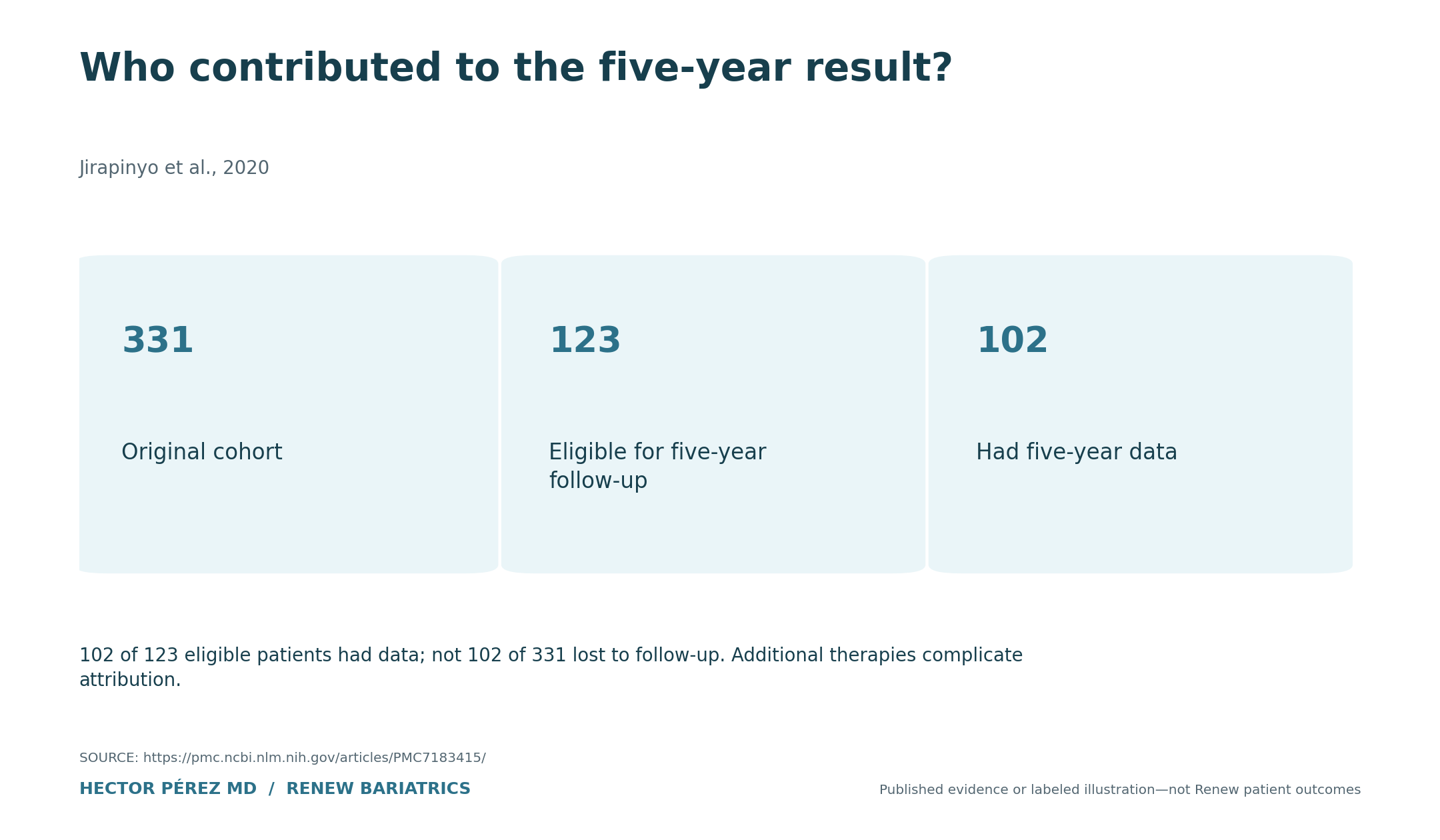
Figure data and interpretation
| Measure or group | Reported value or context |
|---|---|
| 331 | Original cohort |
| 123 | Eligible for five-year follow-up |
| 102 | Had five-year data |
102 of 123 eligible patients had data; not 102 of 331 lost to follow-up. Additional therapies complicate attribution.
Risks and alternatives
What are the risks?
TORe avoids abdominal incisions, but it is still an invasive procedure performed with anesthesia. Possible complications include bleeding, perforation, infection, and excessive outlet narrowing, called stenosis. Nausea and discomfort can occur during recovery. These risks are described in Johns Hopkins’ patient guidance.
A useful consent discussion covers more than the chance of an event. Ask how a suspected problem would be recognized, where it would be assessed, whether further endoscopy might be needed, and how care would be coordinated if you had already returned home. Ask what the quoted package includes if recovery is more complicated than expected.
When should another option be discussed?
Ask how TORe compares with continued medical management for your specific goals. If the main concern is a problem the outlet procedure will not address, the discussion may need to move to a different evaluation or treatment. Our comparison of TORe and surgical revision explains why “less invasive” is only one part of that decision.
TORe, medication, and surgical revision are different decisions
Medication may remain relevant after bypass, including when an endoscopic procedure is considered. If both are proposed, ask what each is intended to accomplish and who will manage the prescription. A combined approach should have a clinical rationale and a workable follow-up plan.
Surgical revision of an existing bypass can mean several different operations. Some address an outlet, while others alter intestinal anatomy or treat another complication. A comparison with TORe should name the specific operation rather than treating all surgical revisions as a single alternative.
Renew’s published bypass-revision information currently describes TORe as its available option and states that surgical revision of an existing bypass and bypass reversal are not offered. Educational discussion of those operations on this site does not establish availability. Confirm the exact proposed treatment during clinical review.
Preparation, recovery and continuing care
What should I plan for recovery?
Expect a clinician-directed progression of food textures and specific anesthesia precautions. Hospital discharge guidance describes a liquid-to-soft-food progression and restrictions on driving and activities requiring alertness after anesthesia. Your own team’s instructions take priority over a general online schedule.
Before booking travel, obtain written answers about the recommended local stay, companion requirements, return-to-work planning, symptom contact number, and follow-up appointments. Ask which clinician will manage prescriptions and supplements. Do not change blood thinners, diabetes treatment, or other prescribed medicines based on this page.
A practical recovery plan should also account for your home life. Identify who can help with childcare or transport, how you will obtain the prescribed foods, and where you will seek care if you cannot reach the procedure team. A simple written plan is easier to use than instructions scattered across messages.
Preparation begins before the final fasting instructions
Provide a complete medication and supplement list, including injections, blood thinners, nonprescription products, nicotine, and cannabis. Ask which clinician will give the final instructions for each relevant medicine. Do not change prescribed treatment based on a generic online timetable.
For GLP-1 medicines, the preparation guide explains why current guidance requires individual assessment. The team needs the dose, timing, recent changes, and any digestive symptoms. A coordinator can route questions, while the prescribing and anesthesia clinicians determine the clinical plan.
Confirm the prescribed diet preparation and the separate final fasting instructions. Ask what to do if you cannot follow them or if the procedure time changes. Report any deviation accurately rather than trying to compensate with an improvised longer fast.
Recovery is more than a shorter hospital stay
An endoscopic approach can avoid abdominal incisions while still requiring anesthesia precautions, a prescribed food progression, symptom monitoring, and follow-up. Ask how these instructions fit your work, home responsibilities, and travel route. Do not assume that a brief facility stay means you can immediately resume every activity.
Arrange help with transport and other tasks according to the discharge requirements. If you intend to travel alone, discuss that before booking. A driver or hotel arrangement does not automatically provide any supervision the clinical team requires after anesthesia.
Persistent vomiting or inability to maintain the prescribed fluids should be reported promptly. Excessive outlet narrowing is one potential complication, but symptoms require clinical assessment rather than self-diagnosis. Ask where further endoscopy or other treatment would be available if needed after you return home.
The original bypass still needs continuing care
TORe does not reverse the bypass or remove its nutritional implications. Review your current supplement regimen, laboratory monitoring, and any history of deficiencies. The team should explain which instructions continue and which change temporarily during recovery.
Identify the local clinician who will review results and manage ongoing care. Ask how records will be transferred and how the procedure team will communicate with that clinician if a problem arises. Remote support can be helpful without replacing every examination or treatment needed near home.
Include these continuing needs in the financial discussion. A procedure quote may not include local laboratory tests, prescriptions, or treatment of complications. The quote comparison guide helps separate those services.
What patient stories can tell you
Use patient stories for the questions they can answer
Reviews may help you understand communication and individual experiences, but a review that names Dr. Perez without identifying TORe is not evidence of a TORe outcome. Likewise, a sleeve before-and-after photograph should not be presented as an endoscopic bypass-revision result.
The patient gallery and attributed reviews retain that context. A clinic-specific TORe outcome report would require documented procedures, defined follow-up, complete denominators, and adverse-event reporting. The studies summarized here are external research, not that personal series.
Bring the questions raised by patient stories to a clinical review, then connect the recommendation with your own anatomy, health, and continuing care needs. ## Additional questions about expectations
Questions about TORe
Can TORe be performed after gastric sleeve?
A surgical sleeve does not have the bypass outlet targeted by TORe. See endoscopic sleeve revision for that separate topic and gastric sleeve revision options for the broader discussion.
Will TORe get me back to my lowest bypass weight?
That cannot be promised. Ask the treating clinician to discuss a realistic range of goals and what would happen if the initial response falls short. Returning to a historical number and improving current health are related but separate objectives.
Is TORe a one-time cure for weight recurrence?
No treatment should be presented that way. Decide in advance how progress will be reviewed and what ongoing support will be available. An incomplete response should trigger reassessment, not an assumption that the patient has failed.
Does the five-year average show that TORe worked alone for five years?
No. The cohort included additional weight-loss treatment, and the number contributing data changed with follow-up eligibility. The result describes a course of care in that program. Ask how continuing treatment will be organized for you and how the team will distinguish the contribution of different interventions when reviewing progress.
Is a larger outlet the only factor considered for TORe?
No. The finding must be interpreted with the original anatomy, symptoms, weight history, nutrition, and medical treatment. Ask why the outlet is considered a meaningful target and whether another concern should be assessed first. A measurement is part of the evaluation rather than automatic approval.
What information should be available if I need care at home?
Keep the original bypass history, the TORe procedure report, discharge instructions, medication list, and clinical contact details. Tell a local clinician about both procedures when seeking assessment. The recent endoscopic treatment does not replace the relevance of the underlying bypass anatomy or its nutritional follow-up.
Discuss your bypass history with the team
See Renew Bariatrics’ TORe program information and request a coordinator review. Include your original operation and your main concern so the team can identify the records needed for clinical assessment.
Selected sources
- Transoral Outlet Reduction (2022).
- Five-year outcomes of transoral outlet reduction for the treatment of weight regain after Roux-en-Y gastric bypass (2020).
- Association for Bariatric Endoscopy systematic review and meta-analysis assessing ASGE PIVI thresholds for transoral outlet reduction (2025).
- Learning About Transoral Outlet Reduction (2026).