Bariatric revision means treating a problem after an earlier weight-loss operation. The right approach depends on the original anatomy, the cause of the problem and the risks of changing that anatomy again. A revision may be surgical, endoscopic or part of a broader treatment plan that includes medication and nutrition care.
This guide helps you find the relevant procedure information before an evaluation. It does not assume that a second operation is the next step.
Start with the operation you already had
| Previous procedure | Question to investigate | Read next |
|---|---|---|
| Gastric sleeve | Is the concern weight recurrence, reflux, difficulty eating or another problem? | Sleeve revision overview |
| Roux-en-Y gastric bypass | What is contributing to recurrent weight gain, and is the outlet relevant? | Weight regain after bypass and TORe |
| Adjustable gastric band | Does the band need removal, and should conversion be simultaneous or staged? | Band removal and conversion |
| One-anastomosis or mini bypass | What is causing the symptoms, and is specialist revision assessment needed? | Mini-bypass conversion: educational guide |
| Several previous operations | What anatomy and scar tissue remain? | Assessment after multiple operations |
Weight regain is a reason to reassess care
A number on the scale does not reveal the cause of recurrent weight gain. The evaluation may need to address the weight trajectory, eating tolerance, medications, health changes and the structure of the previous operation. The question is which part of that problem a proposed treatment can reasonably address.
For a sleeve patient, the options discussed during assessment may differ substantially from those considered after bypass. Read the guides to weight regain after sleeve and medication or revision before choosing a procedure name to pursue.
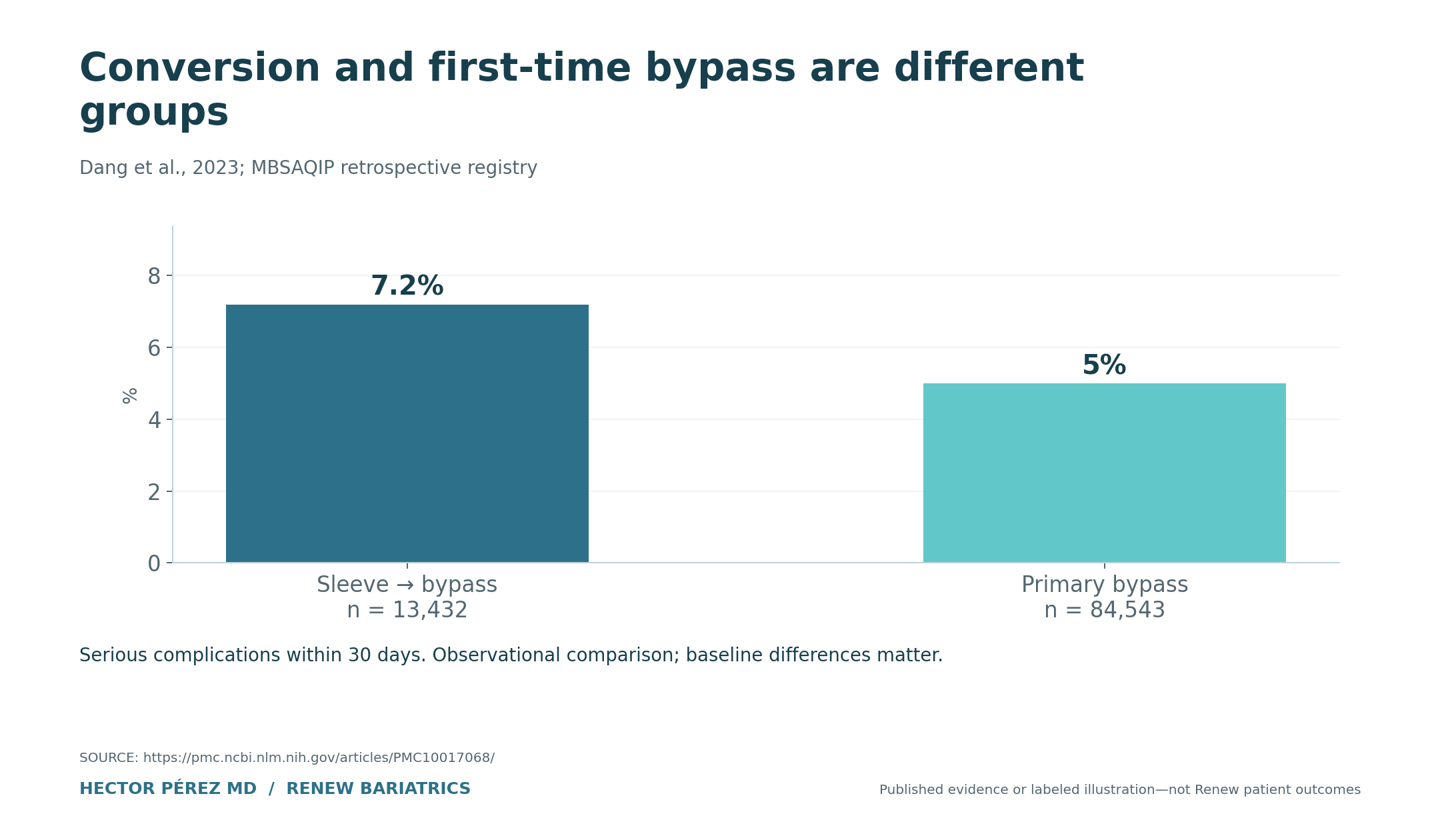
Figure data and interpretation
| Measure or group | Reported value or context |
|---|---|
| Sleeve → bypass n = 13,432 |
7.2% |
| Primary bypass n = 84,543 |
5.0% |
Serious complications within 30 days. Observational comparison; baseline differences matter.
Reflux and weight recurrence are different treatment goals
Someone seeking help for reflux after a sleeve may need a different assessment from someone whose main concern is weight recurrence. The treatment discussion should identify the symptom to be improved and how success will be measured. Our reflux guide explains the questions to bring to that evaluation.
If conversion is being considered, compare sleeve-to-bypass, sleeve-to-SADI-S and re-sleeve in the context of your actual problem. They are not interchangeable ways to make an operation “stronger.”
Endoscopic revision has a specific role
TORe is discussed for selected patients after Roux-en-Y gastric bypass. An endoscopic revision of a surgical sleeve is a different intervention. Primary ESG is different again. A consultation should establish which anatomy you have before applying evidence from any of these procedures.
What is offered through Renew?
Renew’s revision program describes selected sleeve and gastric-band conversions and TORe after bypass. Its current information states that surgical revision or reversal of an existing gastric bypass is not offered. Pages about bypass distalization and some other advanced operations are included for education, not as booking offers. A sleeve-to-bypass conversion creates a bypass from a previous sleeve and is a different situation.
How to compare the evidence
Ask whether a quoted result comes from primary surgery or revision, which patients were included and how many returned for follow-up. A percentage measured from the original surgery weight is not interchangeable with a percentage measured from the revision-day weight. Our results guide explains the calculations.
For a close look at a specific study, visit the evidence library. Patient reviews can tell you about a person’s experience, but they cannot establish a procedure’s average benefit or risk.
Prepare for the next step
Gather your original operative report, later procedure reports, recent testing and a dated weight history. Bring a list of symptoms and the treatment goal most important to you. Review what a revision evaluation involves, risks and recovery and long-term nutrition needs.
Request a review of your history through Renew
Revision is a category of care, not one operation
The word revision can describe correction of a complication, conversion from one operation to another, or an intervention for an inadequate weight response. It can also include selected endoscopic treatments. These procedures change different parts of anatomy and should not share an assumed outcome, price, or recovery timetable.
Start by naming the original operation and the problem that needs attention now. A patient with reflux after sleeve, a patient with weight recurrence after bypass, and a patient struggling to maintain nutrition need different questions answered. A general request for the strongest revision skips the most important part of selection.
Ask the clinician to state the treatment goal before naming the procedure. If several problems are present, identify which takes priority and whether one intervention can reasonably address all of them. Sometimes the assessment leads to a sequence of treatments rather than one operation.
Reconstruct the existing anatomy
Collect the original operative report and reports from later conversions, repairs, band removal, or endoscopic treatments. Include admissions for complications and any temporary devices when known. A discharge summary may help locate the records but may not contain all the anatomical detail.
Do not infer the current arrangement from scars or a remembered nickname. If information is missing, mark it as unknown and explain where the earlier care occurred. The team can determine which gaps are important and whether further testing may help.
The evaluation guide provides a record checklist. Its purpose is to make clinical review more accurate, not to require a perfect file before you can ask for help. Begin with the available facts and identify what still needs clarification.
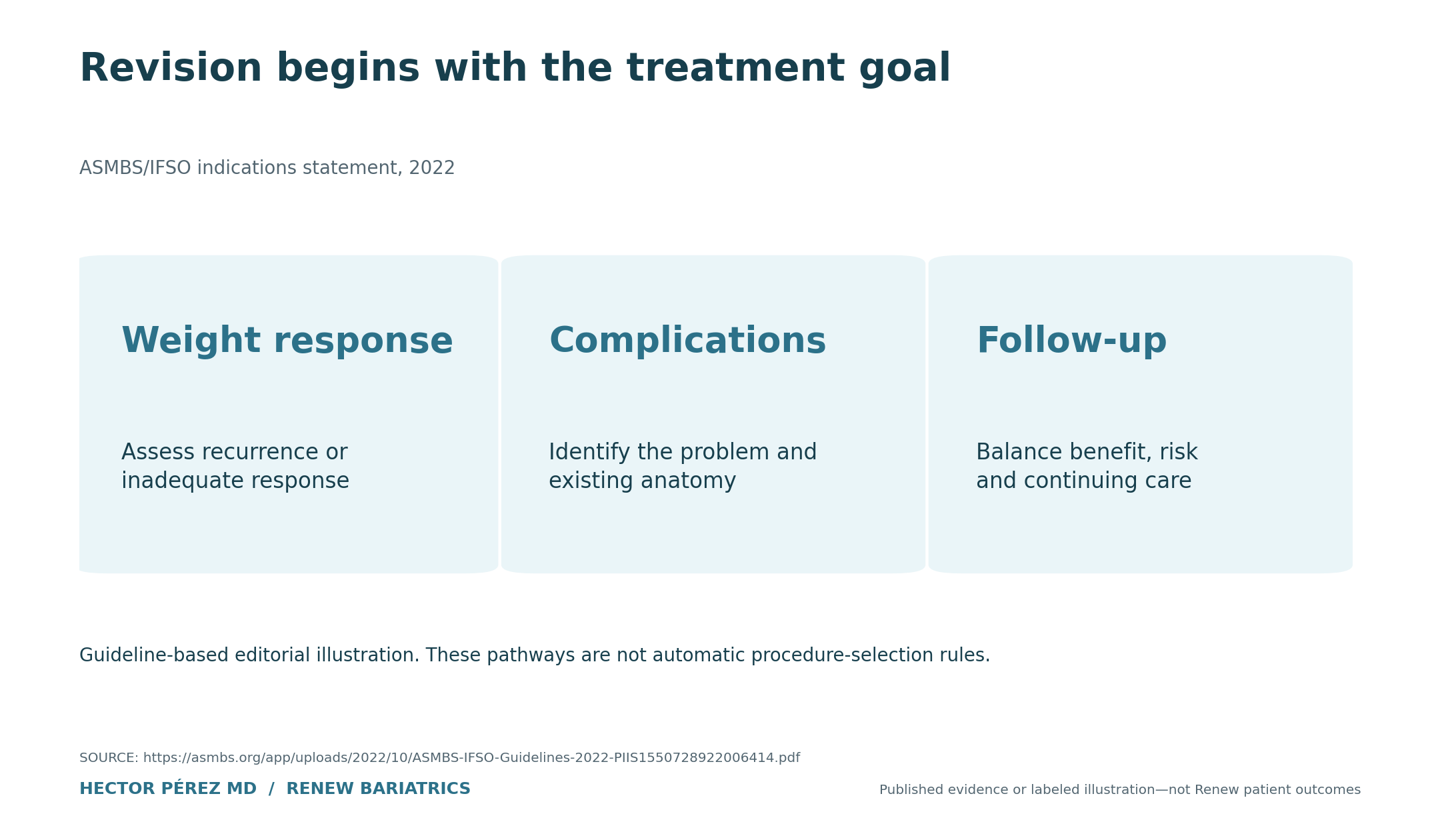
Figure data and interpretation
| Measure or group | Reported value or context |
|---|---|
| Weight response | Assess recurrence or inadequate response |
| Complications | Identify the problem and existing anatomy |
| Follow-up | Balance benefit, risk and continuing care |
Guideline-based editorial illustration. These pathways are not automatic procedure-selection rules.
Different symptoms can change the order of priorities
Weight recurrence may be the reason you started researching, but persistent vomiting, difficulty swallowing, bleeding, severe pain, or poor fluid intake can require more immediate assessment. Tell the team about those concerns explicitly. Do not assume they are ordinary consequences of the earlier operation.
Reflux should also be described in detail rather than only labeled acid. Timing, regurgitation, nighttime symptoms, previous testing, and response to treatment can help define the next question. The appropriate investigation depends on the operation and clinical findings.
If urgent symptoms develop, use appropriate local care rather than waiting for an elective revision consultation. An application process is not an emergency service. The immediate problem should be assessed on its own clinical merits.
Weight recurrence does not automatically identify an anatomical failure
Changes in appetite, medicines, eating patterns, health, mobility, and anatomy may overlap. A current weight or a larger meal size cannot establish which contributor is most important. A useful assessment includes the trajectory and the treatment history.
Record the weight before the first operation, the lowest postoperative weight, current weight, and approximate dates. Add major health or treatment changes. Keep symptoms on a separate line so a weight-focused discussion does not obscure another problem.
Ask how medical treatment fits into the options. Medication and nutrition care can remain relevant after surgery, including when a procedure is also considered. A recommendation against revision should still lead to an active plan for the concern that brought you to care.
Understand the main pathways after sleeve
After sleeve, the assessment may lead to medical treatment, a surgical conversion, or selected other approaches. Conversion to Roux-en-Y bypass and conversion to SADI-S alter anatomy differently and have different implications for reflux and nutrition.
Re-sleeve and endoscopic sleeve revision also differ from each other. One involves further surgical resection, while the other uses endoscopic suturing in selected anatomy. Educational comparison does not establish that every option is available through Renew.
Ask which finding supports the proposed path and what it would leave unresolved. A recommendation should not be based solely on the amount of additional weight loss reported in a study. The study population and the reason for revision need to fit the question.
Understand the main questions after bypass
For selected patients with an enlarged gastrojejunal outlet after Roux-en-Y bypass, TORe may be considered. It changes the outlet through an endoscopic approach while leaving the original bypass in place. It is not a reversal or a treatment for every cause of weight recurrence.
Surgical revision of an existing bypass includes other operations, some of which change absorption or address complications. They should not be grouped together as a single comparison with TORe. Ask for the exact operation and its intended anatomical target.
Renew’s current public information offers TORe for eligible bypass patients and states that surgical bypass revision and reversal are not offered. Pages explaining distalization or OAGB conversion provide education, not confirmation that those operations can be scheduled with Dr. Perez through Renew.
Band removal and conversion have their own selection questions
After adjustable gastric banding, the reason for removal, tissue condition, reflux, food tolerance, and treatment goals can influence the next step. The decision between one-stage and staged conversion should be made from clinical findings, not only the convenience of one trip.
Registry research can compare observed short-term outcomes, but it does not prove that every patient is suitable for either strategy. Ask what would lead the surgeon to separate removal from conversion and how the interval would be managed.
The band conversion guide explains the distinction. If a plan changes after assessment, request the reason and updated expectations for treatment, recovery, and cost.
Compare risks with matching definitions
The safety graphic on this page compares sleeve-to-bypass conversion with primary bypass in a registry. It supports treating revision as a distinct clinical discussion. It does not provide a universal complication rate for every revision or a personal estimate for one patient.
Ask which events are included in a reported percentage and over what period. Serious complications within 30 days, all early symptoms, and long-term nutritional problems are different outcomes. A low value for one category cannot establish that all others are negligible.
Also ask how a complication would be recognized and treated. The response plan should account for the facility, the local recovery period, and care after returning home. Published frequencies are useful only when accompanied by a practical plan for the individual patient.
Nutrition can determine readiness and suitability
Bring current intake, supplement use, laboratory reports, and any previous treatment for deficiencies. Obesity does not exclude malnutrition or micronutrient deficiency. If another intervention changes absorption, the starting condition becomes particularly important to the decision.
Ask what needs correction before treatment and who will manage it. If surgery is deferred, request the target and reassessment plan. A clinical delay should be linked to a defined purpose rather than interpreted as a personal judgment.
Continuing care must also be feasible. Identify local laboratory access, clinicians, supplements, and the ability to obtain treatment when needed. The nutrition guide explains how to organize these responsibilities.
Read research by indication and baseline
A revision study may measure weight loss from the revision date rather than the original operation. Primary-surgery results cannot simply be added to revision percentages. The starting weight, outcome measure, follow-up period, and patients assessed should all be stated.
Studies performed mainly for reflux may not represent patients treated mainly for weight recurrence. A mixed cohort can be informative while leaving uncertainty about a specific subgroup. Ask the clinician to explain how closely the evidence matches your case.
Patient photographs and reviews are another type of information. They can illustrate experiences but cannot establish a procedure-specific average or risk rate without systematic data. The site’s attributed stories should not be relabeled as TORe, ESG, or revision outcomes when the original procedure is different.
Plan recovery around your actual responsibilities
Explain work tasks, commuting, lifting, childcare, and available help. Ask for restrictions that address those activities and a plan for reassessment. A quick recovery from the first operation does not guarantee the same experience after a different intervention.
Confirm transport and supervision requirements after anesthesia. Discuss the complete return journey and medical timing before booking flights. The travel guide explains why a package itinerary does not equal clinical clearance.
Include flexibility for further evaluation or a longer stay. Fixed travel or work commitments should not determine whether an unresolved medical concern receives attention.
Compare the complete plan before committing
Request the exact proposed procedure, remaining tests, clinical team, facility, included services, follow-up, and contingency arrangements. A preliminary quote should identify the assumptions that could change after review. The quote guide provides a consistent comparison framework.
At the end of the evaluation, you should understand the problem being treated, why the recommendation fits, the important alternatives, and what happens next. The next step may be another test, medical treatment, a procedure, or referral.
Use Renew’s application to begin organizing records for clinical review. Coordinator support can make the process clearer, while the clinical team determines suitability and the information needed for an informed decision. ## Questions that help distinguish a recommendation from a sales estimate
What finding makes this procedure the preferred option?
The answer should identify the clinical problem and connect it with the proposed anatomical or medical treatment. A general statement that a procedure produces more weight loss is not enough when reflux, poor intake, or another complication is the main concern. Ask what evidence supports the connection and which findings would favor another approach. This makes the recommendation understandable rather than simply authoritative.
What remains uncertain before the final decision?
A preliminary review may leave a missing operative report, test result, examination, or specialist opinion. Ask which item could materially change the plan and who will resolve it. Conditional approval should remain clearly conditional. Knowing the uncertainty helps you plan responsibly and prevents a travel date or deposit from being mistaken for a completed clinical assessment.
How will the result be judged for my indication?
Define the baseline and outcome before treatment. If the aim is reflux relief, discuss symptoms and relevant findings. If the aim is additional obesity treatment, include weight trajectory and associated health goals. If the aim is better nutrition, the scale may move differently from a weight-loss target. A single universal success percentage cannot capture these different purposes.
What if the procedure is not recommended after evaluation?
Ask for an explanation and an alternative care plan. The next step may be medical treatment, nutritional optimization, further investigation, or referral. A decision against one intervention does not make the underlying concern unimportant. It should clarify the path forward and, when appropriate, the conditions for reassessment.
How should I use patient reviews when deciding?
Reviews can inform questions about communication, coordination, and personal experience. They cannot establish your anatomy, predict your result, or replace systematic outcome data. Check whether the procedure is actually identified before treating a story as evidence for a specific revision. Keep patient experience, published research, and clinical assessment in their distinct roles.
Who will own the next step after I return home?
Ask for named responsibilities rather than a general promise of support. Identify the clinician who reviews results, the prescriber who adjusts medicines, and the local route for examination or urgent care. The original program can help coordinate without being physically available for every need. This handoff should be planned before travel, while there is time to resolve gaps.
Sources and further reading
Care, in patients’ words
Patient experiences relevant to this guide
David H.
Sleeve-to-bypass revision
Describes bypass revision after problems with an earlier sleeve.
Tammy M.
Gastric sleeve following prior Lap-Band removal
“I want to Thank Dr. Perez and his team for giving me a new start.”
Selected patient accounts published by Renew Bariatrics. Procedures are labeled for each account; individual experiences and results vary.