Bariatric surgery has evolved in how operations are performed, how benefits and risks are measured, and how patients are followed over time. The most useful lesson for a patient is not that the newest technique is automatically best. It is that treatment should connect a specific health problem with evidence, suitable anatomy, and a workable long-term care plan.
This article looks at those changes through the decisions patients face today: sleeve or bypass, surgery or endoscopic treatment, first procedure or revision, and short-term weight change or lasting health outcomes. It also explains why a research result from one generation of treatment cannot simply be transferred to another.
From an operation name to an anatomical explanation
Procedure names can make treatments sound more alike than they are. A sleeve removes part of the stomach. Roux-en-Y gastric bypass creates a stomach pouch and changes the route food takes through part of the intestine. These anatomical differences matter for symptoms, nutritional needs, risks, and the options available if a later problem develops.
The NIDDK overview of weight-loss operations describes sleeve, bypass, adjustable gastric band, and biliopancreatic diversion with duodenal switch. It is a useful starting point for understanding why bariatric surgery is a group of treatments rather than one interchangeable operation.
More precise naming is especially important when a patient already has altered anatomy. A bypass revision may refer to different interventions. A procedure using an endoscope to reduce an outlet is not the same as surgically changing intestinal connections. Ask for both the name and a plain-language description of what would change.
Smaller access does not mean a smaller decision
Laparoscopic techniques allow many operations to be performed through small abdominal incisions. Endoscopic approaches reach the stomach through the mouth. These are different routes of access, and the route alone does not tell you the likely benefit or the full set of risks.
Marketing terms such as minimally invasive can be helpful only when the underlying treatment is explained. They should not imply that anesthesia, complications, nutritional effects, or follow-up are unimportant. A procedure with fewer external incisions may still require careful selection and a defined plan for unexpected symptoms.
For a patient, useful questions are concrete: what tissue is removed, what connection is created or changed, what remains in place, and which later treatments may still be possible? Those answers are more informative than ranking procedures by scar size or the number of nights in hospital.
Evidence has moved beyond the first year
Early weight change is important, but it cannot answer every question about durability, reflux, nutrition, or further treatment. Longer follow-up helps show whether benefits persist and which concerns appear over time. It also makes missing follow-up and additional interventions important parts of interpreting a result.
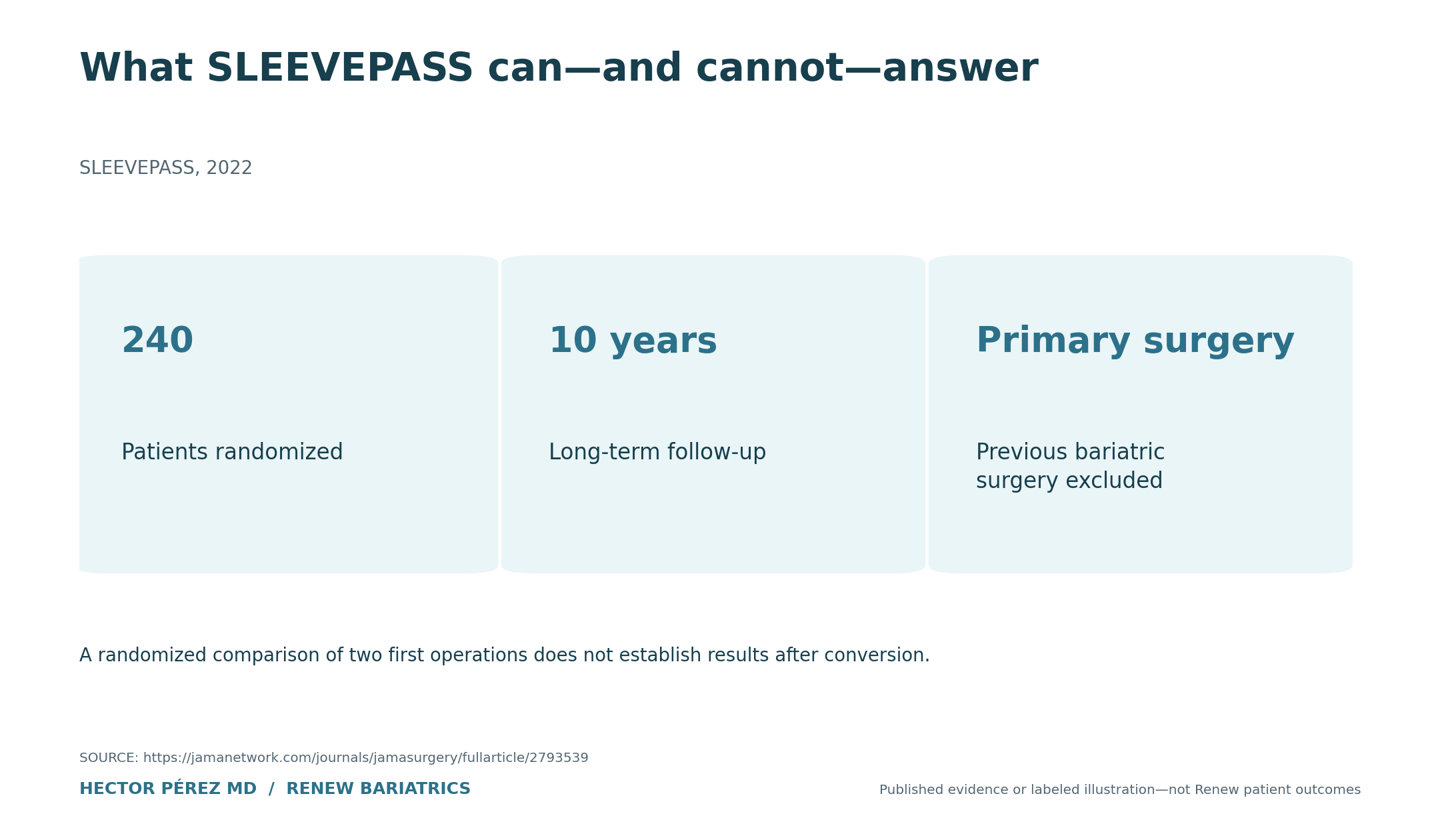
The 10-year SLEEVEPASS report compared sleeve and Roux-en-Y bypass after random allocation to a first operation. The custom graphic with this article identifies the study’s scope: 240 randomized patients and long-term follow-up. Those features make the study informative without making it a prediction for every patient.
A trial of primary operations does not establish the result of converting a previous sleeve to bypass. Revision patients have already had surgery and may be seeking treatment for a different problem. Our sleeve-to-bypass guide uses evidence relevant to that separate decision.
Ask what an outcome means. Weight change, symptom improvement, medication reduction, quality of life, and further procedures are different measures. A study can be favorable on one measure while leaving uncertainty about another. The most useful comparison is the one aligned with the reason you are seeking care.
How to read a modern treatment study
| Study feature | Why it matters |
|---|---|
| Patient population | A first-operation trial may not apply to a patient with prior sleeve or bypass. |
| Comparison group | A randomized comparison asks a different question from a single-center case series. |
| Outcome definition | Total and excess weight loss use different denominators. |
| Follow-up | Know the time point and how many eligible patients had measurements. |
| Additional treatment | Medicines, repeat procedures, and structured follow-up can affect the observed outcome. |
These questions are relevant even when a paper appears in a respected journal. Publication does not remove the need to ask whether the study resembles your circumstances. A clinician should help translate the evidence into an individual assessment, including what remains uncertain.
Be cautious when two advertisements compare percentages from unrelated studies. Different starting weights, treatment definitions, follow-up periods, and additional care can produce different averages. A larger number on a graphic does not by itself identify the better treatment.
Eligibility guidance has also changed
The 2022 ASMBS/IFSO guideline updated professional recommendations for metabolic and bariatric surgery. It considers the evidence for treating obesity and associated disease and recognizes the importance of clinical assessment and continuing care.
A guideline is not the same as an automatic approval policy. A program still needs to assess the person, proposed treatment, available resources, and follow-up arrangements. Insurance eligibility, local policies, device indications, and a clinician’s recommendation may answer different administrative or clinical questions.
If you were previously told that surgery was not an option, ask why. The reason may have been an insurance rule, a health concern, the treatment available at that time, or missing assessment. Understanding the reason is more useful than assuming that a change in guidance means everyone should now undergo surgery.
Endoscopic treatment adds distinct options
Endoscopic sleeve gastroplasty, or ESG, uses internal suturing to reshape the stomach without removing it. Despite the shared word sleeve, it is not surgical sleeve gastrectomy. Its evidence, selection, risks, and follow-up should be discussed on their own terms.
Transoral outlet reduction, or TORe, addresses an enlarged outlet in selected patients after Roux-en-Y bypass. It is a treatment for a particular anatomical situation, not a general substitute for every bypass revision or a procedure designed for a primary surgical sleeve.
The expansion of options makes precise assessment more important. A technique is useful when it addresses the problem present in that patient. Ask what the endoscopic treatment would change, what it would leave unchanged, and why other forms of treatment were or were not recommended.
Revision is now part of the long-term discussion
A patient may seek further assessment because of recurrent weight gain, reflux, food intolerance, another complication, or an inadequate response. These concerns should not be collapsed into a single label of failure. They may require different investigations and different treatment objectives.
The ASMBS/IFSO guideline recognizes indications for revisional treatment and notes its greater complexity compared with primary surgery. That supports careful assessment rather than selecting a revision from the name of the original operation alone. Operative reports and current findings can matter as much as the patient’s weight history.
Dr. Pérez’s site focuses on these distinctions in its revision overview and evaluation guide. A coordinator can help collect records; the clinical team determines which assessment and treatment are appropriate. Sometimes the next step is another form of care rather than another operation.
Continuing care is part of the intervention
Modern treatment discussions should include what happens after the initial recovery period. Nutrition, supplements when prescribed, laboratory review, digestive symptoms, and changes in health conditions all need a continuing plan. The operation does not remove the need for accessible clinical support.
For patients traveling internationally, identify how follow-up will work near home. Ask who reviews laboratory results, who adjusts medicines, and where an examination can occur if needed. Written records and a named contact help different teams coordinate rather than leaving the patient to reconstruct the history.
The NIDDK discussion of benefits provides context for outcomes beyond body weight. When evaluating progress, discuss the health and functional goals that matter to you as well as the scale. Improvement in one area does not mean that all ongoing care can stop.
What should patients expect from future developments?
New techniques, devices, and combinations of treatment will continue to be studied. A useful question is whether the evidence supports the specific use being proposed, not simply whether the treatment is described as new. Ask about the study population, duration of follow-up, alternatives, and unresolved risks.
Do not assume that promising preliminary findings establish long-term safety or that a technique discussed at a professional meeting is available through every physician. Procedure availability, the surgeon’s experience, and the setting must be confirmed individually.
To discuss your own options, contact Renew’s team or submit your health history. Bring the questions behind your interest in treatment. The most useful result of an evaluation is a plan supported by evidence and your individual circumstances.
Keep the original operation record
As treatment options evolve, a reliable account of earlier care becomes more valuable. Keep the operative report, discharge summary, and records of later procedures. A procedure name recalled years later may leave important anatomical details unclear.
If a new treatment is proposed, ask how it fits with the operation you already have. Evidence for a primary treatment may exclude people with prior surgery. A clinician may need further testing before deciding whether an option described online is relevant to your anatomy.
The same principle applies to new symptoms. Tell the team what changed and when, rather than assuming that every concern is explained by the age of the operation. An evaluation should connect the current problem with the available records and findings. Better documentation helps future clinicians assess those changes, even when you move or receive care from a different team.