A bariatric revision evaluation brings together your previous operation, current symptoms, weight history, nutrition and health goals. Its purpose is to determine whether another procedure is likely to help, whether something else should be treated first, and what follow-up would be necessary. A weight increase by itself does not identify the cause or select the right operation.
Before exploring revisional bariatric surgery, write down the change that matters most to you. Is it returning hunger, reflux that interrupts sleep, difficulty eating, a recurrence of diabetes, or a combination? Those concerns deserve separate attention even when they began around the same time.
Start with a timeline, not just a current weight
A useful timeline names the original procedure and date, the lowest weight you reached, when weight began changing, and when symptoms appeared. Add later operations, endoscopic treatments, pregnancy, major illness and changes in medication. Approximate dates are useful when exact records are unavailable; mark estimates clearly.
For example, “I now weigh 240 pounds” tells a clinician less than “I reached 200 pounds two years after surgery, gradually returned to 240 over three years, and developed nighttime reflux six months ago.” This is a hypothetical illustration, not a patient result. It shows why the order of events can help organize the discussion.
What records should you gather?
| Bring if available | Question it helps the team address |
|---|---|
| Original operative report and later procedure reports | What anatomy was created, and has it been changed? |
| Endoscopy reports, pathology and relevant imaging | What has already been examined, and what findings need clarification? |
| Weight timeline and recent health measurements | What changed, over what period, and alongside which health problems? |
| Medication and supplement list, including products stopped | What benefits, side effects, access problems or nutritional gaps should be discussed? |
| Recent blood tests and previous deficiency treatment | What needs review before considering another intervention? |
| A short symptom diary | When do pain, reflux, vomiting or food intolerance occur? |
Do not delay asking for help because you cannot assemble everything. Explain which records are missing. Ask the receiving team which documents they need, whether older tests remain useful, and how to transfer them securely. A previous discharge summary may help locate the original operative report.
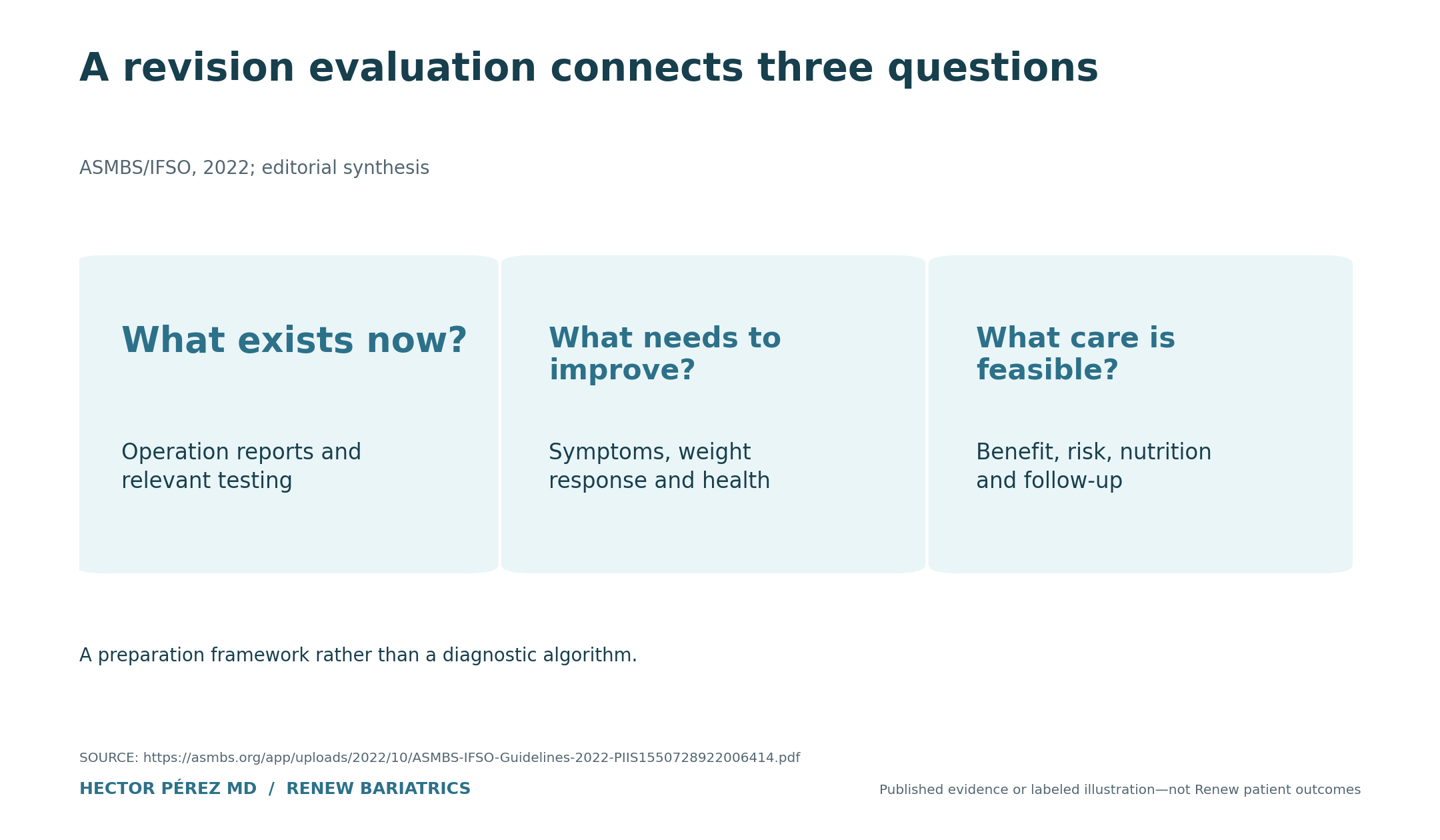
Figure data and interpretation
| Measure or group | Reported value or context |
|---|---|
| What exists now? | Operation reports and relevant testing |
| What needs to improve? | Symptoms, weight response and health |
| What care is feasible? | Benefit, risk, nutrition and follow-up |
A preparation framework rather than a diagnostic algorithm.
Why might endoscopy or other testing be discussed?
Endoscopy can inspect the upper digestive tract; other tests answer different questions about structure or function. The appropriate combination depends on the previous operation, symptoms and available records. A 2025 IFSO position statement found that symptoms alone did not reliably predict abnormal endoscopic findings. That supports careful assessment, but does not establish one testing schedule for every revision patient. Read the IFSO statement.
Ask what each proposed test is intended to resolve. Useful questions include: “Could this finding change the recommended procedure?” and “If the result is normal, what would the next step be?” Do not arrange invasive testing solely from an online checklist; the treating clinician should determine its purpose and timing.
How are treatment options compared?
The ASMBS/IFSO guideline supports assessment across surgical, medical, nutritional and psychological needs. It also recognizes several reasons for revision, including an inadequate response, weight recurrence and complications. The balance of benefit and risk is individual, especially because revision can be more complex than a first operation. See the 2022 guideline.
The discussion should connect a specific problem with a proposed response. If an option is recommended, ask how it addresses that problem, which alternatives remain reasonable, and what it will not resolve. For people with a prior sleeve, the gastric sleeve revision guide provides a starting point. People researching TORe should clarify whether their previous bypass anatomy fits that procedure.
A medication review or nutrition plan may be part of the evaluation even when another procedure remains under consideration. The OMA nutrition statement describes assessment of intake, symptoms, laboratory findings and procedure history. It is more informative than judging nutritional health from body size alone. Read the OMA assessment guidance.
Make the follow-up plan concrete
Before making a decision, ask who would review results, who would adjust medication, and who would handle new symptoms after you return home. If you travel for care, clarify how records reach your local clinician and where urgent problems would be assessed. List the practical costs of follow-up alongside procedure and travel costs. Planning for continuing care is part of an informed surgical decision. NIDDK explains the questions to consider.
Common questions
Does an evaluation mean I have agreed to surgery?
No. It is an opportunity to understand the problem and possible responses. Ask for the proposed next step in writing, including remaining uncertainty. Completing an intake form does not establish eligibility or commit you to a procedure.
Can I choose a revision from a before-and-after photo?
A photo cannot show your anatomy, nutritional condition or the reason another person received treatment. Use it to raise questions, then compare evidence and recommendations that match your circumstances.
What should I do next?
Prepare your operation history and top three questions. You can contact Renew Bariatrics through the pre-qualification form to begin a coordinator-led discussion about submitting information for clinical review. The clinical team determines what further assessment is needed.
Separate the intake process from the clinical decision
A coordinator can help gather records, explain logistics, and route questions. The clinical team determines which assessment is needed and whether a procedure is appropriate. Completing a form or receiving travel information does not mean that every medical question has been resolved.
Ask where you are in the process: information collection, preliminary review, additional testing, or a finalized recommendation. If approval is conditional, request the conditions in writing. This helps you avoid treating a preliminary discussion as a commitment to a specific operation.
If you want a direct clinical discussion, ask what format is available and how it is arranged. Do not assume that an intake appointment automatically includes a live surgeon consultation. The roles and next steps should be clear before you make major plans.
Turn a test request into a defined question
For each requested investigation, ask what the team needs to learn and how the result could change the recommendation. This makes the workup easier to understand and can prevent unnecessary duplication. The testing guide provides a more detailed framework.
Confirm whether an existing test is recent and complete enough for the intended purpose. Send the full report, including images or pathology when requested, rather than only a brief summary. A test described as normal may still leave a particular anatomical question unanswered.
Record who will review the result and how you will hear the interpretation. A result uploaded to a portal has not necessarily completed the clinical review. Ask about outstanding items before assuming that the evaluation is finished.
Explain practical barriers during assessment
If you cannot obtain an old report, afford a prescribed product, attend frequent appointments, or arrange help at home, tell the team. These are relevant facts about whether a proposed plan can be carried out. They should not be hidden to make the application appear simpler.
Ask which barriers can be addressed and which materially affect treatment suitability or timing. A different approach, referral, or preparation period may be appropriate. The recommendation should connect with the care you can realistically access.
For travel, include the route, companion arrangements, and flexibility to extend the stay if needed. A fixed itinerary should not prevent attention to a clinical finding that requires further assessment.
Compare recommendations using the same records
If you seek more than one opinion, provide the same operation history, symptoms, test results, and treatment goals. Different recommendations are difficult to interpret when the clinicians received different information.
Ask each clinician to explain the main reason for the recommendation, the important alternatives, and the uncertainty that remains. The aim is to compare reasoning, not only procedure names or prices. A willingness to offer a more extensive operation does not automatically make it a better fit.
Keep a concise written summary of the discussion. It will be useful if the plan changes or if another clinician becomes involved in follow-up.
Define what happens if revision is not recommended
Ask whether the decision means not now, not this procedure, or not in this setting. Each answer suggests a different next step. You may need further information, treatment of another issue, a different form of obesity care, or referral to a specialist center.
A decision against another operation should still address the concern that brought you to care. Persistent symptoms, weight recurrence, or poor nutrition deserve a plan even when surgery is not the appropriate response.
The guide to being declined for revision can help frame that conversation. The goal of evaluation is an informed next step, which may or may not involve another procedure.
Leave with a short action list
Write down the documents still needed, the next clinical assessment, the person responsible for each task, and the expected communication route. Include any unresolved medication or travel questions. A short, specific list is easier to use than a long collection of messages.
Update the team if symptoms, medicines, or health conditions change while the review is underway. An accurate evaluation depends on current information, not only the history supplied at the first contact.
Sources and further reading
- IFSO Position Statement on Upper Gastrointestinal Endoscopy Before and After Metabolic Bariatric Surgery (2025).
- 2022 ASMBS/IFSO Indications for Metabolic and Bariatric Surgery (2022).
- Bariatric nutrition and evaluation of the metabolic surgical patient: OMA clinical practice statement update (2024).
- Potential Candidates for Weight-loss Surgery (2020).