Reflux after gastric sleeve can cause heartburn, regurgitation, disturbed sleep, or difficulty tolerating meals. Persistent symptoms deserve assessment rather than an assumption that you must either live with them or have another operation. Treatment depends on what is causing the symptoms, how the esophagus is affected, and how well appropriate medical care works.
Seek urgent local care for severe chest or abdominal pain, vomiting blood, black stools, fainting, or inability to keep fluids down. Chest pain should not be assumed to be reflux. New or progressive difficulty swallowing also requires prompt medical assessment.
Does reflux after sleeve mean I need gastric bypass?
No. Some patients improve with medical management, and some need additional investigation or treatment of a particular anatomical problem. Conversion is considered when there is a clear reason to change the anatomy and the likely benefit justifies its risks. A history of sleeve surgery does not establish that every upper-abdominal symptom comes from acid reflux.
The SAGES guideline places medical therapy first. When reflux remains medically refractory, it considers BMI, metabolic health, and anatomy in the choice of intervention. It also recommends addressing a hiatal hernia when present; in selected situations, hernia repair may be sufficient. These are conditional recommendations with important evidence limitations.
Describe the symptom, not only the label
“Acid reflux” can mean burning behind the breastbone, liquid rising into the mouth, a sour taste, cough, chest discomfort, or food sticking. Record which experience you actually have. Note its relationship to meals, lying down and sleep, and how often it happens.
Bring the names, doses and timing of treatments you have used, including whether they helped burning, regurgitation or neither. Do not stop or alter prescribed treatment to prepare for a test unless the clinician ordering that test instructs you to do so. Some investigations require a specific medication plan.
A clear account makes the next discussion more useful: “Fluid comes into my mouth three nights a week despite my prescribed treatment” supplies more information than “My sleeve failed.” It also gives you and the clinical team a symptom to reassess after treatment.
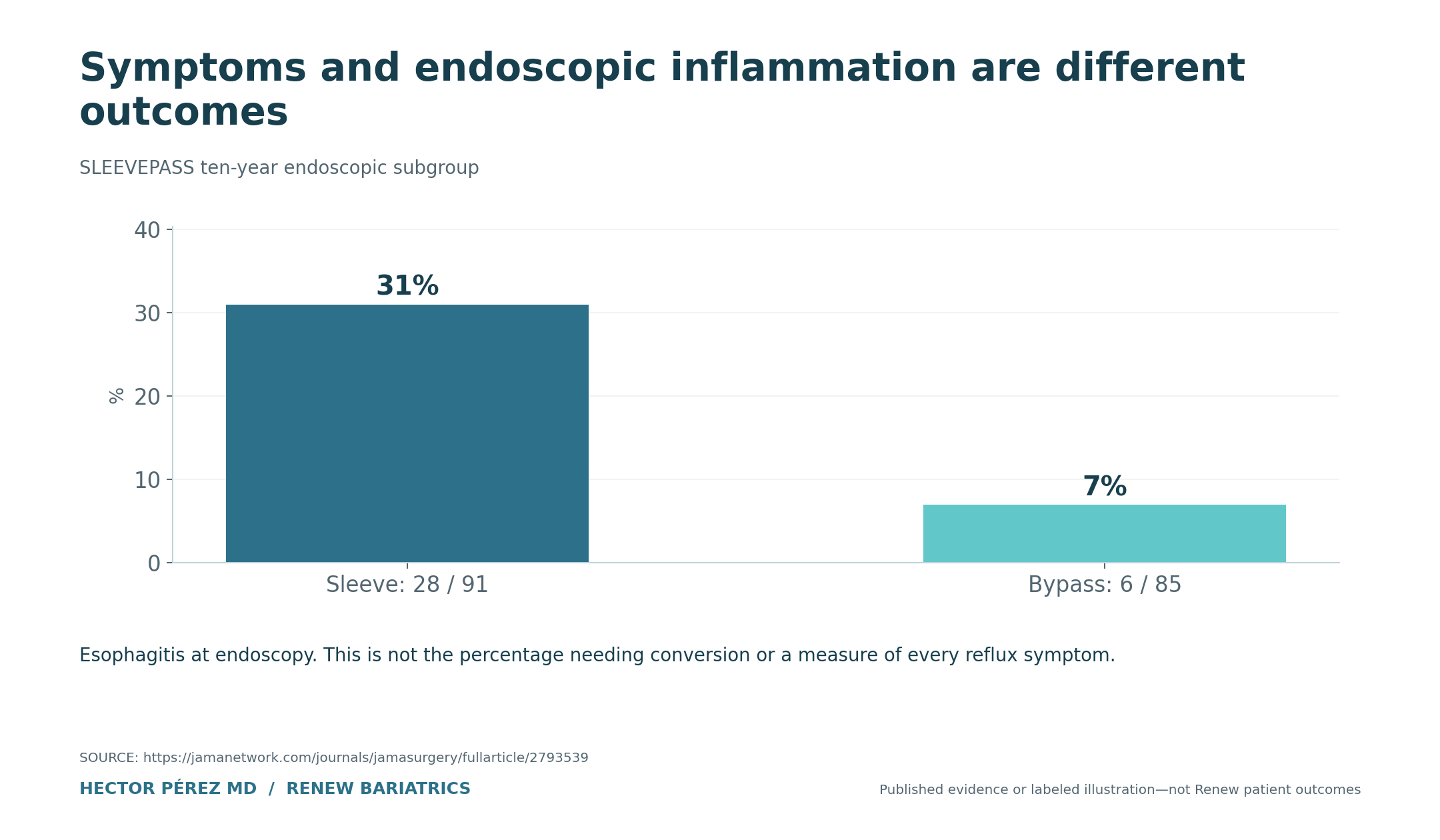
Figure data and interpretation
| Measure or group | Reported value or context |
|---|---|
| Sleeve: 28 / 91 | 31% |
| Bypass: 6 / 85 | 7% |
Esophagitis at endoscopy. This is not the percentage needing conversion or a measure of every reflux symptom.
Which tests might be useful?
Tests answer different questions. The AGA clinical practice update supports confirming the reflux mechanism and evaluating esophageal function when invasive treatment is being considered. Not every patient needs every test.
| Investigation | What it can contribute | Important limit |
|---|---|---|
| Upper endoscopy | Assessment of the esophageal lining, sleeve lumen and gastroesophageal junction; biopsies when indicated. | A normal examination does not by itself settle every reflux question. |
| Contrast study | Information about sleeve shape and the passage of swallowed contrast. | It is not a stand-alone diagnostic test for GERD. |
| Ambulatory reflux monitoring | Measurement of reflux exposure and its relationship to recorded symptoms. | The choice of test and whether it is performed on medication depend on the clinical question. |
| Esophageal manometry | Assessment of muscle function and possible motility problems. | It does not alone diagnose acid reflux. |
The ACG guideline specifically cautions against using a barium swallow alone to diagnose GERD and recommends endoscopic assessment for alarm symptoms such as dysphagia or gastrointestinal bleeding. Ask what each proposed investigation would change about treatment.
Why an endoscopy report matters even when symptoms vary
Symptoms and tissue findings are different types of information. An endoscopy may identify inflammation, narrowing or changes that need biopsy and follow-up. Keep the full report and pathology results, not only a message saying the test was “normal” or showed “reflux.”
The 2025 ASGE guideline suggests endoscopy for reflux symptoms after sleeve. It also suggests screening at three years after sleeve and then every five years in asymptomatic patients, with a different surveillance plan when Barrett’s esophagus is found. These are conditional recommendations based on very-low-quality evidence. Discuss your own interval with a clinician rather than applying a calendar rule without considering prior findings.
What is a hiatal hernia’s role?
A hiatal hernia concerns the relationship between the stomach, diaphragm and esophagus. It may be one part of the explanation for symptoms, but its presence does not make the rest of the evaluation unnecessary. The team needs to consider the hernia together with sleeve shape, reflux testing and swallowing function.
If a repair is proposed, ask whether it would be performed alone or during another procedure, what problem it is expected to solve, and what would happen if symptoms persist. If you had a previous repair, obtain that operative report as well.
When bypass conversion enters the discussion
Sleeve-to-Roux-en-Y conversion may be appropriate for selected patients with persistent, documented reflux. The review should consider whether the symptoms are actually reflux-driven, what medical treatment has been tried, the implications for weight, and the new nutritional and surgical responsibilities.
Do not assume that more weight loss is always a desired result. If you are already at a weight you wish to maintain, make that clear. Conversely, if reflux and weight recurrence are both concerns, the clinical discussion should set separate goals for each. Relief of heartburn and a change on the scale are not interchangeable outcomes.
What should happen if symptoms persist after treatment?
A good plan includes reassessment. Ask which symptoms should trigger an earlier review and how the team will distinguish persistent reflux from other causes. The possibility of additional testing should be part of informed planning rather than a surprise if the first treatment is incomplete.
Before travelling for evaluation or surgery, identify a local route for urgent care and a clinician who can assist with follow-up. Keep copies of the operative and investigation records where you can access them. These practical steps help a later clinician understand your altered anatomy quickly.
Prepare a focused review request
Collect the sleeve report, endoscopy and biopsy reports, imaging, a medication list and a short symptom history. State whether your main goal is relief of regurgitation, better swallowing, less nighttime disruption, additional weight treatment or another concern.
A Renew coordinator can help organize records for clinical review through the gastric sleeve revision service. A treatment recommendation should follow that assessment. For the broader comparison, see gastric sleeve revision options.
Keep symptom relief and esophageal findings separate
An improvement in burning does not answer every question about the esophagus, and an abnormal endoscopy does not describe how much a symptom affects daily life. Ask the clinician to explain both the symptom assessment and any objective findings. They provide related but different information when deciding whether to continue medical care or discuss an intervention.
For example, a person may report fewer symptoms after a medicine change while still needing follow-up of an earlier finding. Another may describe persistent discomfort despite a report that does not explain it. Neither situation should be reduced to a simple online diagnosis. The next investigation should address the remaining clinical question.
Keep copies of the reports rather than relying on a remembered description such as “mild reflux.” Include biopsy results when available. If a clinician recommends surveillance or another test, ask what finding it is monitoring and who will arrange it.
Read the ten-year study without turning it into a prediction
The SLEEVEPASS illustration shows esophagitis in the endoscopically assessed groups. It does not show the percentage of all sleeve patients who will need conversion. The original trial compared primary operations and excluded some patients with severe reflux and a large hiatal hernia. That study population differs from a clinic specifically evaluating difficult reflux after sleeve.
This distinction should change how you use the result. It supports taking reflux seriously during procedure selection and follow-up. It does not establish that bypass is required for every symptom or that conversion guarantees complete relief. Ask which findings make the published evidence relevant to your situation.
Also separate inflammation seen at endoscopy from Barrett’s esophagus, medication use, and symptom questionnaires. They are different outcomes. A graph labeled only “reflux rate” may conceal which one was actually measured.
Build a treatment-response record
Write down the name, prescribed schedule, and dates of treatments you have tried, along with what changed. Include whether a medicine was unavailable, difficult to tolerate, or taken differently from the instructions. This is useful clinical information, not a test of whether you followed a perfect routine.
Record which symptoms improved and which remained. “The medicine did not work” may mean no change in burning, continued regurgitation despite less burning, or an adverse effect that prevented continued use. Those histories can lead to different next questions.
Do not change doses or combine treatments based on this article. Bring the record to the clinician who manages the symptoms. If another team is considering revision, make sure it receives the same information so that recommendations are based on a consistent history.
Discuss what conversion would leave unresolved
Before an operation, ask what degree of improvement is realistic and what follow-up would remain necessary. If the team recommends bypass, it should explain both the reflux-related goal and the new nutritional and surgical responsibilities. The decision includes more than whether one symptom might improve.
Ask how persistent symptoms would be evaluated after treatment. Knowing the next step is useful even when the expected response is favorable. A clear plan avoids interpreting any residual discomfort as proof that the operation failed or that nothing further can be done.
For patients traveling for care, identify who will manage ongoing prescriptions and any recommended endoscopic follow-up near home. Use the aftercare planning guide to make those responsibilities concrete before booking.
Bring a short decision summary to the review
Prepare three sentences: what the main symptom is, what testing has shown, and what treatment has already been tried. Add the most important question you want answered. This helps keep a consultation focused when weight history and other concerns also need discussion.
If you do not have the reports, explain where the tests were performed and ask which documents are most important to obtain. Missing records should be identified openly. They should not be replaced with assumptions about what a prior clinician probably found.
Sources and further reading
- ACG Clinical Guideline for the Diagnosis and Management of Gastroesophageal Reflux Disease (2022).
- Personalized approach to the evaluation and management of gastroesophageal reflux disease (2022).
- ASGE guideline on the diagnosis and management of GERD: summary and recommendations (2025).
- SAGES guidelines for the management of comorbidities relevant to metabolic and bariatric surgery (2024).