Sleeve-to-bypass conversion changes a previous sleeve gastrectomy into a Roux-en-Y gastric bypass. It may be considered for troublesome reflux, weight recurrence, inadequate weight response, or selected complications of the sleeve. The goal of the revision determines how its likely benefits should be judged.
For someone seeking relief from regurgitation, a smaller medication burden and improved sleep may matter most. For someone seeking further obesity treatment, weight trajectory and metabolic health may take priority. A useful evaluation identifies those goals before an operation is selected.
What happens to the sleeve during conversion?
The surgeon creates a small stomach pouch from the remaining stomach and connects it to a segment of small intestine. Food takes the new route, while digestive secretions travel through another intestinal segment before joining it. This changes both the stomach outlet arrangement and the way food moves through the digestive system. The ASMBS bypass overview explains the reconstruction and its tradeoffs.
The original sleeve removed stomach tissue. Conversion does not replace that tissue or restore a normal, unoperated stomach. It also introduces intestinal connections and their associated considerations. Ask the clinical team to explain your planned anatomy using your own operation report and test findings rather than a diagram of a first-time bypass alone.
Why is bypass discussed for reflux after sleeve?
The sleeve and bypass have different pressure and flow characteristics. Conversion can reduce reflux exposure for selected patients, but symptoms should first be assessed and treated appropriately. Reflux-like discomfort can overlap with problems that a conversion would not necessarily resolve.
The SAGES guideline suggests conversion to RYGB for medically refractory reflux after sleeve in patients with BMI above 35. Decisions at lower BMI are more individualized. This is conditional guidance informed by limited evidence, not a universal eligibility rule or an instruction to stop medical treatment.
A hiatal hernia may also need attention. Your review should distinguish whether the proposed benefit comes from changing the sleeve, repairing a hernia, or both. See the reflux assessment guide for more about testing.
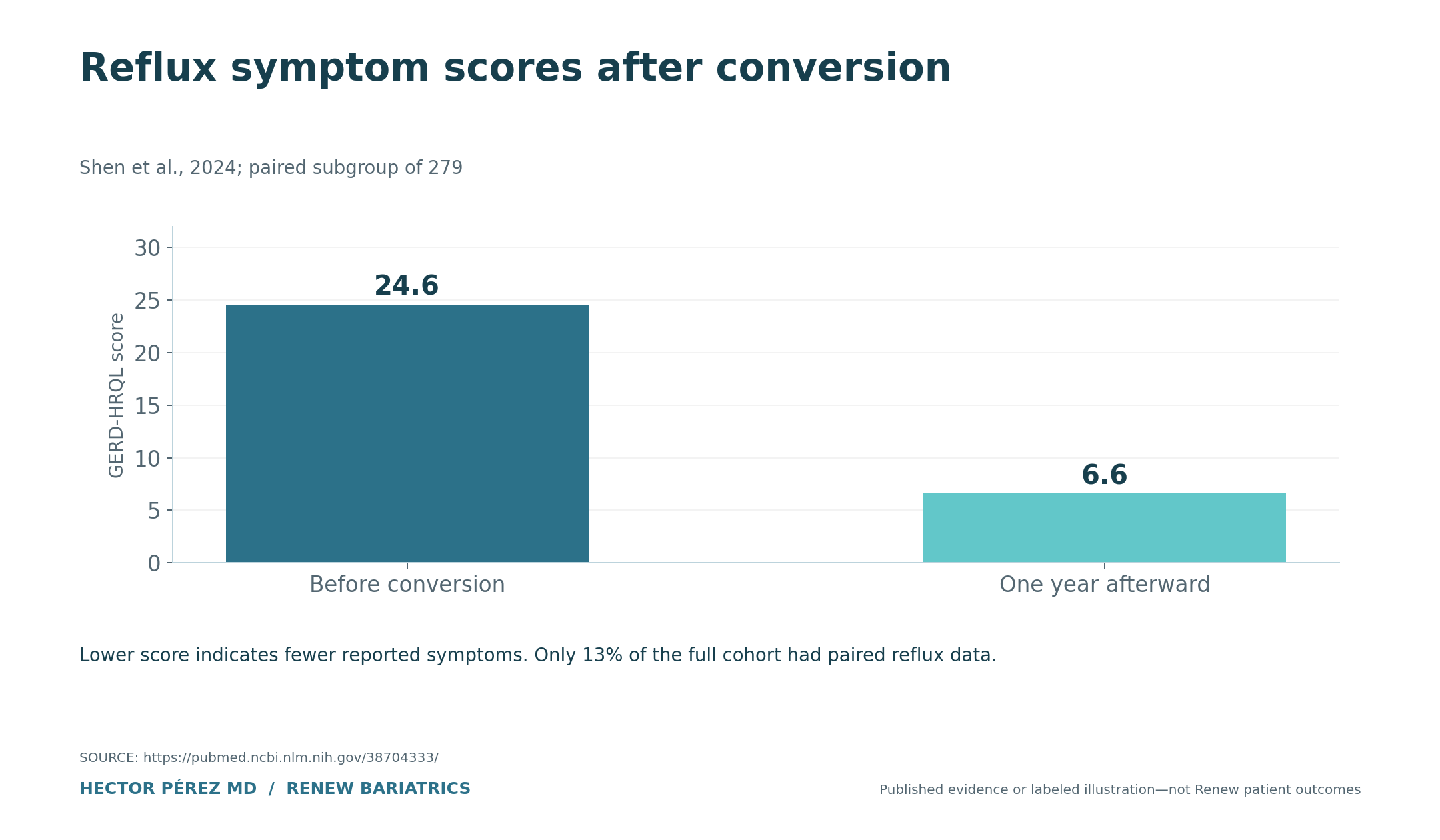
Figure data and interpretation
| Measure or group | Reported value or context |
|---|---|
| Before conversion | 24.6 GERD-HRQL score |
| One year afterward | 6.6 GERD-HRQL score |
Lower score indicates fewer reported symptoms. Only 13% of the full cohort had paired reflux data.
What outcomes should you expect?
A study average cannot promise that every patient will stop reflux medication or achieve a specified weight. The 2024 Michigan conversion study is one of the sources examined in our dedicated evidence review.
Our sleeve-to-bypass research review explains the numbers and their denominators. Those are published study results, not Dr. Perez’s personal results. Ask separately what documented experience the treating team can share for patients with an indication and health profile similar to yours.
How do the risks differ from a first-time bypass?
Scar tissue and altered anatomy make conversion a different operation from primary gastric bypass. In a 2023 MBSAQIP study, 30-day serious complications occurred in 7.2% of 13,432 sleeve-to-bypass patients versus 5.0% of 84,543 primary bypass patients. Mortality was about 0.1% in both groups, without a statistically significant difference. These registry averages describe specific populations and outcome definitions; they are not an individual risk estimate.
Discuss bleeding, leakage, infection, clots, readmission, and possible further intervention. Long-term discussions should cover problems such as ulcers, intestinal obstruction, internal hernia, food intolerance, and nutrient deficiencies. The relevant risks depend on your health, medications, smoking or nicotine exposure, prior abdominal operations, and the details of the proposed reconstruction.
Bring a complete medication list, including nonprescription pain medicines and supplements. Do not change a prescribed medication on the basis of website guidance. The team needs to assess how your medicines fit the preoperative and postoperative plan.
Weight loss and reflux relief are separate endpoints
It is possible for symptoms and weight to change by different amounts. Define what additional weight loss means from the weight immediately before conversion, not only from your highest lifetime weight. If the primary reason is reflux and substantial weight loss would be undesirable, that needs an explicit discussion.
If weight recurrence is the main reason and reflux is absent, ask how bypass compares with other reasonable options for your circumstances. Those may include obesity medication, SADI-S conversion, or selected approaches directed at the sleeve itself. A list of options does not mean each is appropriate or available for every patient.
Recovery is a sequence, not a return-flight date
Your individual instructions should cover fluid intake, food progression, activity, medications, wound care, and symptom monitoring. A previous easy recovery from sleeve does not establish how you will recover from conversion. Arrange work, caregiving, travel and access to local care around the plan supplied by your treating team.
Ask who receives a call about a problem during the first week, who reviews progress after you leave, and what happens if local testing is needed. An itinerary describes logistics; it does not establish that you are medically ready to travel.
What continuing care will I need?
Bypass requires ongoing attention to nutrition and laboratory monitoring. The OMA clinical practice statement supports follow-up and supplementation matched to the procedure and laboratory findings. A normal result at one visit does not eliminate the need for later monitoring.
Build the follow-up plan before surgery: who orders testing, who interprets it, how deficiencies are treated, and who handles weight recurrence or persistent reflux later. If you have previously struggled to access supplements or attend follow-up, tell the team so that the care plan addresses those barriers.
Can I have this revision if my sleeve was done elsewhere?
Previous surgery elsewhere does not replace the need for a new assessment. Obtain your operative report, discharge summary, relevant endoscopy and imaging reports, and information about any leaks, strictures, hospital admissions, or subsequent procedures. If a record is missing, tell the coordinator rather than guessing at the operation details.
For review through Renew, use the gastric sleeve revision page and ask a coordinator to organize your records for clinical assessment. The next step is a decision about suitability and needed testing, not a promise that conversion will be recommended.
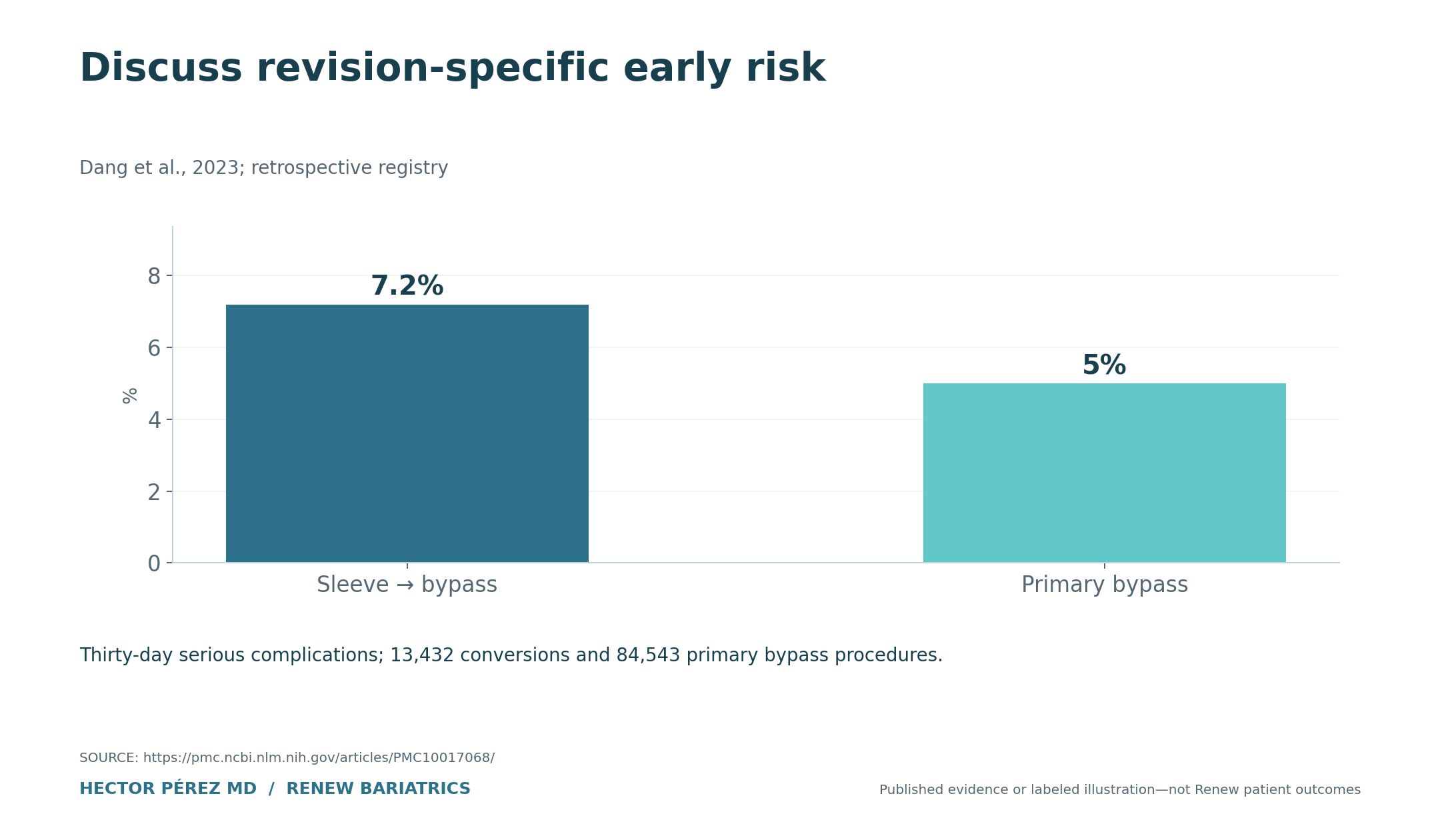
Figure data and interpretation
| Measure or group | Reported value or context |
|---|---|
| Sleeve → bypass | 7.2% |
| Primary bypass | 5.0% |
Thirty-day serious complications; 13,432 conversions and 84,543 primary bypass procedures.
Confirm what the evaluation has established
Before choosing conversion, ask which findings are documented and which remain uncertain. A symptom history, endoscopy, imaging, and prior operative report can answer different questions. The team should explain how those pieces support the recommendation.
If reflux is the main concern, distinguish persistent symptoms despite appropriate care from a symptom that has not yet been fully evaluated. The treatment history should include the medicine, prescribed schedule, response, and any difficulty obtaining or tolerating it. Do not change treatment to test the diagnosis on your own.
If weight recurrence is the main issue, bring the trajectory and previous medical treatment. Current weight alone does not explain why the sleeve response changed. The recommendation should account for both anatomical and nonanatomical contributors.
The Michigan study separates benefit from follow-up completeness
The reflux-score graphic shows improvement in the subgroup with paired measurements. Only 279 of the full 2,133-patient cohort contributed paired reflux and medication data. That denominator limits how confidently the subgroup average can be generalized to every patient who underwent conversion.
The weight analysis used another subgroup, with 380 patients providing data. It would be wrong to present the weight and reflux findings as if both were measured in the entire cohort. It would also be wrong to add the subgroup percentages together as though the groups could not overlap.
These limitations do not erase the observed improvements. They show why the result should support a nuanced discussion rather than a promise that everyone stops medication or loses a specified amount. The research review examines the methods in more detail.
Compare symptom benefit with the consequences of new anatomy
Conversion creates a bypass configuration and its ongoing responsibilities. If the primary aim is relief from reflux, ask how the potential benefit is balanced against nutritional monitoring and other risks of bypass. A favorable symptom outcome does not make those additional considerations disappear.
Ask what the operation is expected to change about regurgitation, medication needs, food tolerance, and weight. These outcomes may move by different amounts. If substantial additional weight loss would be undesirable, discuss that explicitly.
Also ask what would happen if symptoms persist. Further assessment may be needed rather than an assumption that the operation completely failed. A clear postoperative pathway is part of an informed decision.
Primary bypass statistics do not fully describe conversion
The registry graphic compares conversion with first-time bypass and reports a higher observed rate of serious early complications in the conversion group. The comparison is not randomized, and patient characteristics can differ. It is still useful evidence that the two clinical situations should not be treated as identical.
Ask the surgeon which features of your history affect the risk discussion beyond the procedure label. Prior complications, other abdominal operations, nutritional condition, and the reason for conversion can all be relevant to the assessment.
Clarify which outcomes are included in a safety percentage and how long they were observed. A 30-day report cannot establish every later nutritional, ulcer-related, or intestinal complication. Consent should address the longer course of care as well.
A hiatal hernia may require a separate explanation
If the team identifies a hernia, ask how it contributes to the symptoms and what treatment is proposed. The benefit of a combined operation may involve both reconstruction and hernia repair. Understanding the components helps you interpret the recommendation and the recovery plan.
Ask what would favor hernia-focused treatment, conversion, or another approach in your case. The answer depends on findings and the broader clinical picture rather than a universal rule that every hernia after sleeve needs the same operation.
Keep the relevant test reports so local clinicians can understand what was found and treated. The final operative report should document the actual procedures, not simply state bariatric revision.
Compare SADI-S and other options only when they address the same goal
SADI-S conversion retains a sleeve in the food pathway and changes intestinal routing differently from Roux-en-Y bypass. It should not be treated as an interchangeable alternative for every reflux problem. Ask how existing symptoms influence the recommendation.
If further obesity treatment is the main goal, the discussion may also include medication and selected other approaches. A higher average weight loss from a different study does not by itself settle the choice. The populations, indications, and nutritional consequences need to be comparable.
Ask which option offers the best balance for the problem being treated, and what it would leave unresolved. That question is more useful than ranking operations by a single percentage.
Prepare nutrition before changing the anatomy again
Bring laboratory results, supplement details, current intake, and any earlier deficiency treatment. If you struggle to tolerate food or have persistent vomiting, the team should know before prescribing a preparation diet or finalizing the operation.
Ask whether any issue needs correction first and how readiness will be reassessed. A plan to optimize nutrition should name the responsible clinician and the next review. Body weight alone does not prove adequate nutritional status.
After conversion, the follow-up should reflect bypass anatomy rather than simply reuse the old sleeve instructions. Identify local laboratory access and a clinician who will act on results. The nutrition guide helps organize that discussion.
Medication planning needs coordination across teams
Provide every prescription, injection, supplement, and nonprescription product. Ask the prescriber and anesthesia team to resolve any conflicting instructions. Do not stop medicines simply because another patient’s surgery schedule required it.
For GLP-1 treatment, include dose escalation and digestive symptoms as well as the last dose. The medication article explains why individualized planning is important. The clinical team should provide the actual instructions for your procedure.
Ask who manages medicines after discharge as intake changes and how prescriptions will be obtained at home. A clear handoff reduces the risk of two offices working from different medication lists.
Recovery should have milestones and a contingency plan
Ask which activities are permitted, what remains restricted, and when reassessment occurs. Describe work, commuting, lifting, and caregiving responsibilities. An estimated return date is more useful when it is connected to those tasks.
Confirm the route for symptoms during the local stay and after returning home. If urgent assessment is needed, do not wait for a routine coordinator reply. Keep the procedure summary and clinical contacts accessible.
Discuss flying separately from hospital discharge and package duration. The travel guide includes the public-health guidance that should be considered before booking a return flight. Allow for a longer stay when clinically necessary.
End the evaluation with a written decision summary
Record the main indication, the findings supporting conversion, alternatives considered, important risks, and the continuing care plan. Include any conditions still attached to approval. This summary helps if you seek another opinion or coordinate local follow-up.
If the recommendation changes after additional testing, ask for the reason and updated expectations. A conversion should not be treated as inevitable simply because it was the first option discussed.
The Renew application can begin record collection for clinical review. Provide the original sleeve report and your main concern so the team can identify the information needed for a useful recommendation. ## Additional questions about conversion outcomes
Does stopping reflux medicine prove that conversion was successful?
It can be one useful outcome, but it is not the only one. Symptoms, objective findings, food tolerance, nutrition, and the original treatment goal also matter. Medication changes should be made with the treating clinician, not used as a self-directed test of whether the operation worked. Ask how the complete result will be assessed over time.
What if my main concern is reflux at a lower BMI?
The decision requires individualized assessment of symptoms, findings, medical treatment, and alternatives. A BMI threshold from a general eligibility page does not settle the treatment of a complication. Ask the clinician to explain how the guideline and evidence apply to your specific situation and what options remain reasonable.
Can I expect the same weight loss as someone having their first bypass?
Not automatically. Conversion starts from a different anatomy and weight history and may have a different indication. Ask for results measured from the appropriate conversion baseline and relevant patient population. A first-time bypass average should not be presented as a promise of additional loss after sleeve.
What should I keep after the operation?
Retain the original sleeve report, the conversion report, important test results, and the current nutrition and medication instructions. Future clinicians need the full sequence to interpret symptoms and plan care. A short accessible summary is useful for urgent visits, while the complete records support detailed follow-up and any later specialist assessment.
Sources and further reading
- Conversion of Sleeve Gastrectomy to Roux-en-Y Gastric Bypass: Indications, Prevalence, and Safety (2023).
- Conversion of sleeve gastrectomy to Roux-en-Y gastric bypass: impact on reflux and weight loss (2024).
- SAGES guidelines for the management of comorbidities relevant to metabolic and bariatric surgery (2024).
- Bariatric nutrition and evaluation of the metabolic surgical patient: Update to the 2022 OMA clinical practice statement (2024).
- Roux-en-Y Gastric Bypass.
Care, in patients’ words
Patient experiences relevant to this guide
David H.
Sleeve-to-bypass revision
Describes bypass revision after problems with an earlier sleeve.
Selected patient accounts published by Renew Bariatrics. Procedures are labeled for each account; individual experiences and results vary.