Lap-Band removal and conversion are related but different decisions. Removal takes out the device. Conversion adds another bariatric operation, most often a sleeve gastrectomy or Roux-en-Y gastric bypass. Whether both happen together depends on the condition of the stomach, the reason for removal and the proposed next procedure.
Renew Bariatrics currently evaluates band conversion to either sleeve or Roux-en-Y bypass. A surgeon’s review determines suitability and whether treatment should occur in one or two stages. That review is particularly important when there has been erosion, significant reflux, repeated vomiting or an earlier attempt at removal.
Removal alone may answer a different question
A patient seeking relief from band-related symptoms may first need to understand what removal can accomplish. A patient concerned about future weight control also needs a longer-term obesity-treatment plan. Those conversations overlap, but one should not replace the other.
Ask which symptoms are believed to come from the band, what evidence supports that conclusion, and whether another condition needs investigation. Describe symptoms in practical terms: which foods are difficult, whether liquids pass normally, how often regurgitation occurs and whether the problem is worsening.
Choosing between sleeve and gastric bypass
A sleeve removes part of the stomach, while Roux-en-Y creates a pouch and reroutes part of the intestine. Both are substantial changes after band removal. The team should consider your reflux history, current anatomy, health conditions, weight response to the band and ability to maintain long-term nutritional follow-up.
A procedure that worked well for another former band patient is not automatically the right match for you. Someone whose main concern is severe reflux may need a different conversation from someone whose band produced little weight loss without reflux. Read the separate guides to gastric sleeve and gastric bypass before discussing conversion.
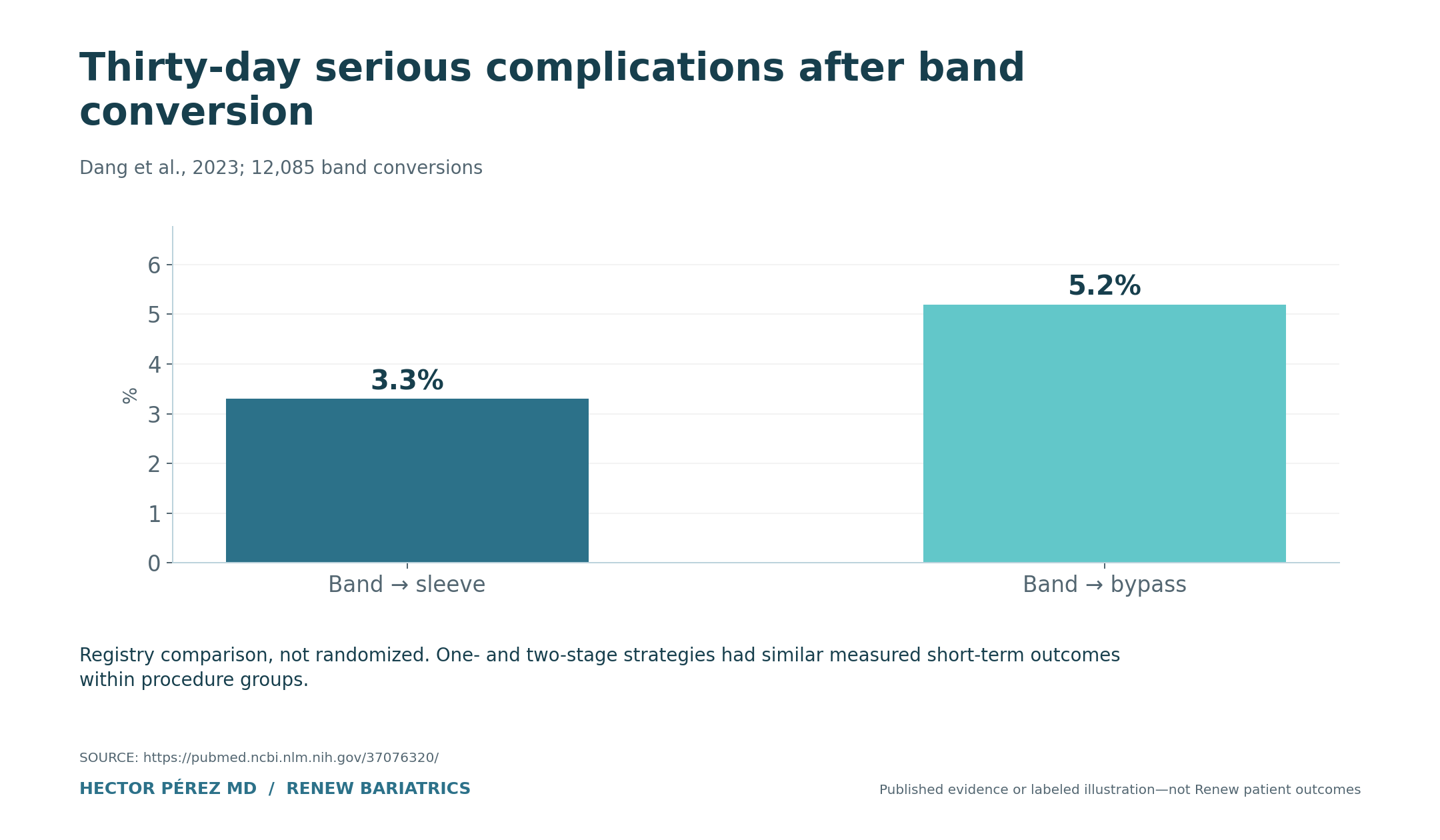
Figure data and interpretation
| Measure or group | Reported value or context |
|---|---|
| Band → sleeve | 3.3% |
| Band → bypass | 5.2% |
Registry comparison, not randomized. One- and two-stage strategies had similar measured short-term outcomes within procedure groups.
What does research say about short-term safety?
A US registry analysis included 12,085 band conversions to sleeve or bypass. Serious complications within 30 days occurred in 3.3% of sleeve conversions and 5.2% of bypass conversions. Within each procedure group, the researchers did not find a difference between one- and two-stage conversion. These observational results cannot identify the best operation for an individual and do not compare long-term reflux control or weight outcomes. Read the study abstract.
When evaluating a number like this, ask what it counts, how long patients were followed and whether the patients resemble you. A 30-day complication study cannot answer whether you will tolerate food well five years later. Nor does a lower group average mean that a procedure fits an unhealthy or unsuitable stomach.
One stage or two stages?
In one-stage treatment, the band is removed and the new operation is completed during the same procedure. In two-stage treatment, removal occurs first and conversion is reconsidered or performed after a separate interval. A staged plan may be chosen because of tissue condition or a complication, rather than because the team expects it to produce more weight loss.
A multicenter study of 832 band-to-bypass conversions illustrates this selection issue: patients treated in two stages more often had technical band problems, including slippage or erosion. Comparing the groups without considering those differences can be misleading. See the cohort methods and results.
Before surgery, ask whether the proposed one-stage plan could change once the surgeon sees the tissue, what circumstances would lead to stopping after removal, and how a second stage would be organized. Knowing that possibility in advance is more useful than expecting a single fixed pathway.
Records that make a band review more useful
Collect the date and location of band placement, the device type if known, adjustment history, prior imaging and endoscopy results, and reports of any emergency visits or operations. If the band has already been removed, send that operative report as well as the original placement report.
A concise symptom timeline helps connect the records. Note whether symptoms changed after deflation, a previous procedure or a period of weight change. State your present priorities clearly: improved food tolerance, reflux relief, further obesity treatment or several of these together. The revision evaluation guide provides a practical starting point.
Recovery depends on what was actually done
Removal alone, removal with sleeve and removal with bypass should not share one automatic recovery schedule. Ask for written instructions covering food progression, hydration, medication use, activity and follow-up. If you are traveling, confirm the expected stay and who will assess new symptoms after returning home.
Repeated vomiting, inability to drink, severe pain or bleeding should not be treated as normal band behavior while waiting for an elective appointment. Seek prompt local care when these occur.
Frequently asked questions
Can I have a sleeve if my band was removed years ago?
Possibly, but elapsed time does not establish suitability. The removal history and current stomach anatomy still need review. An old operation remains relevant even when the device is no longer present.
Does band removal reverse every change?
Removing the device does not guarantee that every symptom resolves or that the stomach behaves exactly as it did before placement. Ask what follow-up is planned if symptoms persist.
How do I arrange a review?
A Renew coordinator can explain record submission for clinical review and provide current logistical information. Request a procedure-specific quote after the treatment plan is defined; removal alone and conversion are different services.
Patient experience after a previous band
Tammy M.
“I want to Thank Dr. Perez and his team for giving me a new start.”
Context: Gastric sleeve following prior Lap-Band removal.
Patient excerpt published by Renew Bariatrics; Google review, 2025. Read the published source.
Renew labels Tammy’s account as gastric sleeve following earlier Lap-Band removal. It is a patient experience of care, not comparative evidence for one-stage versus two-stage conversion or a procedure complication rate.
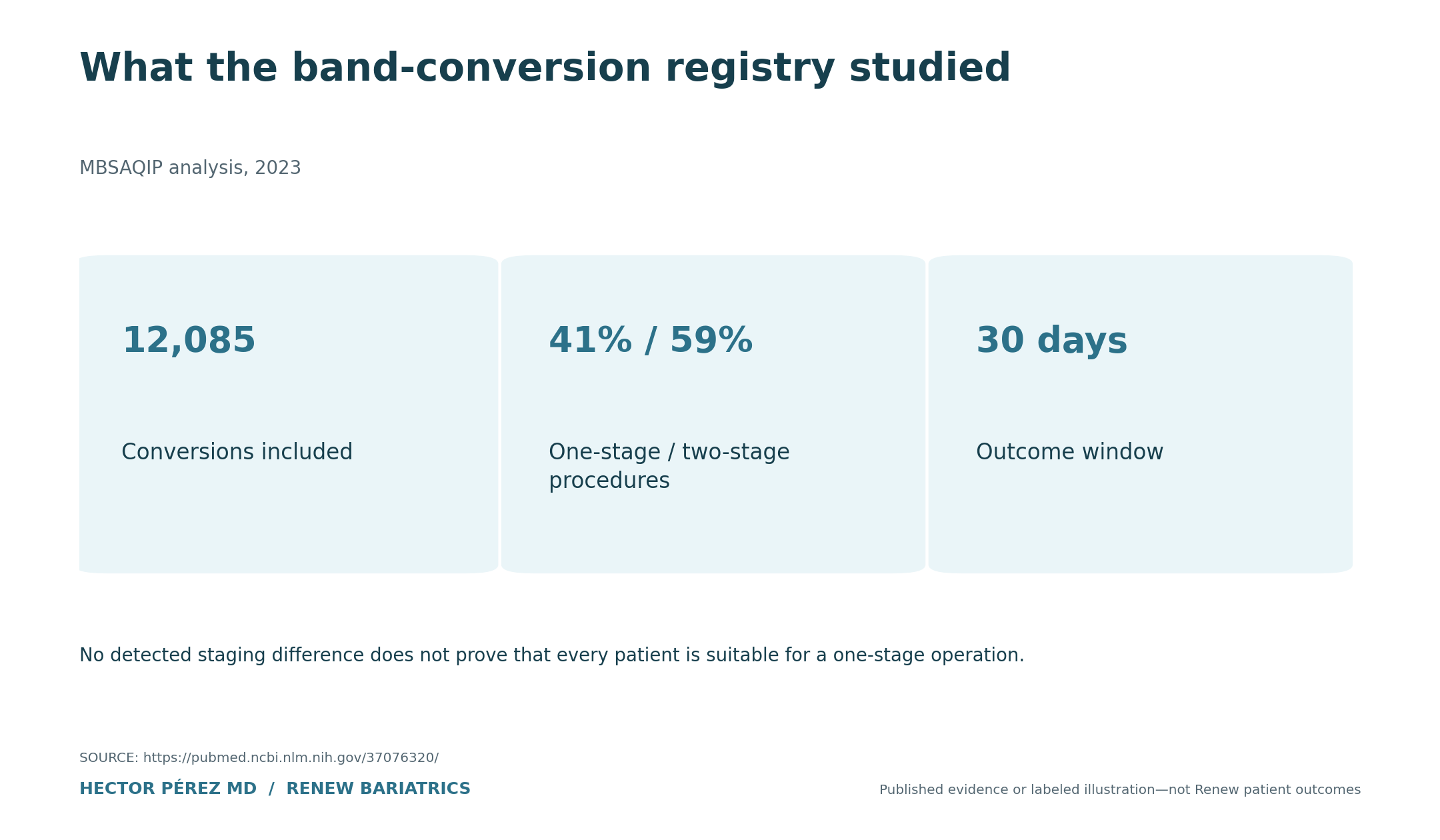
Figure data and interpretation
| Measure or group | Reported value or context |
|---|---|
| 12,085 | Conversions included |
| 41% / 59% | One-stage / two-stage procedures |
| 30 days | Outcome window |
No detected staging difference does not prove that every patient is suitable for a one-stage operation.
Clarify why the band is being removed
The reason for removal can influence the timing and choice of another treatment. Describe reflux, regurgitation, food intolerance, pain, weight response, and any known band-related findings. A request to replace the band should not bypass assessment of the problem that prompted removal.
Bring the original band records, adjustment history when available, and reports from endoscopy or imaging. If you do not know the device details, explain where the original procedure was performed. The clinical team can identify which information is necessary.
Persistent vomiting, inability to maintain fluids, bleeding, or severe pain requires timely clinical assessment rather than waiting for an elective conversion discussion. The immediate problem may need to be addressed before the longer-term weight plan.
One-stage and two-stage conversion answer a timing question
A one-stage approach combines band removal and the next operation in one treatment episode. A staged approach separates them. The appropriate choice depends on clinical findings and the proposed conversion, not just the convenience of one trip or one recovery period.
Ask what would make the surgeon prefer staging in your case and what the interval would accomplish. Also ask how symptoms, nutrition, and weight management would be handled between procedures. A staged plan should have a clinical rationale and a clear reassessment process.
If the plan cannot be finalized until evaluation or operative findings are available, ask how that uncertainty is handled in consent and financial arrangements. You should understand the possible paths before making logistical commitments.
Interpret the registry evidence by procedure group
The 12,085-patient analysis compared observed outcomes in band-to-sleeve and band-to-bypass conversions and examined staging within those groups. It found similar measured short-term outcomes between one- and two-stage strategies within the procedure cohorts. That is not proof that staging is irrelevant for every individual.
The groups were not randomly assigned, and clinical selection can affect who receives each approach. The study also focused on 30-day outcomes. It does not settle every question about later reflux, weight response, nutrition, or another procedure.
The serious-complication graphic compares the two conversion types within that registry. It should not be used as the sole reason to select sleeve or bypass. The operation must also address the symptoms, anatomy, and health goals that led to conversion.
Choosing sleeve or bypass involves more than short-term risk
Discuss existing reflux and food tolerance before deciding between the options. Ask what each procedure is expected to do about those concerns and what it would leave unresolved. A patient whose main problem is reflux may face a different balance from one whose main concern is weight response.
The operations also differ in anatomy and nutritional follow-up. Sleeve removes stomach tissue while preserving the intestinal route. Roux-en-Y bypass changes the path of food through the intestine. Ask the clinician to explain the consequences in practical terms.
A comparison should include continuing medical treatment and the possibility that another operation is not appropriate at the same time. The useful goal is a workable long-term plan, not simply replacing one device with the most familiar procedure name.
Removal alone and conversion are different treatment decisions
Ask whether removal is needed to treat a problem independently of the decision about another bariatric operation. If so, clarify what benefit removal is intended to provide and how future weight management will be addressed afterward.
Do not assume that band removal restores every aspect of the situation before the original operation or guarantees a particular weight trajectory. The clinical team should explain the expected changes and uncertainties for your history.
If you prefer time to consider the next step, discuss that openly. A decision can be staged for clinical reasons, and the evaluation should also allow you to understand the alternatives before consenting to a new anatomy.
Evaluate intake and nutrition before conversion
Long-standing food intolerance or vomiting can affect nutritional preparation. Describe what you can eat and drink, what causes difficulty, and any known deficiencies. Bring laboratory results and supplement details rather than assuming that a high body weight rules out a nutrition problem.
Ask what needs treatment before the next operation and who will manage it. If a preparation diet is prescribed, it should account for your current tolerance and medical conditions. Do not substitute an online plan that ignores the problems associated with the band.
The preoperative diet guide explains why existing anatomy and symptoms matter. Its purpose is to support a discussion with the team, not provide a universal menu.
Coordinate medicines and anesthesia for each stage
Provide the full medication list, including injections, blood thinners, supplements, nicotine, and cannabis. If treatment is staged, confirm whether instructions need to be reviewed again before the second procedure. Changes in health or medicines between stages should be reported.
Ask the prescribing and anesthesia teams to reconcile any conflicting instructions. A coordinator can help route the question but should not be the only source of a clinical medication decision. Do not stop treatment based on another patient’s preparation schedule.
Keep the final instructions with the relevant procedure date. If scheduling changes, ask for updated diet, fasting, and medication guidance rather than assuming every instruction shifts automatically.
Plan recovery around the procedure actually performed
Band removal alone, removal with sleeve, and removal with bypass do not have identical recovery requirements. Ask for written instructions tied to the treatment you receive. If the plan changes, request updated guidance before discharge.
Describe lifting, work, commuting, and caregiving responsibilities during preparation. Arrange help with tasks that conflict with the restrictions. A previous easy recovery from band placement does not establish how a later conversion will proceed.
Confirm transport and supervision requirements after anesthesia. If you intend to travel alone, discuss the entire plan early rather than relying on a general statement that companions are optional.
Include the interval and contingency costs in a quote
For a staged plan, ask whether the estimate covers both procedures, both evaluations, and the travel associated with each visit. Clarify what happens if the second procedure is delayed or the recommendation changes after removal.
For either strategy, ask about additional hospital care, extra accommodation, local follow-up, and treatment of unexpected problems. A single advertised conversion price may not describe every service required for an individual case.
The quote comparison guide helps put those assumptions in writing. Clinical suitability should guide the strategy, while transparent costs help you implement the plan responsibly.
Keep the complete sequence for future care
After treatment, obtain the removal and conversion reports and retain them with the original band history. Future clinicians may need to understand both the earlier device and the final anatomy. A brief note saying revision may not provide enough detail.
Arrange nutrition monitoring and symptom follow-up for the new procedure. Ask who will review results near home and how the original team will communicate if a problem arises. The care plan should continue after the last trip or incision check.
When contacting Renew, include the reason for band removal, current symptoms, and available records. The team can then identify the appropriate assessment rather than treating every band conversion as the same scheduling request. ## Additional questions about band conversion
Does the registry prove that one stage is always as safe as two?
No. It reports observed short-term outcomes in selected patients, without random assignment. A lack of a detected difference does not remove the need to consider tissue condition, symptoms, and other findings. Ask why the proposed staging fits your case and what would lead the surgeon to change the plan.
Can removal and conversion have different goals?
Yes. Removal may address a device-related problem while conversion addresses longer-term obesity treatment. Ask the team to explain each goal separately. This is useful when deciding whether they should occur together and how care would continue if the second step is delayed or not recommended.
What should I ask if I cannot tolerate many foods already?
Describe the specific foods, symptoms, frequency, and effect on fluids and nutrition. Bring previous investigations and deficiency treatment. The team may need to assess the problem before choosing a preparation diet or another operation. Do not assume that a conversion automatically resolves every reason for poor tolerance without identifying the cause.
How can I compare two different staging recommendations?
Give both clinicians the same records and ask each to explain the clinical reason, expected benefit, risks, and interval plan. Different recommendations may reflect different findings, interpretations, or capabilities. Comparing those reasons is more informative than choosing whichever plan requires fewer trips or appears easier to schedule.