Mini gastric bypass, also called one-anastomosis gastric bypass (OAGB), creates a long stomach pouch connected to a loop of small intestine. The word “mini” refers to the different reconstruction; it does not mean a minor operation, minimal risk or minimal aftercare. Like other bypass procedures, it changes digestion and requires continuing nutritional monitoring.
Renew Bariatrics lists primary OAGB as a service. Confirm the proposed surgeon, procedure and location during clinical review. The existence of a program page does not establish that every surgeon performs that operation or that it is appropriate for every patient.
OAGB and Roux-en-Y are different operations
OAGB uses one connection between the stomach pouch and small intestine. Roux-en-Y gastric bypass creates a different arrangement with a separate connection where digestive juices rejoin the food stream. Both bypass part of the upper digestive tract, but their anatomy and potential complications are not identical.
Ask which operation is on your treatment plan and consent form. A generic label such as gastric bypass can obscure a meaningful difference. The team should be able to describe the proposed reconstruction, its intended benefits and the follow-up it requires in terms you can use with your local clinician.
What the YOMEGA trial found
YOMEGA randomized 253 patients to OAGB or Roux-en-Y. At five years, OAGB met the trial’s noninferiority criterion for excess BMI loss in the per-protocol analysis. Clinical reflux was reported in 27 of 66 assessed OAGB patients and 14 of 76 assessed Roux-en-Y patients. Overall, 68% of the original participants were followed at five years. Severe reflux, Barrett’s esophagus and previous bariatric surgery were exclusion criteria, limiting application to those groups. Read the five-year report.
“Noninferior” means the weight-loss result met a prespecified statistical boundary. It does not mean that the procedures were identical across reflux, nutrition or other outcomes. Excess BMI loss is also different from total body-weight loss; the measures should not be exchanged in a comparison.
The trial’s earlier two-year report found more nutritional adverse events with the OAGB configuration studied. That operation used a particular bypassed-limb length, so the findings should not be generalized to every technical variation without qualification. See the original randomized trial.
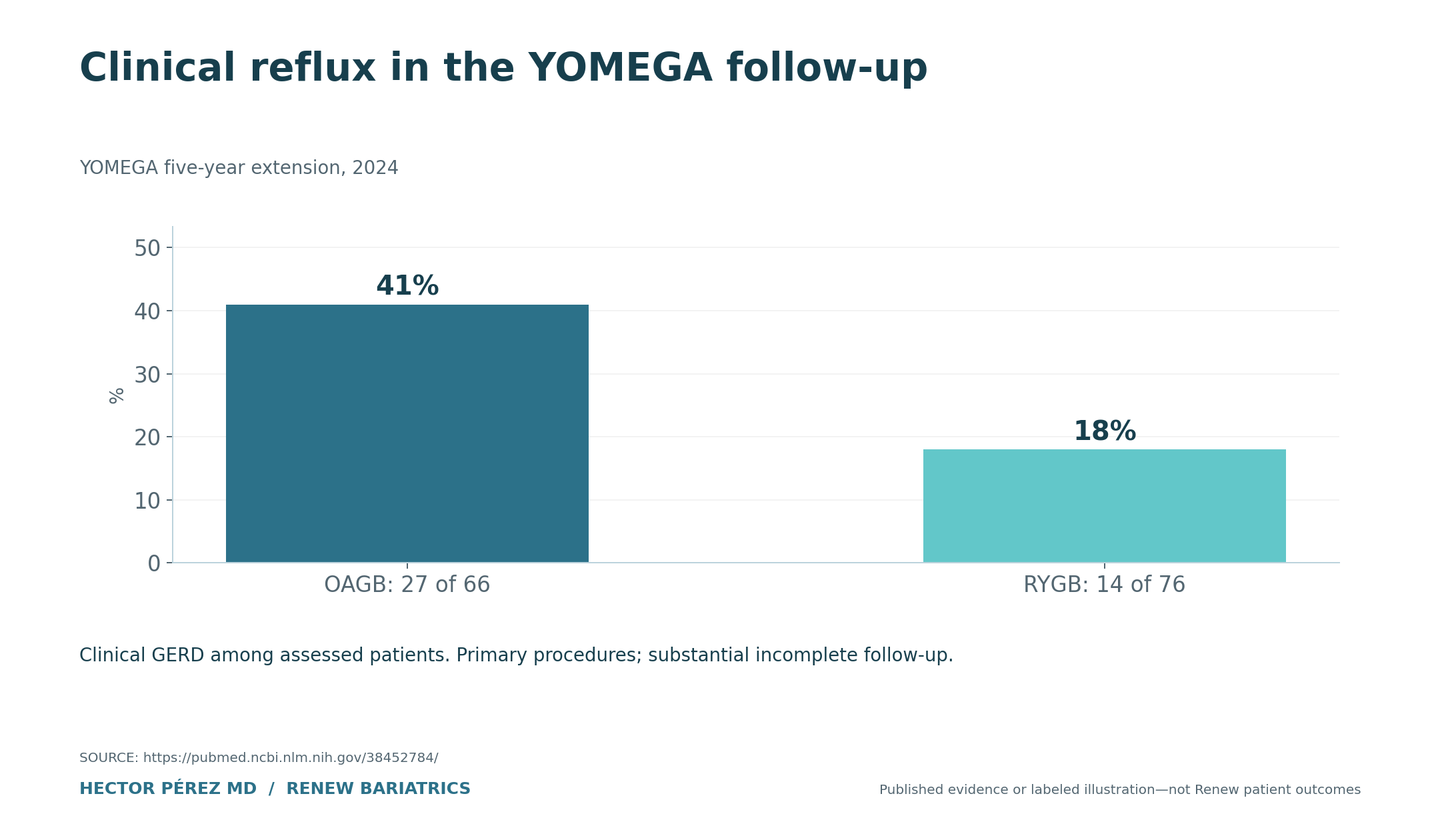
Figure data and interpretation
| Measure or group | Reported value or context |
|---|---|
| OAGB: 27 of 66 | 41% |
| RYGB: 14 of 76 | 18% |
Clinical GERD among assessed patients. Primary procedures; substantial incomplete follow-up.
Reflux needs a specific conversation
Tell the team about heartburn, regurgitation, symptoms at night, swallowing difficulties and any previous endoscopy. The question is not only whether you currently take an acid-reducing medicine. Symptoms and findings may change which operation is recommended.
If you already have OAGB and have persistent reflux or poor intake, seek assessment of the cause rather than assuming another bypass will fix it. Conversion from OAGB to Roux-en-Y is a separate specialist topic. Renew’s current service page states that surgical bypass revision and reversal are not offered.
Weight loss is only one outcome to compare
A useful decision should also consider food tolerance, reflux, nutrition, bowel symptoms, medication needs and the possibility of further treatment. Ask what the team expects to improve in your case and which outcomes remain uncertain. If a comparison mentions a large percentage of weight lost, ask about the starting point, measurement and follow-up time.
Personal priorities belong in the discussion. Someone especially concerned about reflux may weigh the tradeoffs differently from someone whose main priority is metabolic improvement. Neither preference can substitute for the clinician’s assessment, but both should inform it.
Plan the follow-up before surgery
Confirm the written supplement plan, laboratory schedule, nutrition support and clinician responsible for interpreting results. Consider the ongoing costs and whether testing is realistically accessible near home. If a result is abnormal, ask how it will be corrected and when it will be checked again.
Discuss surgical risks, including bleeding, leakage, infection, blood clots and anesthesia-related problems, as well as longer-term nutritional or digestive concerns. Ask for an emergency pathway after discharge. Severe abdominal pain, repeated vomiting with inability to drink, bleeding or breathing difficulty should receive urgent local assessment.
Frequently asked questions
Does one connection automatically make OAGB safer?
No. The number of connections describes anatomy, not the complete benefit-risk balance. Short-term recovery and long-term reflux or nutritional outcomes need separate consideration.
Is OAGB the same as SADI-S?
No. SADI-S combines a sleeve with a connection from the duodenum to a later part of the intestine. It is a different reconstruction with its own evidence and follow-up requirements.
How do I request a review?
A Renew coordinator can explain how to submit your history for clinical review, identify the proposed treating clinician and confirm current program details. Ask for the exact procedure name before comparing prices or arranging travel.
“Mini” does not mean a minor commitment
One-anastomosis gastric bypass is an operation that changes the route of food and the relationship between intake and absorption. The word mini describes a commonly used name, not a guarantee of low risk, minimal follow-up, or suitability for every patient. Ask for the exact procedure name on the recommendation and consent documents.
The anatomy differs from Roux-en-Y bypass. A meaningful comparison should explain that difference and its consequences for reflux, nutrition, and future care. It should not rely on the number of connections as a shortcut for judging overall benefit or risk.
If you have had previous bariatric surgery, state that at the beginning. Evidence from primary OAGB does not automatically describe conversion from a sleeve, revision of a bypass, or treatment after several operations.
What non-inferiority means in YOMEGA
The YOMEGA extension tested whether OAGB was not unacceptably worse than Roux-en-Y bypass for a predefined weight-related endpoint under the study’s statistical framework. That conclusion concerns the specified endpoint and margin. It does not mean the operations are identical on every outcome.
The weight endpoint was percentage excess BMI loss, which should not be relabeled as percentage total weight loss. These measures use different denominators. The measurement guide explains why apparently similar percentages can describe different calculations.
Ask the clinician to discuss the tradeoffs beyond the primary endpoint. Reflux, nutritional effects, further operations, and the feasibility of lifelong follow-up remain important even when two procedures achieve comparable results on a chosen weight measure.
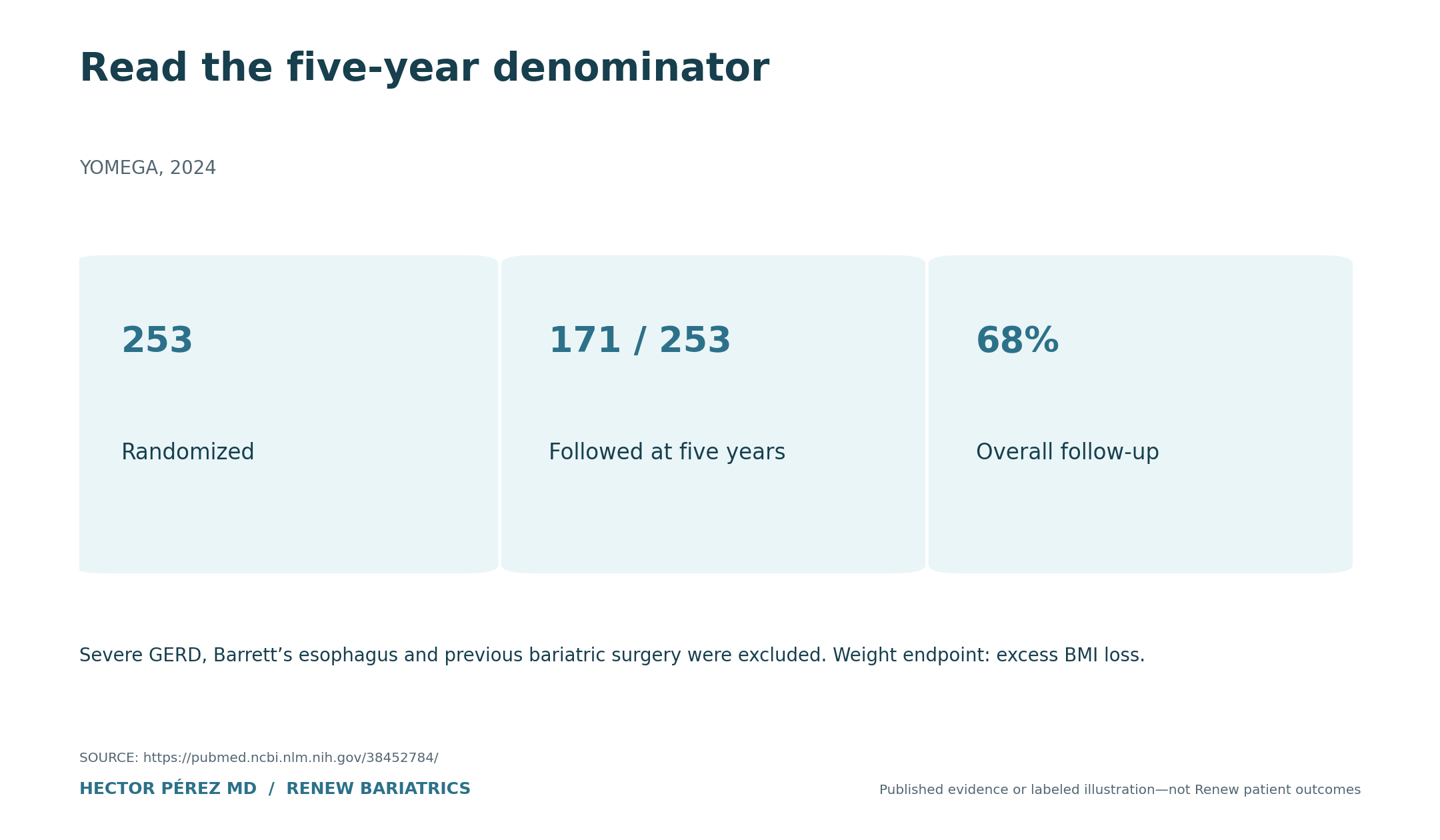
Figure data and interpretation
| Measure or group | Reported value or context |
|---|---|
| 253 | Randomized |
| 171 / 253 | Followed at five years |
| 68% | Overall follow-up |
Severe GERD, Barrett’s esophagus and previous bariatric surgery were excluded. Weight endpoint: excess BMI loss.
Follow-up completeness changes the interpretation
The five-year report followed 171 of 253 randomized patients, approximately 68%. The reflux comparison used still more specific assessed groups. The illustrations keep those denominators visible so the findings are not presented as complete measurements in every randomized patient.
Missing follow-up can affect the observed results in an uncertain direction. A study remains informative, but its limitations should accompany the outcome rather than disappear when the number is used in a marketing summary.
Ask whether a clinic’s own reported results use consecutive patients, how many return for assessment, and whether additional treatment is included. A favorable average without that context is difficult to compare with a carefully reported trial.
Reflux deserves a detailed preoperative discussion
YOMEGA excluded severe reflux or Barrett’s esophagus and previous bariatric surgery at entry. Its reflux findings therefore do not justify assuming that OAGB is appropriate for someone already experiencing difficult symptoms. Existing reflux needs its own assessment.
Describe burning, regurgitation, bitter fluid, nighttime symptoms, and swallowing problems, while avoiding self-diagnosis of acid versus bile exposure. Provide endoscopy and pathology reports if available. The clinician should explain what has been established and what remains uncertain.
Ask how new or persistent reflux would be evaluated after treatment and what options would be considered if medical management were insufficient. A discussion of potential later conversion should acknowledge that another operation has its own risks and is not a trivial adjustment.
Bowel configuration matters to nutrition
The trial used a specified OAGB configuration, including a 200-centimeter biliopancreatic limb. That detail belongs to the study methods; it should not be interpreted as a recommended measurement for every patient. Clinical anatomy and operative planning require specialist judgment.
Ask the surgeon to explain how the proposed configuration affects the long-term nutrition plan. Bring any existing deficiencies, poor intake, or prior treatment with infusions or injections into the discussion. A person can have obesity and still need nutritional optimization before surgery.
The final operative report should preserve the relevant anatomical details for future clinicians. Keep it with your laboratory history and supplement plan so care does not depend on a remembered procedure nickname.
Make the monitoring commitment concrete
Identify who will order laboratory tests, review results, adjust supplementation, and manage a deficiency. Ask how often the plan will be reassessed and what symptoms require earlier contact. The clinical team should tailor the details rather than provide one generic regimen for every operation.
Discuss access and cost before treatment. If you cannot reliably obtain supplements, appointments, or laboratory testing, the team needs to know. Those barriers can affect preparation and the appropriateness of an intervention with a substantial effect on absorption.
Do not use high-dose supplements as a substitute for monitoring. More is not automatically better, and treatment should respond to the actual clinical problem. The nutrition guide provides organizational questions that also help with long-term bypass care.
Compare alternatives against your main goal
Ask why OAGB is being recommended over Roux-en-Y bypass, sleeve, an endoscopic option, or continued medical treatment in your case. The answer should connect anatomy and evidence with your health goals, rather than focus only on technical simplicity or an average weight figure.
If diabetes management is a major goal, ask how improvement will be measured and who will manage medicines as intake changes. If reflux or nutritional concerns dominate, ask how those alter the choice. Different priorities can lead to different reasonable recommendations.
A decision can also be to obtain further information before selecting a procedure. That is useful progress when the missing result could materially change the balance of benefit and risk.
Preparation and recovery need individualized instructions
Provide the complete medication list, including injectable obesity medicines, blood thinners, nonprescription products, and supplements. Ask the prescribing and anesthesia teams to coordinate instructions. Do not stop or restart treatment using a generic schedule from another patient’s experience.
Obtain separate instructions for the preparation diet, any liquid-only period, and final fasting. Ask how to report difficulty following the plan or a change in symptoms. Accurate information helps the team decide whether any adjustment is needed.
After treatment, follow the prescribed intake progression and activity guidance. If symptoms prevent adequate fluids or food, seek clinical advice rather than assuming that difficulty is an expected price of a more effective operation.
Travel and aftercare should be planned before payment
Confirm the treating facility, clinical team, expected stay, and arrangements for unexpected care. Ask when travel is medically appropriate for the operation and your recovery. A standard package itinerary is not an individualized travel assessment.
Arrange local follow-up and transfer of records before leaving home. Clarify which services are included in the package and which are provided by clinicians near you. The aftercare guide can help assign these responsibilities.
If a future complication requires surgical bypass revision, availability must be confirmed with an appropriate specialist center. Renew’s current published scope does not offer surgical revision of an existing bypass or reversal. Educational coverage of those topics should not be mistaken for a booking offer.
Questions that make a final recommendation understandable
Ask the team to summarize the treatment goal, why this anatomy fits that goal, the main uncertainties, and the continuing care required. Request an explanation of the alternatives and the findings that would favor them instead.
You should also understand how an incomplete weight response, reflux, or a nutritional problem would be reassessed. A complete plan includes the possibility that care needs will change over time. It does not promise that the initial operation will be the last medical decision you need to make.
Bring the recommendation and supporting records to another qualified clinician if you want a second opinion. Comparing the reasoning is more useful than comparing the word mini with another procedure name or selecting a package based only on its starting price. ## Additional questions about OAGB evidence and follow-up
Does non-inferiority mean OAGB and Roux-en-Y bypass are equally safe?
No. A non-inferiority conclusion concerns a specified endpoint and statistical margin. In YOMEGA, the primary five-year endpoint was a weight measure, not a declaration that every complication, reflux outcome, and nutritional consequence was identical. Ask for the results relevant to each concern separately. A procedure comparison becomes clearer when benefits and burdens are kept visible instead of compressed into one overall winner label.
Why does the study specify a limb length?
The configuration is part of the intervention the investigators studied. It helps readers understand what the results describe and whether another operation is genuinely comparable. It is not an instruction for a patient to request that measurement. Ask the surgeon to explain the planned anatomy and how it relates to your health and nutrition plan. Keep the final operative report because future care may depend on those details.
Can reflux symptoms tell me whether bile is involved?
Symptoms can prompt assessment but do not establish the mechanism by themselves. Describe the sensation, timing, frequency, and response to treatment, then let the clinician determine the appropriate investigation. Avoid changing the proposed operation based only on a label you found online. The useful question is what the evidence from your evaluation shows and how that finding changes the treatment options.
What should I ask about a possible later conversion?
Ask why it might be considered, what anatomy it would change, which risks it introduces, and where appropriate specialist care would be available. A possible future revision should not be described as an easy fallback that makes the original choice consequence-free. The decision today should remain reasonable based on current findings, expected benefit, and the continuing care you can sustain.
What if the follow-up plan is more than I can manage?
Explain the barrier before committing. It may involve cost, distance, laboratory access, work schedules, or product tolerance. Ask which parts can be adapted and whether another treatment offers a more workable balance. The point is not to demonstrate perfect compliance during an application; it is to establish a care plan that remains feasible after the surgical trip and the first period of weight loss.
What makes a written recommendation useful?
It should name the operation, the indication, the findings supporting it, the important alternatives, and the follow-up required. Any pending test or condition of approval should be explicit. That document helps you ask focused questions, seek another opinion, and distinguish a clinical recommendation from a preliminary quote or general description of program services.
Sources and further reading
- YOMEGA: five-year randomized extension comparing one-anastomosis and Roux-en-Y gastric bypass (2024).
- YOMEGA: two-year randomized comparison of one-anastomosis and Roux-en-Y gastric bypass (2019).
- Mini gastric bypass in Mexico at Renew Bariatrics (2026).
- Gastric bypass revision options at Renew Bariatrics (2026).