Duodenal switch procedures combine a sleeve-shaped stomach with an intestinal bypass. Traditional biliopancreatic diversion with duodenal switch (BPD-DS) uses two intestinal connections. SADI-S, or single-anastomosis duodeno-ileal bypass with sleeve gastrectomy, uses one. Both require careful selection and substantial long-term attention to nutrition.
Renew Bariatrics currently states that it performs SADI-S, not traditional BPD-DS. Its dedicated procedure page identifies Dr. Hector Perez as its SADI-S surgeon. That distinction matters when you read research, request a quote or discuss the procedure with a local clinician.
What SADI-S changes
The operation combines a sleeve with division of the duodenum just beyond the stomach’s outlet valve. The duodenum is connected to a later section of small intestine, so food bypasses a substantial portion of the usual route. The ASMBS procedure guide describes the reconstruction and its nutritional and reflux considerations.
A primary operation creates both parts during the treatment pathway. A conversion after an existing sleeve starts from different anatomy and needs its own assessment. Do not use results from first-time surgery as a direct prediction for a sleeve revision.
Traditional duodenal switch research is not SADI-S research
A randomized trial compared traditional DS with Roux-en-Y in 60 people whose starting BMI was 50–60. Forty-eight were assessed after a median of twelve years. Total weight loss averaged 33.9% after DS and 20.0% after bypass, but DS had more adverse events and nutritional problems. Four of 29 DS patients developed severe protein-calorie malnutrition; three underwent revision. This was traditional DS using the trial’s specific anatomy, not SADI-S. Read the trial methods and results.
That distinction prevents a misleading promise: a favorable result for one operation cannot simply be attached to the name of another. Greater average weight loss also does not establish that the overall tradeoff is better for an individual patient.
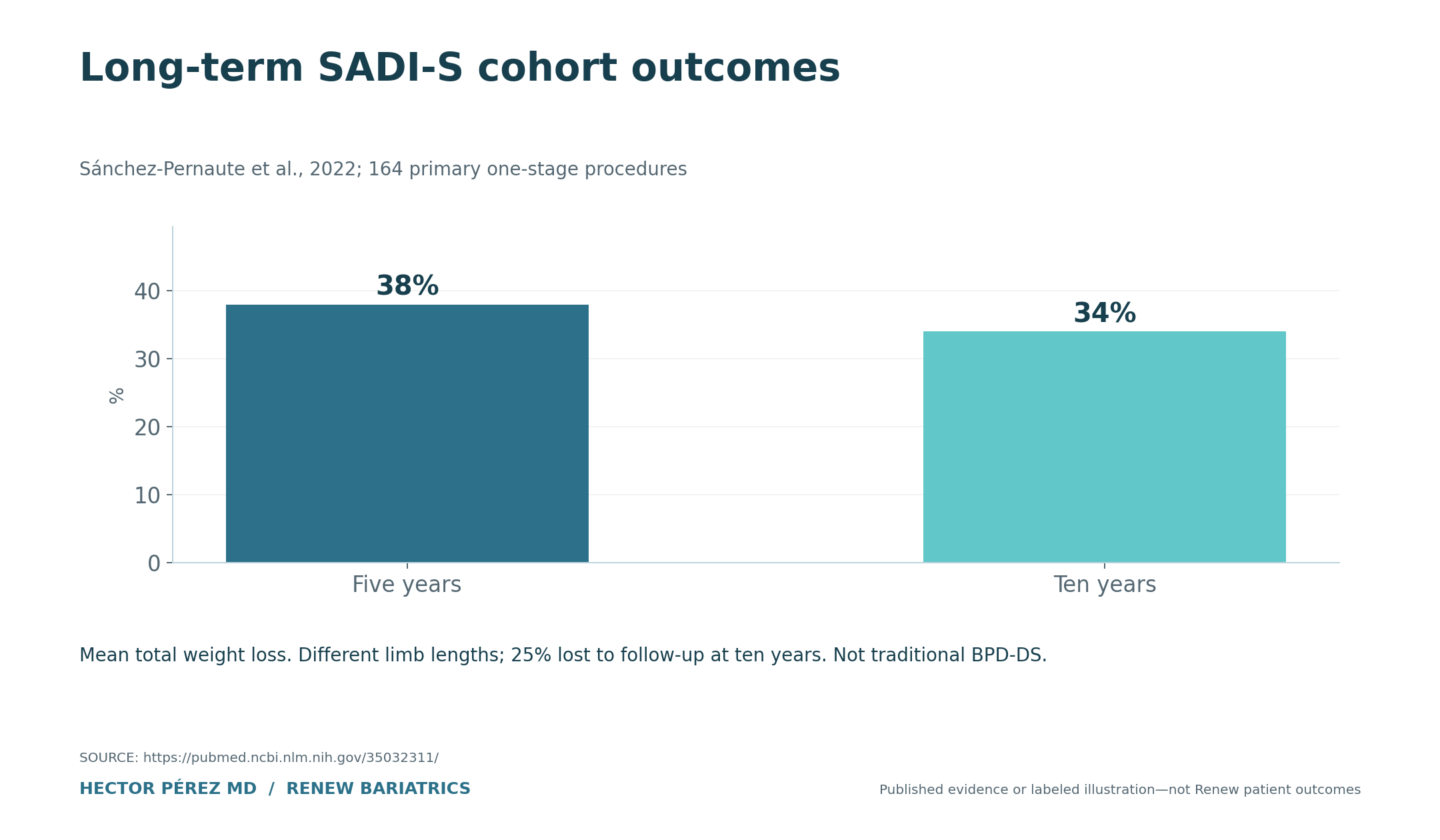
Figure data and interpretation
| Measure or group | Reported value or context |
|---|---|
| Five years | 38% |
| Ten years | 34% |
Mean total weight loss. Different limb lengths; 25% lost to follow-up at ten years. Not traditional BPD-DS.
What long-term SADI-S evidence shows
A single-center cohort followed 164 patients undergoing primary SADI-S. Reported total weight loss was 34% at ten years, with 25% lost to follow-up. Twelve patients required revision for low protein levels. The intestinal lengths varied within the cohort, and there was no randomized comparison group. The results support potential durability while demonstrating why nutritional outcomes and incomplete follow-up belong in the same discussion. Read the cohort abstract.
Ask whether an advertised figure is total weight loss or excess weight loss and whether it describes primary SADI-S, a sleeve conversion or traditional DS. These distinctions are more informative than combining all “duodenal switch” results into one percentage.
Who might discuss SADI-S with a surgeon?
A clinical review considers the degree of obesity, associated medical conditions, previous treatment and surgery, reflux history, nutritional status and ability to maintain follow-up. A BMI number alone cannot establish that a more malabsorptive operation is the right choice.
Reflux deserves particular attention because SADI-S can worsen existing reflux or lead to new symptoms. Tell the team about regurgitation, nighttime symptoms, swallowing trouble and previous endoscopy. Ask whether Roux-en-Y bypass or another treatment better fits the complete picture.
Nutrition is central to the decision
Before agreeing to SADI-S, confirm who will manage protein intake, supplementation, laboratory monitoring and treatment of deficiencies. Ask how often follow-up is expected, which expenses continue after the initial package and what happens if oral intake or supplements are inadequate.
Discuss bowel changes and the impact on daily life as well as the expected weight response. A plan needs a response to persistent diarrhea, difficulty eating, dehydration or unintended excessive loss. Nutrition care should be available where you live, with a clinician who understands the operation.
General surgical risks include bleeding, leakage, infection, blood clots and anesthesia complications. Your team should explain individualized risks and recovery instructions. Severe pain, inability to keep fluids down, gastrointestinal bleeding or difficulty breathing needs urgent medical evaluation rather than routine online follow-up.
Questions to ask before scheduling
- Is the proposed operation SADI-S or traditional BPD-DS?
- Is this primary surgery or conversion from an existing sleeve?
- Why does it fit my health better than the alternatives?
- Which research applies to the proposed operation?
- Who monitors nutrition and handles unexpected problems after I return home?
Frequently asked questions
Is SADI-S simply another name for gastric sleeve?
No. Sleeve changes the stomach. SADI-S adds an intestinal bypass, with additional nutritional implications.
Can it be considered after a sleeve?
Yes, selected patients may be assessed for conversion, but the reason for revision and existing anatomy matter. Read the revision overview and prepare records using the evaluation guide.
How do I contact the team?
A Renew coordinator can explain submission for clinical review by Dr. Perez’s team and confirm the current SADI-S program. Ask for a plan and quote specific to the actual operation; primary surgery and sleeve conversion should not be assumed to share the same package.
Confirm whether the discussion is about SADI-S or traditional duodenal switch
These names describe related but different operations. They should not be used interchangeably when discussing anatomy, research results, or availability. Renew’s current service information identifies SADI-S, and the recommendation should state that exact procedure when it is the operation being considered.
Ask the clinician to explain the path of food and digestive juices after the proposed operation. You do not need to memorize technical terminology, but you should understand that the operation changes more than stomach capacity. That difference helps explain both potential benefits and the continuing nutritional responsibilities.
If a study concerns traditional biliopancreatic diversion with duodenal switch, its outcomes should remain labeled that way. It may provide background on related operations without establishing the results of SADI-S. The number of intestinal connections alone does not make the evidence interchangeable.
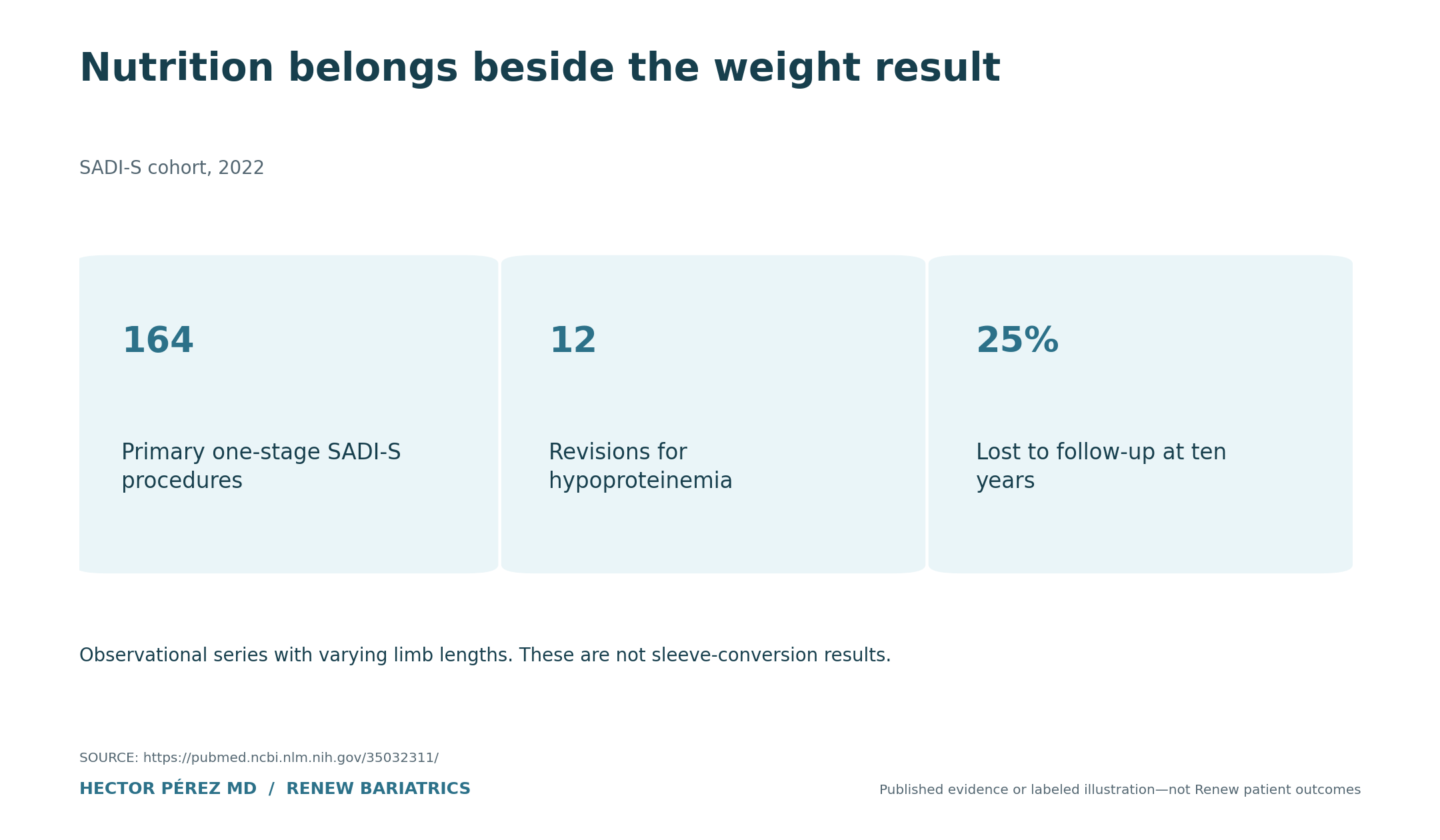
Figure data and interpretation
| Measure or group | Reported value or context |
|---|---|
| 164 | Primary one-stage SADI-S procedures |
| 12 | Revisions for hypoproteinemia |
| 25% | Lost to follow-up at ten years |
Observational series with varying limb lengths. These are not sleeve-conversion results.
Primary SADI-S and conversion after sleeve are different populations
The long-term cohort illustrated here involved primary one-stage SADI-S. Its starting point was not a patient who had already lost weight after sleeve and was later converted. The reported total weight loss should not be promised as additional loss after a previous operation.
If you already have a sleeve, use the sleeve-to-SADI-S guide to frame the discussion. The assessment needs the original report, current symptoms, weight trajectory, and nutritional status. A prior sleeve can make SADI-S anatomically relevant without establishing that it is the right next treatment.
Ask which evidence directly addresses the conversion being proposed and which evidence is background from primary surgery. A transparent distinction is more useful than presenting the largest published percentage without its population.
Read long-term weight results beside nutritional outcomes
The cohort’s weight results are substantial, but they should be read alongside the reported revisions for hypoproteinemia and the incomplete ten-year follow-up. The purpose of showing both graphics is to keep benefit and nutritional burden in the same discussion.
The operation’s effect on absorption is relevant to both sides. It is not possible to evaluate the weight-loss mechanism as if its nutritional consequences were an unrelated optional feature. Ask how the team balances expected benefit against the ability to maintain adequate nutrition over time.
A later revision for a nutritional problem is itself an important outcome. A report that highlights only weight at follow-up can obscure the additional treatment needed to achieve or maintain a workable result. Ask whether a program includes such interventions when describing its outcomes.
Limb lengths are study details, not patient instructions
The published cohort used different limb lengths across patients and time. That variation limits a simple interpretation of the average as the effect of one fixed configuration. It also means the measurements should not be copied into a request for an individual operation.
The surgeon should explain the planned anatomy and why it fits the clinical situation. Keep the operative report afterward so local clinicians have the actual configuration if nutrition or symptoms need assessment later.
If a future clinician needs to evaluate a complication, a remembered procedure name may be insufficient. Documentation of the anatomy is a practical part of continuing care, especially when treatment and follow-up occur in different countries.
Evaluate nutritional readiness before the operation
Bring recent laboratory results, current supplements, usual intake, and any history of anemia, vitamin deficiency, or protein concerns. Describe vomiting, diarrhea, food intolerance, and treatment with infusions or injections. These facts can affect preparation and the risk-benefit discussion.
Body weight does not prove that nutritional reserves are adequate. A person can have obesity and a deficiency at the same time. Ask whether anything needs correction before treatment and how the response will be checked.
The plan should identify who manages that preparation. If the recommendation is to delay surgery for nutritional treatment, request the clinical goal and a review point. A purposeful delay should come with a route forward rather than a vague instruction to improve health.
Make lifelong monitoring feasible before choosing SADI-S
Ask which clinicians will provide follow-up, where laboratory testing will occur, and who will interpret results. Clarify how an abnormal finding leads to treatment and reassessment. The plan should not depend solely on the patient recognizing symptoms after a deficiency has already developed.
Discuss the ability to obtain prescribed supplements and any necessary treatment. Cost, product tolerance, and access to appointments are relevant clinical facts. A monitoring plan that cannot be implemented should be addressed before the operation rather than after a problem appears.
Do not assume that a general multivitamin or a normal early laboratory panel removes the need for continuing care. The appropriate regimen must be individualized and reviewed over time. The nutrition guide helps organize that process without prescribing doses.
Reflux and bowel symptoms belong in selection
Describe existing reflux, regurgitation, swallowing difficulty, and prior endoscopy. Do not assume that adding an intestinal component will resolve a symptom simply because the operation can produce substantial weight loss. The clinician should explain how the proposed anatomy relates to the actual problem.
Also discuss current bowel habits and any symptoms that affect intake or daily life. If the operation could change those experiences, ask what is expected, what would be concerning, and how persistent problems would be evaluated.
The goal is a realistic understanding of life after treatment, not a decision based only on the largest weight-loss estimate. Functional outcomes and the ability to maintain nutrition are part of whether the operation is a good fit.
Compare alternatives with the same health goal
Ask why SADI-S is being recommended over Roux-en-Y bypass, another procedure, or continued medical treatment. The answer should connect the recommendation with your anatomy, metabolic health, reflux, and follow-up resources. Different goals may favor different approaches.
If you have a previous sleeve and reflux is a major concern, ask how that affects the comparison with sleeve-to-bypass conversion. If weight response is the main issue, ask whether medication and other care have been assessed and what they achieved.
Avoid ranking procedures as simply stronger or weaker. The relevant question is which balance of effect, burden, and uncertainty best addresses your situation. A more extensive physiological change is not automatically the more appropriate choice.
Preparation needs coordinated medication instructions
Provide the full medication list and ask the prescribing, surgical, and anesthesia teams to coordinate the plan. Include diabetes treatment, GLP-1 medicines, blood thinners, supplements, nicotine, and cannabis. Do not independently stop medicines to meet an assumed surgery requirement.
Clarify the preoperative diet, any liquid-only instruction, and final fasting times. These may have different purposes and should not be blended into one improvised regimen. If intake is difficult or symptoms change, report that before proceeding.
Ask what equipment or medical records to bring for conditions such as sleep apnea or earlier anesthesia problems. Preparation should reflect your health, not simply the procedure name.
Recovery and travel need room for clinical judgment
Request written food, fluid, medication, and activity instructions. Ask how to obtain help if symptoms prevent adequate intake and which findings require urgent assessment. A complication response plan is as important as an expected recovery timetable.
Discuss the complete travel route and the timing of the flight home with the clinician. A package’s standard stay does not establish individual readiness for travel. The travel guide explains why public-health guidance and the actual recovery need to be addressed separately from logistics.
Arrange local aftercare before leaving home. The treating team may provide remote support, while clinicians near you provide examinations, tests, and treatment when needed. Confirm those roles and the transfer of records.
A final decision should include a long-term contingency plan
Ask what happens if weight response is incomplete, nutritional status deteriorates, or symptoms persist. The answer should identify assessment and treatment pathways, including referral when needed. No procedure can responsibly be presented as eliminating every future care decision.
Include the practical costs of supplements, testing, appointments, and unexpected care in the comparison. A procedure price does not describe the entire long-term commitment. The quote guide can help make those assumptions explicit.
For inquiries about Dr. Perez, provide the original operation history, current concerns, and available results through Renew’s application. Clinical review determines whether SADI-S is appropriate and which further assessment is necessary. ## Additional questions about SADI-S
Can I compare SADI-S and traditional duodenal-switch percentages directly?
Only after checking that the operation, population, baseline, outcome, and follow-up are comparable. The procedures have different intestinal reconstructions, and a study of one should not be relabeled as the other. Ask the clinician to identify the evidence that directly supports the proposed operation. Where related evidence is being used for background, that role should be stated clearly.
Does substantial weight loss prove nutrition is adequate?
No. Weight change and nutritional status are different outcomes. The team may need information about intake, symptoms, supplements, and laboratory results even when the scale response appears favorable. Ask how excessive unintended loss, poor tolerance, or abnormal results would be evaluated. A treatment should be assessed by health and function as well as the amount of weight lost.
What should a local clinician know after surgery?
They need the exact procedure and operative details, current supplements and medicines, relevant results, and the recommended monitoring plan. Ask how the original team will communicate if a nutritional problem develops. A brief note saying duodenal switch may leave important ambiguity if the actual procedure was SADI-S. Accurate documentation supports appropriate interpretation of later symptoms and laboratory findings.
Is the larger expected effect always worth the additional commitment?
That is an individualized decision. Ask how the expected benefit compares with alternatives for your health goals, and whether the follow-up requirements can be maintained. A more substantial effect on absorption can bring both benefit and burden. The clinician should explain the balance without treating a higher average weight-loss figure as the only measure that matters.
Sources and further reading
- Single anastomosis duodeno-ileal bypass with sleeve gastrectomy.
- Ten-year outcomes following Roux-en-Y gastric bypass versus duodenal switch for high BMI: randomized clinical trial (2024).
- Long-term results of single-anastomosis duodeno-ileal bypass with sleeve gastrectomy (2022).
- Duodenal switch (SADI-S) in Mexico at Renew Bariatrics (2026).